Tagged: reviews
Just Go See It
I don’t know what the big fuss is about. H8ers gunna hate, I guess. It’s a perfectly good movie. I’d probably say it was “great” but I don’t want to build it up too much. Just go see it.
To critics: That’s enough alone time. I didn’t mean forever. You can go play with your friends again.
Fast Broken, Fast Renewed–For Two Reasons
From Star Wars Episode VII until Logan, I had determined, for spiritual reasons, to not watch any movies. That’s fourteen months of no movies. While I do confess that several times during those months, I told folks, “If it gets solid reviews, I’ll go see it,” no solid reviews came in for those films. Finally, my childhood hero, Wolverine, seemed to rise to the occasion. Rated-R Adamantium claws and solid reviews? How could I resist?
Unfortunately, I seem to not be able to fully “escape” anymore–darn you, books!
By my thinking Logan normalized the act of harpooning little girls through the chest on screen and also advocated lying to children if it keeps them hopeful while the world falls to shit. No thank you, Hollywood. As Colonel Nathan R. Jessup once said, “You see Danny, I can deal with the bullets, and the bombs, and the blood. I don’t want money, and I don’t want medals. What I do want is for you to (censored) extend me some courtesy.” Do we really need to see a bloody (red-not-British) harpoon point sticking out of a little girl’s chest to be entertained? Fool-ish-ness.
Then, as if I needed another reason to not visit the cineplex again, I resumed reading some Tolstoy short fiction and came across a story called, “God Sees the Truth, But Waits.” It’s a brief account of a wrongfully convicted man spending his adult life in prison for a crime he didn’t commit. And while in prison he finally meets the real killer, who proceeds to try to escape by digging out, little by little, and dumping the sand from his pockets onto the prison yard. Upon light investigation, sho’ ’nuff the internet tells me I’m not the first to notice that Shawshank Redemption totally ripped off Tolstoy.
So I’m back on the movie fast. Twenty-eight plus years of staring at screens. And for what? What a waste.
Review of Sicario and The Heart of the Sea
These two movies had piqued my interest when I first heard of them, but the mainstream critical reception was off-putting enough that I hadn’t take the time to view them. Finally I had a minute. The critics are wrong.
If you liked Miami Vice and Zero Dark Thirty, then Sicario is for you. My only real problem with Sicario is that it would be ruined if the cartel horrors it depicts were not based in the historical record, but I am too afraid to confirm that they are to do any fact checking. Depressing stuff.
If you have read Moby Dick, then The Heart of the Sea is for you. This one’s reception is especially baffling. Critics can’t say anything good about it, but as far as ocean voyage movies go it is much better than Master and Commander, which wasn’t bad. I loved Moby Dick and so I can’t say how much of that influences my enjoyment of The Heart of the Sea. What I can say is that if you know that Moby Dick is not about a whale, then you’ll like this movie. Conversely, if you are asking yourself, “Moby Dick isn’t about whale?” right now, skip the movie.
It’s Just Us, Daddy, Written by Pete Deakon and Illustrated by Kaelyn Williams Now Available On Kindle. Buy it!
 Buy it today for $2.99 by clicking here or on the images. And even if you don’t have $2.99 to spare, please, please add a review so that balance is restored to the force.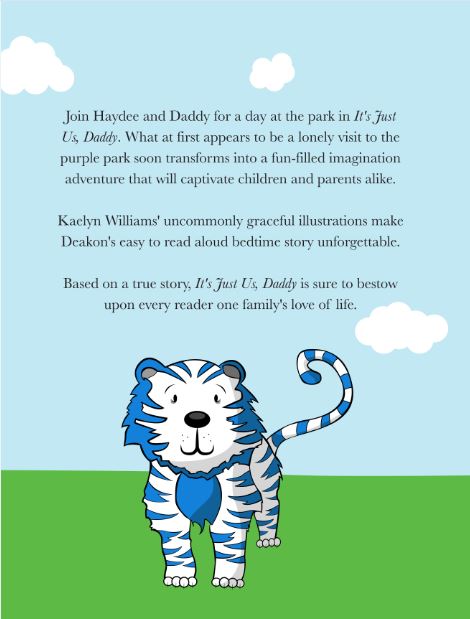
That is Patently Untrue–A Review of Matt Damon’s Opening Claim in The Martian Trailer
From his dissection of the card player’s hands in Rounders, to his dissertation on clubbing baby seals in Good Will Hunting, to his explanation that he knows which vehicle in the parking lot is most likely to have a gun in it in Bourne Identity and more, in just about all of his films Mr. Damon has proven he can memorize and deliver long, dry, and yet convincing speeches that seem like they might trip up other acting professionals. And that’s fine and dandy. I like those movies and I like his characters in those movies. But I don’t know if anyone likes to hear what he has to say after he clocks out, and it seems like the two are beginning to merge. Recently, he’s starred in films that sacrifice entertainment value in favor of agendas, films like the one about fracking. Soooo dramatic. And they’re probably filled with science. Again, whatever.
A year or so ago a couple handed me the book The Martian because they knew I had applied to be an emigrant to Mars. I read it and reviewed it here. This book is now a major motion picture. And all of this is very interesting to me and probably every other independent author, as its author published the book by his own self years before it got picked up by a major publisher and now Hollywood. It looks like Mr. Weir self-published it in 2011, three years before the big boys picked it up in 2014. So it seems that five years after self-publishing a quality book any one of us could watch A-listers act out our story on the big screen. That’s neat. Anyhow, back to the point. The book has nothing to do with making a statement about “every culture” of humans. Anyone that disagrees with this is flat out wrong and I would argue hasn’t read the book. And yet somehow (I picture a lot of whining and temper tantrums and threats to walk out of the room) Matt Damon opens the preview to what looks like a fantastic new space movie with this bogus notion that every culture has a basic instinct to help each other out. I can buy every human does on an individual level. There’s books about that. But the simple fact is there are plenty of cultures who don’t rescue people who find themselves stranded on Mars or mountain tops or the side of the highway. What’s worse is there are plenty of cultures who actively believe in kidnapping people for money or political statements. These cultures are generally those not labeled The West.
I buy and promote the truth that if we’re talking about the level of the soul, then we’re all just people making our way through this world and will more times than not help each other when able. But it is not true that in groups (cultures) we’re all the same and without quantifiable, measurable differences that can be labeled “better” or “worse”–no matter how hard we wish for it.
Review of Sam Neill’s Velociraptor Speech in the first Jurassic Park
Click here if you need your memory jogged.
Or read these two snippets.
“You stare at him, and he just stares right back. And that’s when the attack comes. Not from the front, but from the side, from the other two ‘raptors you didn’t even know were there.”
“The point is… you are alive when they start to eat you. So you know… try to show a little respect.”
Do you remember how surprised you were to learn that the ever mysterious and enchanting king of the dinosaurs T-Rex’s visual acuity was based on movement, as “Oh Alan” describes? What an intriguing revelation that was. And then in the time it took for Sam Neill’s index fingers to swing from his side to his front, within that instant, a previously unknown dinosaur severed any remaining connection our minds had with any reality outside the film. From that moment, unlike the annoying kid who has had enough velociraptor for a lifetime, we found ourselves thirsting for them. Like Dana Delany’s head-straightening declaration “I want one” after hearing Billy Zane’s thespianic description of a quintessential cowboy while marveling at a distant, lean-silhouetted Wyatt Earp upon arriving in Tombstone, we wanted velociraptors. And Jurassic Park gave them to us. And to prove how much we wanted them, we set the Memorial Day weekend box office record as we paid to to see the sequel, The Lost World, way back then. Remember that? It’s true.
But the filmmakers failed us in the sequel. They had a little girl gymnastic-kick our beloved.
And then in number three, a velociraptor spoke English.
Last weekend, however, Sam Neill’s speech was back in the forefront as a new box-office record was set by the head-bobbing six-foot turkeys. Why? Why did we rush to see it? Because the previews and movie posters teased us with the idea that we’d get to see what it would be like to have our very own velociraptors. Velociraptors as pets. Awesome.
All because of Sam Neill. Nice work, Sam.
Review of The Message Of The Cross, by Derek Tidball
When I read a book or watch a movie I am on the look out for the one thing upon which the book or film is centered. Sometimes this one thing can be an entire scene, but more often than not, I find that it is one line. As an illustration, I would argue that the entire movie Monster’s Ball was built to make Halle Berry’s guttural “I want you to make me feel good. Can you make me feel good?” confession as powerful as it was.
Which brings me to this book I received from a pastor’s personal stash. It’s all about both the symbolism and (possible) reality of Jesus of Nazareth’s crucifixion. The author, Tidball, is a pastor and the book certainly carries his preaching voice throughout. This is mostly annoying. On the whole, there are all sorts of quasi-theological points and what have you, but unless you’re a Christian looking to invest some time acquiring answers to some very particular questions, I don’t think this book has much value–save one point.
With an emphasis on an “everyone is on their own journey” attitude, one thing that keeps me very interested in Christianity is its prophetic aspect. I wrote earlier about discovering the money-changer showdown prior to the arrest and crucifixion was at the temple, the same one that was destroyed as Jesus seems to have prophesied, the same one whose site is still being fought over today in the middle east.
Likewise, Tidball’s single scene or line in The Cross is found in Genesis 22:6. He calls to our attention that during the infamous Old Testament scene where Abraham unquestioningly follows god’s command to sacrifice his first and only son, the Bible has it that Abraham places the wood for the burnt offering on his son Isaac’s back for him to carry up the mountain. Boom!
Or crickets.
Remember that we’re talking about stories here. Remember also that words are not things, but the way we attempt to describe things.
So you’re telling me that the one true god’s chosen people–meant to be a beacon of hope for the world–out of whom some say the savior of the world was birthed had as their founding father and exemplar a man who obeyed this god’s command to sacrifice his son up to the point of the down-stroke of the knife; you’re telling me that the son walked with wood on his back at some point during the event? And then, thousands of years after this story had taken root, you’re telling me that a man who claimed to be the savior of the world carried wood on his back as he willfully submitted to his own sacrificial execution? In my book, that’s a pretty powerful and difficult to deny theme, a theme that might actively contribute to the claim that one story reigns as the greatest story ever told.
Unfortunately, in my own life of late I can admit that the Christian god has been at the least hiding, at the most absent in certain tribulations. And yet Isaac carried wood on his back long before Rome invented crucifixion or a father god sacrificed his own son.
I don’t know what to do with information like this, but I will say that I find it to be the most pleasant and empowering thing to think on, so I will continue to do so.
Review of Whiplash, By Damien Chazelle
I don’t care if any of you watch Whiplash—I care if filmmakers do.
Sure, it could’ve been better. I have no context for jazz music. I want to like it and know why I like it, but I don’t. Adding a few scenes which dropped subtle hints that answered “why jazz?” would’ve only made it better. But when I grin like a fool, shake my head in disbelief, write when it is past my bedtime, and what’s more, when I only gave half my attention to the film’s last forty minutes because the other half was busy re-budgeting my time and money towards future music instruction, I know someone just made an effing fantastic movie.
Ginormous Review of Recent Team-of-Heroes Action Movies
I feel equal parts bad and excited for the Justice League movie scheduled for release in 2017. I feel bad because with two Avengers films, three Expendables, and seven Fast and Furious’ the hero-team formula is growing wearisome. I feel excited because by 2017 the filmmakers might be even more motivated to actually make a good team action movie.
My beef with these three film series is that they no longer flow. The respective films aren’t films. They’re like seven or eight, twelve minute scenes glued together and then labeled “movie.” Each character gets a cameo, they have one on screen moment fighting back to back and then the credits roll.
My excitement for the future of team movies–and Justice League in particular–comes from the success of the movie Legends of the Fall. Remember that one? I can still hear my brother’s excited hope-whisper during the final scene. I see no difference between that team-of-heroes movie and these recent ones. There’s Alfred, Tristan, and Samuel, and the dad, Susannah, and One Stab round out the good guys. That’s six essentially main character’s in my book. Obviously Brad Pitt was “the rock they broke themselves against”, but that’s exactly my point. In the three series I’ve mentioned, it was exciting to see the first of each of these movies the because they were new. But on the whole, teams aren’t what movies or, as I’ll argue in a minute, any art is even about.
Avengers One worked decently because it was essentially Ironman on steroids. Number two was not about Ironman. That’s why it isn’t as good. (Not to mention that the “age” of Ultron was hardly long enough to be a “week” let alone an “age” which means that the team behind the movie didn’t even know what their movie was about–fail.) Expendables One was about Stallone. Two and three were not as focused–therefore not as good–as they tried to spread the wealth. And then with the Furious movies, Vin Diesel is cool as shyat, but honestly the Rock can’t stop cookin’ when he’s in a movie. It’s either main good guy or main bad guy for that Übermensch.
This brings us to all art. I like to think about all art the same way. Take Beethoven’s ninth. Everyone knows the simple motif that doesn’t appear until the fourth movement. It is eight notes. The symphony is over an hour long, but boils down to only eight notes. I’d call that motif the “main character”. All the other music makes it seem like there’s a team thing, but there isn’t.
Another example would be Michelangelo’s Sistine Chapel. For all of the many scenes, the main character is the “divine spark” taking place between God and Adam. (No, it is not an accident that these two masterpieces have the moment of creation at their core.)
Which leads to the only thing there is left to say on the subject. In the forthcoming Justice League movie, there must be a main character. And the main character must be Batman.
Are You Doing What They Tell You? Review of Mad Max, by George Miller
Are you doing what they tell you? Or are you doing what you want?
That’s it, ladies and gentlemen. That’s the takeaway. That’s Miller’s point. That’s the lesson learned.
In a word, “Don’t do what they tell you.”
Why not? Because if you’re doing what they tell you before the world goes mad, then you will definitely do what they tell you after the world goes mad. Make no mistake, though, the world will go mad. And we won’t all get to be Max or Furiosa.
So in Mad Max: Fury Road there’s an enormous skull thing carved out of a rock face. We’re shown this shrine in the first few minutes of the film. As awesome as the rest of the movie was, and it was awesome, I couldn’t stop thinking about how the megalomaniacs in charge of the barbarian hordes convinced anyone to create that sculpture. I mean the world’s gone to shit already. Why keep up the symbols? Who would even possess the skill and dexterity to create such a large piece of pseudo-art?
But then I think of my time in the service and also in the oil fields. Men are capable of wondrous deeds. Moreover, people love when those in power direct their attention on them. Even I have fallen prey to basking in the limelight of a boss’s approval despite knowing it was unwarranted or wholly irrelevant. And in those moments I can see Mr. Bossman saying, “I want a skull thing,” and men answering, “Where?”
No more, I say.
The more I write, the more conversations I have with close friends and family about things that were previously hidden. Maybe it’s just my family and friends, but if this blog’s content and conversations have taught me any overarching lesson that I would take to the streets Malcolm X-style, it’s that there is no reason–not-a-one–to work a crummy job. If you’re in debt, get your finances in order, stay until you can quit, then quit. If you’re not in debt, quit today. Forty hours a week–wait, who we kiddin’?–fifty hours a week is too many hours each week to spend doing anything other than what you want to do.
Or you can carve the skull thing.
In the end, Mad Max: Fury Road is great fun for adults. Watch it and don’t forget to enjoy yourself.

