Reading Log 4.17.2026
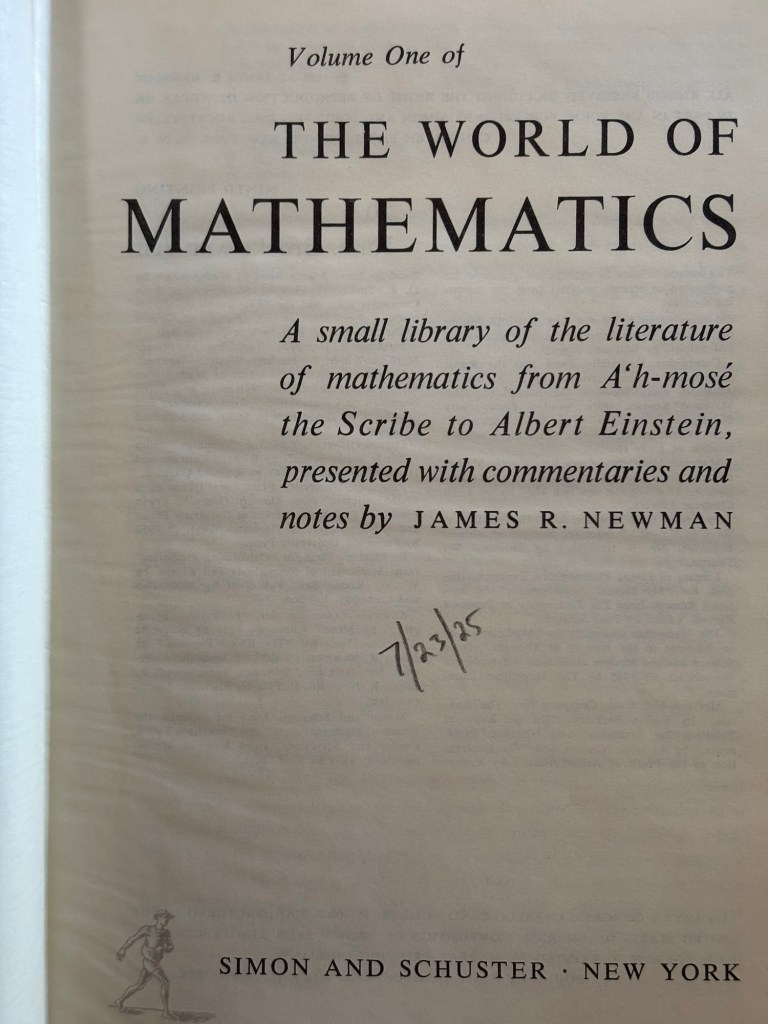
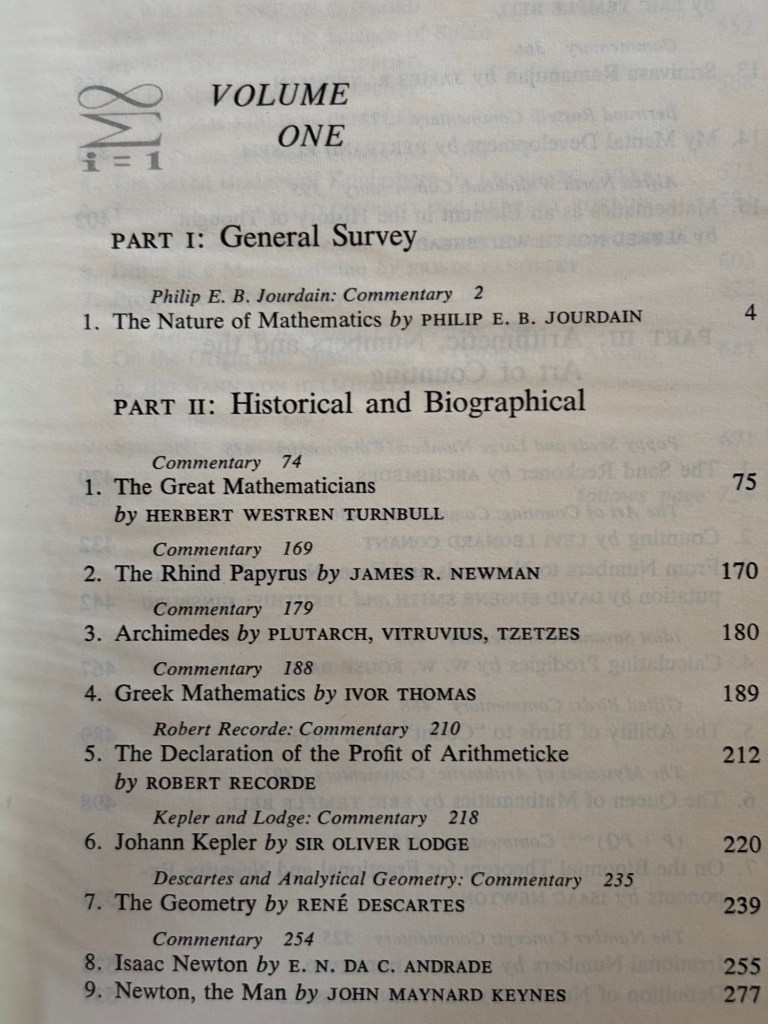
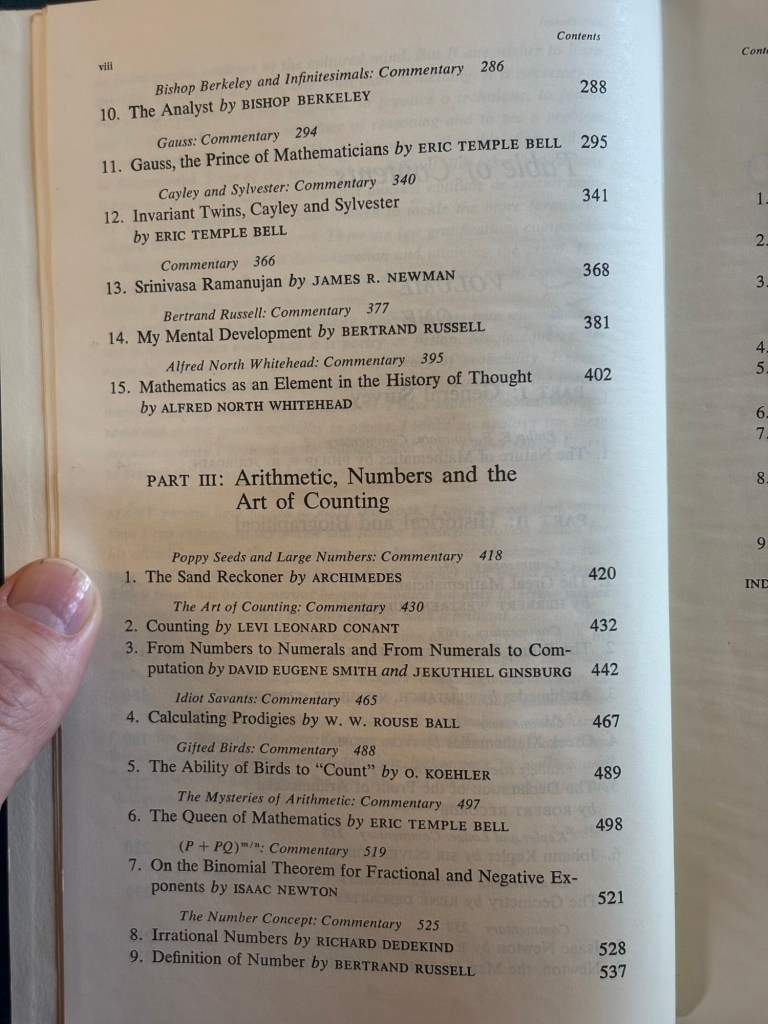
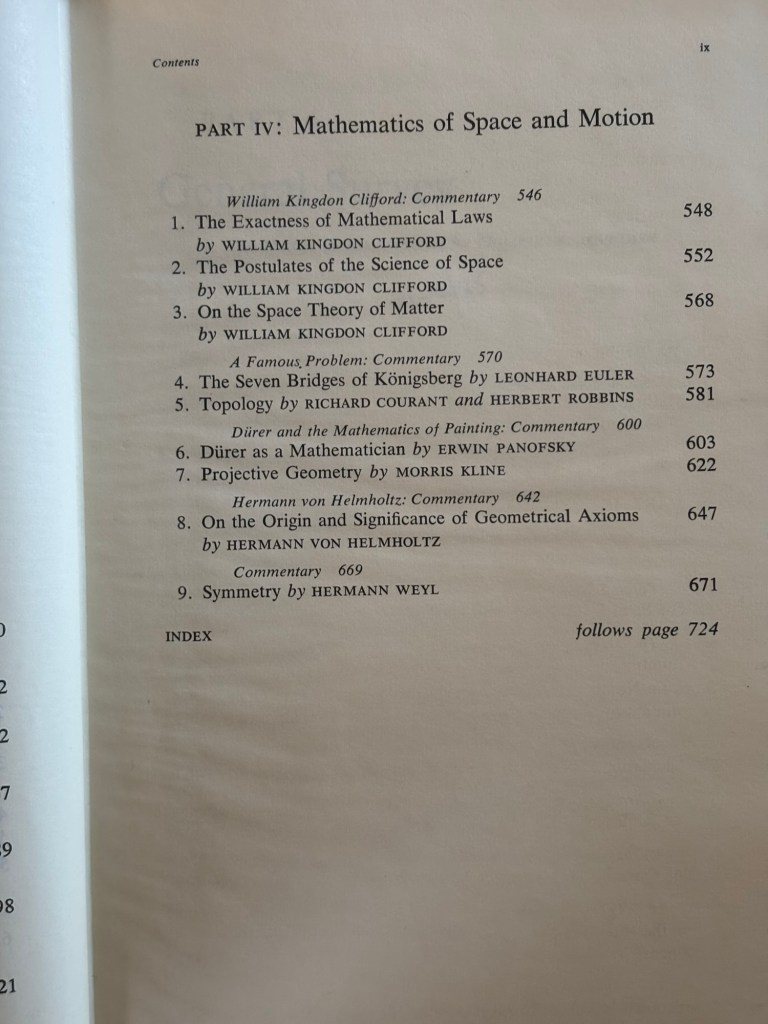
As the influencers and their adoring trolls say these days, “Don’t sleep on those math essay titles!” This is the first volume of a four volume set on the World of Mathematics and I wanted to include the contents so that you can see for yourself just how far-reaching mathematics is. I especially call your attention to an essay near the end on “Mathematics in Painting”.
You see, years ago I stumbled upon the notion that not every math idea has always been around. Specifically, even the seemingly simple concept of the number zero is relatively new. As I explored and validated this notion, I came to read that even our literate ancestors had silly ideas about the size of the sun, some notable philosophers of old speculating that it is only twelve inches in diameter.
This wildly wrong guess called to my mind the fact that early art lacked what we call perspective. The curious question came to mind, “What exactly are we talking about here? When people saw paintings of nature or portraits of people, which we now would never suggest look anything like the landscape or person, did they think, ‘Nailed it!’?”
More pointedly, we can still do this today when we see a kid draw a terrible portrait of someone and it almost physically hurts to ask the kid the simple question, “Do you really think that scribbling looks like me?”
What gives? I wondered. Did their eyes work differently? Do my children’s eyes work differently.
Well, before ever starting this four volume set, I had speculated that the increase in art’s ability to capture life accurately was probably somehow related to the increase in mathematical knowledge. I said to myself that the obvious increase of both was not coincidental.
Long story short: it’s not just somehow related. It was mathematicians who moonlighted as artists (or vice versa) who, with their unique abilities, developed perspective in art!
****
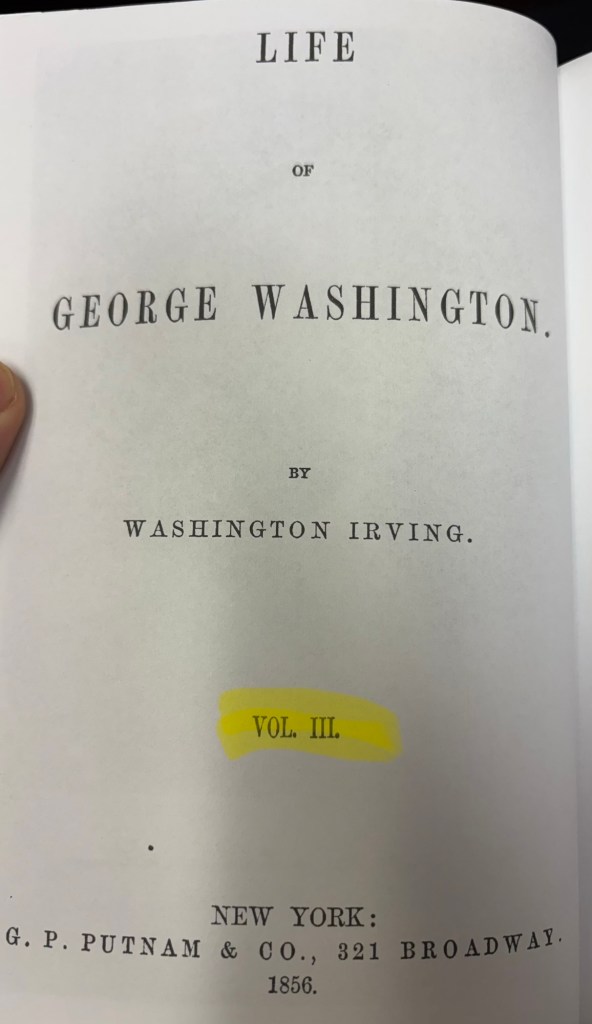
Upon starting Volume 3 of GW, I learned that it was actually a five volume biography by Mr. Irving that I had begun. Luckily eBay exists and I was able to track down the final two volumes before they vanished forever. I also have picked up a post-Revolutionary War map from which to teach my children (and any houseguests) the striking fact of how small a part of America was even involved in our infamous Independence-giving war.
****
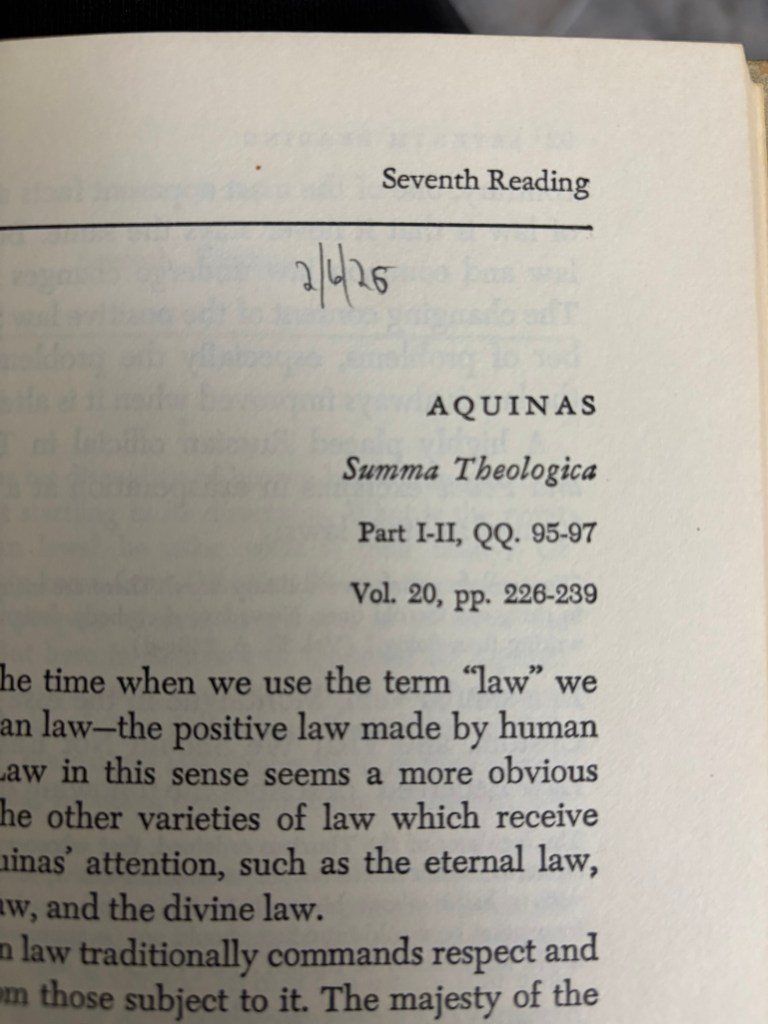
Aquinas is simply the most methodical writer you will ever come across. You owe it to yourself to peruse at least one chapter.
****
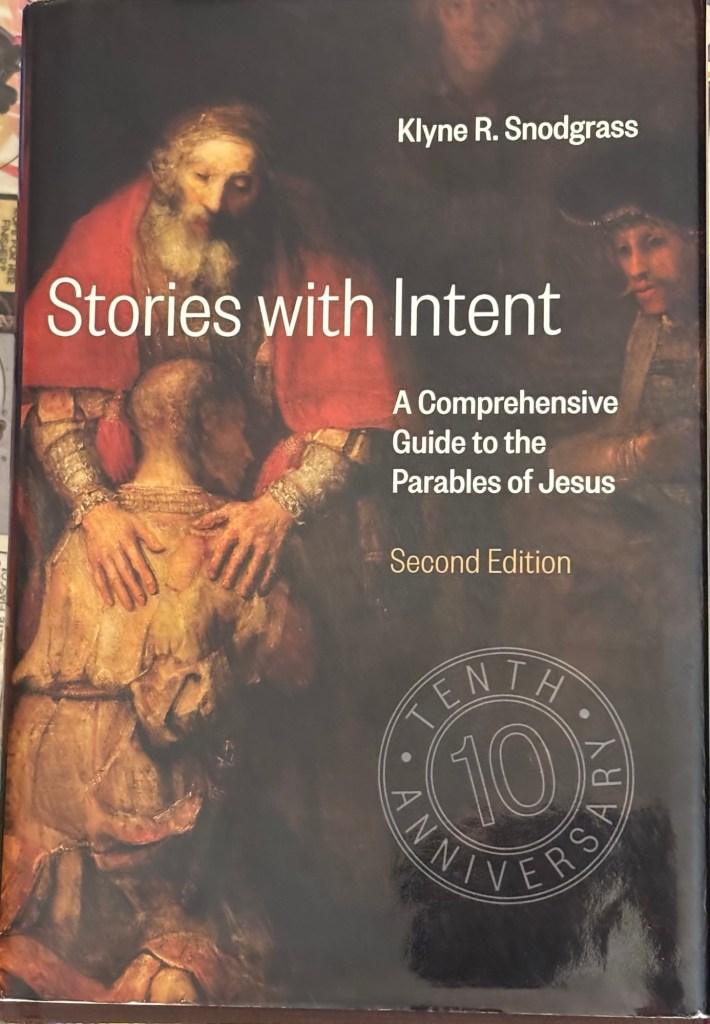
Snodgrass is someone I learned about while reading Meier’s fifth volume of his Marginal Jew series (also on Jesus’ parables). Suffice it to say, I now have a decent depth to my understanding of Jesus’ parables. All I can offer in brief is, “Please do not loft an opinion or interpretation of a parable’s meaning until you read at least one book on them.” Either Meier or Snodgrass is a fine place to start. (Blomberg too.)
****
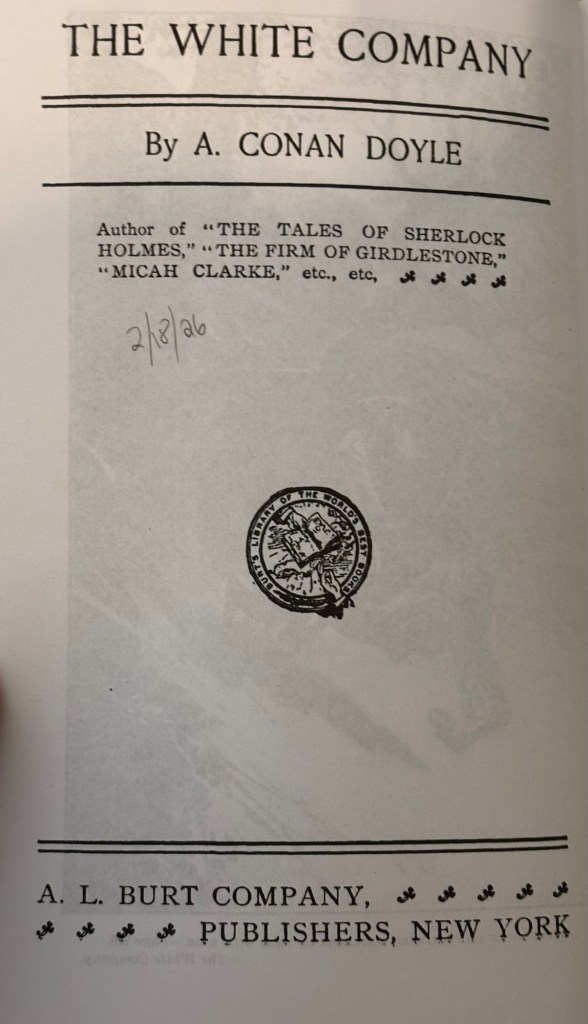
Sherlock Holmes author Sir Doyle wrote a fun little classic knights-in-shining-armor adventure tale in The White Company. Best part is a reminder that once we did things for glory. And it also has some super funny banter among knights.
****
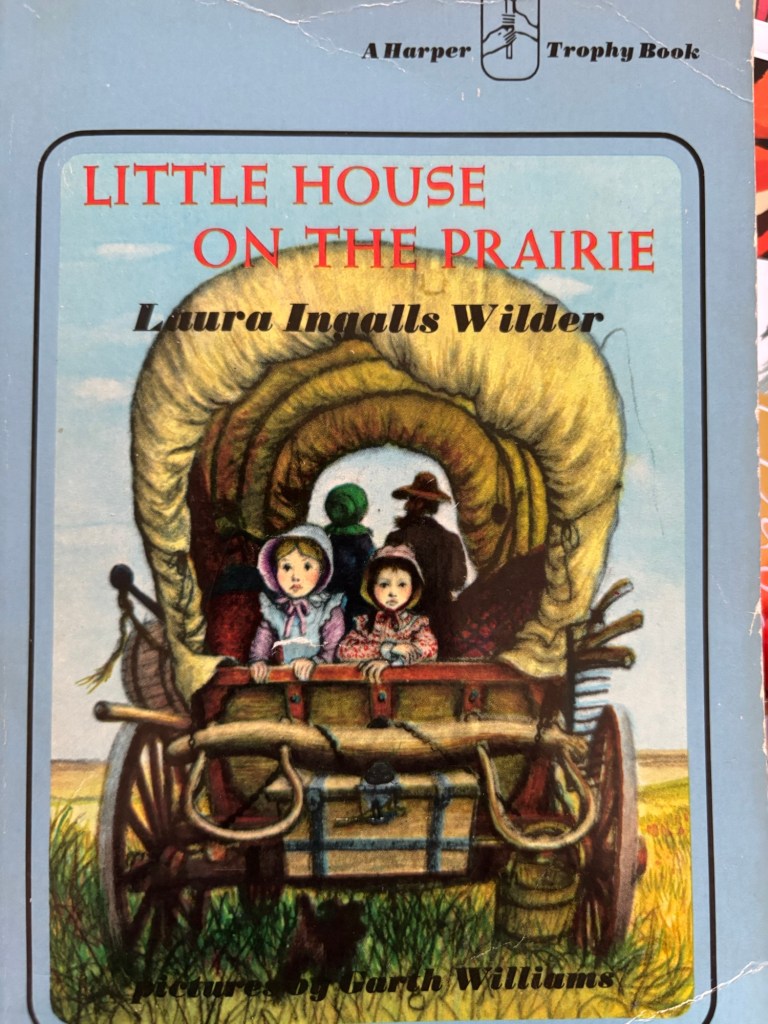
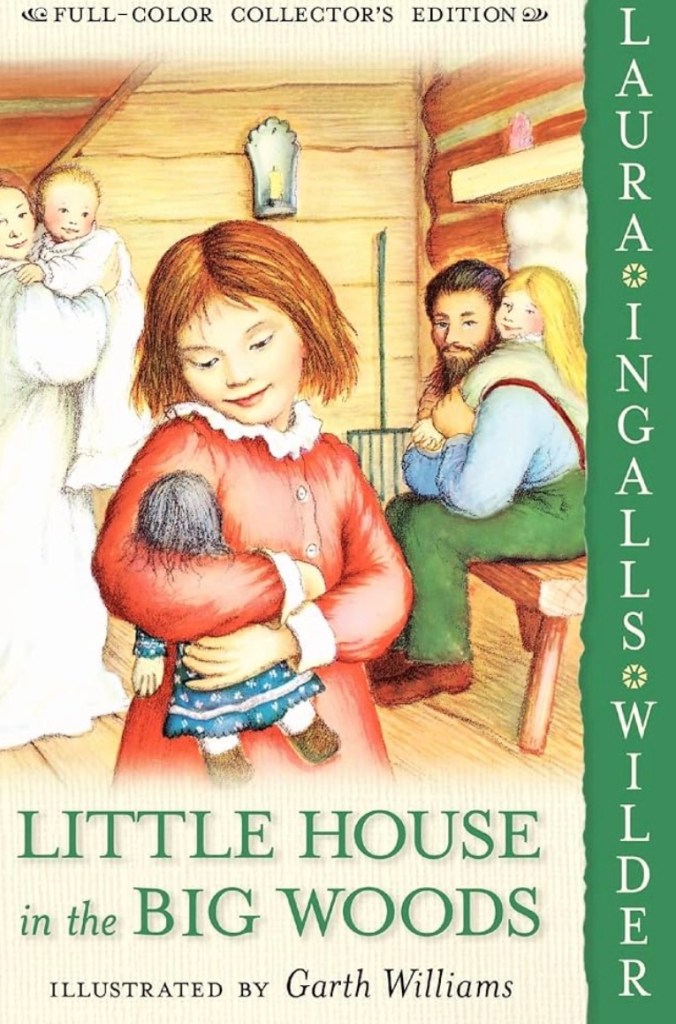
And for fun (and more simply to be forthright) I have included the two bedtime story books I have recently completed with my children. These two have a few great moments apiece, but in moving to Farmer Boy, I have to say FB seems to have a much more compelling plot, what with the whole new teacher being the friend of previous teacher who was essentially murdered.
My sister had the yellow colored box set of these on her shelf all my childhood. I stared and stared and thought they were for girls only—like there was no way a boy could enjoy them. Ha. So stupid.

