Tagged: reviews
Captain’s Log Now On Kindle
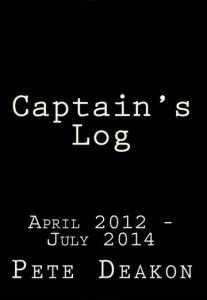
I started writing the posts that make up this book April 20, 2012 after serving for eight years as an Air Force Captain and pilot. The most common response readers give is a smiling, head-shaking look of disbelief that is sometimes sprinkled with joy. What no one has said–but I’m confident all feel–is that after reading these posts, after reading this book, they know they are not alone. And that’s the truth. You are not alone. And the only way to get there is together.
From Professor Batman to A Jaw-Dropping Woman, Captain’s Log April 2012-2014 is now available for Amazon Kindle. Purchase it here for only $2.99.
Review of There Will Be Blood, by Paul Thomas Anderson’s Agenda
The only reason anyone works to pump oil out of the earth is greed. Greed only spawns more greed which eventually creates (or perhaps is a catalyst for) a downward spiral of human vice that passes through selfishness, hate, betrayal, and ultimately murder. Or at least that’s what Paul Thomas Anderson’s award-winning There Will Be Blood wants us to believe. As much as false-prophets–con-men–deserve to be hated, it is impossible not to hate Daniel Day-Lewis’s remarkable portrayal of oil tycoon Daniel Plainview more. And in hating Plainview, it’s difficult not to hate oil.
People hate oil.
Funny to read, isn’t it? It rings true, but it really isn’t. It’s no more true than if we said people hate dirt or people hate wood. It is foolish to make these inanimate, naturally occurring objects the object of our hate, just as it would be to make them the object of our love. They merely are. But we can certainly hate people. We can certainly hate ideas.
Maybe people hate oil men. Maybe people hate their own ignorance of geology. Maybe people hate what they don’t understand. Surely people hate greed.
It seems wherever oil is under the earth American troops are over it, and service members who deploy to the middle-east are bombarded by activist’s propaganda filled with facts and figures which encourage hating Texas Oil Men George W. and Dick Cheney. And Halliburton and KBR and Lockheed Martin and every other group of people that could be lumped into the war-for-profit-is-clearly-a-bad-idea category. Tightening the frame dramatically, I needed no encouragement to hate my aircraft commander on my last deployment. I astonished even myself with how little prompting it took for me to heap some hate on my sister and her small group.
Finding myself in the oilfield here in Colorado, I occasionally hated living in the man-camps. I hated being away from my daughter. I hated her mom for wanting to see her for more than her half during my days-off.
Similar to all men, hate and I have had a long and storied history. Luckily, I have a friend named Kirk. One day, years ago, I told my friend that I was floored to discover that a Kelly Clarkson pop song included the sage lyric, “For hating you I blame myself.” Being the good-natured midwesterner that he is Kirk didn’t miss a beat and replied, “That’s right Pete. Hate comes from within.” Doesn’t it though?
And that begs the question, “Will there be blood?”
Anderson made an excellent film. It is an excellent portrayal of greed from both ends of the spectrum. But in making the film relevant for the masses, in using oil as the backdrop, he, perhaps unintentionally, allowed the oil to obscure a greater truth. Hate, greed, everything comes from within.
Review of the Critics of Transformers 4, By Michael Bay
The first Transformers movie will always have a special place in my heart. Instructor pilots of mine piloted the MH-53 that was the movie-opening Decepticon “Blackout”. Michael Bay even hand chose the pilot that marked me “unsatisfactory” once to be the hologram that “piloted” Blackout and later had a scene in the police car that interrogated Ladiesman217 (Shai LaBeouf).
I need a minute.
Okay, back to the review. Then came the second and third installments. Admittedly they were less than inspiring.
Then number four lost LaBeouf, but gained Marky Mark. Not interested enough to see the film in the theater, I started watching it four weeks ago, and finally finished it yesterday. Why did it take so long? And why did I persist, you ask? Because Optimus Prime riding a T-Rex Dynobot only happens once in a lifetime. And because that darn scene didn’t occur until the 133rd minute in the 165 minute film. But I still got goosebumps. It is awesome.
Here’s what some reviewers said about number 4 on Rotten Tomatoes:
“In the end, though, this is still a movie about giant robots fighting each other, which is to say it’s nearly impossible to take seriously on a narrative level.”
“Inflated, interminable and incoherent …”
“Transformers: Age of Extinction is simply more of the same mindless action, flat characters, and utter boredom that we’ve come to expect from these bloated mechanical sequels.”
And my personal favorite:
“Transformers have souls, this movie repeatedly tells us, but does Michael Bay?”
Know what I say? I say Michael Bay has a soul and it is the soul of a genius. Stay with me. I began watching this movie after listening to H- play for hours on end with a Beauty and the Beast doll set. The set included Belle and a few dresses, the human prince, and a Beast suit to put over the prince. (She hasn’t seen the movie yet.) These three characters became Belle, Belle’s father, and Beast (never mind he doesn’t have legs). And soon thereafter a lego character entered the mix so that it was an even two-on-two. Good guys became bad guys; characters that died came back to life; Beast was always asleep in the moments before only he could save the day. You know I love this child, but listening to her play can be mind-numbing.
Now, I can memorize a two hour movie’s story-line after one viewing, yet can’t follow, let alone repeat, H-‘s story-lines. Michael Bay, on the other hand, can. If you watch Transformers 4 as if you’re watching a four-year-old holding the actors and robots alike and performing all the voice acting, then the movie is perfect. Simply perfect. All the characters are yelling, injured, needing help, fighting, crying, whining, dying, or repeating some cheesy line they probably just heard the day before on TV. Even the scene where the boy and girl kiss after the victory seems like a child is forcing the two of them together while saying, “Mmua, Mmua” and thinking, “Eww gross”. The poor kid knows kissing is what happens when good guys win, but doesn’t understand why.
The genius of the movie and what the critics forget is that it is quite literally a movie about toys in the first place. Perhaps it is the 2007 installment that should be viewed as the fluke. But now with the fourth installment we’re finally getting to the heart of why Transformer toys and Transformers 4 are so great. And all these nay-saying critics probably don’t recognize that when they got big, they became the guy from Big who thinks that there’s something fun about a building that turns into a robot.
Paperback Giveaway and Future Post Warning
So. Another month of pay after just two weeks. And I’m still alive.
Here’s the scoop. Book sales have stalled out. At six. That’s cool, I didn’t do it to get rich, well, not in money–knowledge rich. And to prove it to you, I’m going to give it to you. I really am proud of the book/blog and want it to be read. So if money is the barrier between the paperback version of this blog and your hands, I’m removing that barrier. Just email me at pete.deakon@gmail.com. Tell me where to send it. I’ll send it. And then you’ll have it. Want a couple? Order away. This is a popularity contest after all people. Read it and tell others!
On a wholly different note, I have written a post that contains the most vulgar language I have ever heard spoken whether in person or film or books or whatever. It is still written by me (though not invented by me) and in the end has my voice/style, but seriously it is trash. No one should read it. By no one, I mean Grandma and Grandpa. Mom. Kate. Dad. Well, all family members. (Scratch that. Sam, you’ll likely chuckle in disbelief.) Friends, please consider proceeding carefully. I am going to password protect the post. But the password will be available on a page at the top of the blog called “password”.
Why did I write it? Because Tolstoy came close. He came really close to sharing locker room talk. But he never did. Maybe other fellas have, I can’t say I’ve ever searched for it. But I am frequently confronted by a feeling of shock when I listen to other people’s conversations, and the conversation that this post records takes the cake. I’m ashamed of it. I’m nervous about being associated with it. I’m embarrassed to have been in the group that witnessed it. But I loved writing it. Just don’t read it. And if you do, remember you’re the one who typed in the password.
Vulnerable and Mature, A Counterpoint Review of Michael Jackson’s “Dirty Diana”
Yeah, yeah, yeah. I get it. People generally wouldn’t say MJ was a mature man. But then again, no one really knew him, did they? Just like no one knows Sam Smith. So, taking their respective singles as simply stand alone art, I see no reason that the man who built Neverland for real shouldn’t get a fair shake.
Have you ever read the lyrics to the number one single “Dirty Diana”? I feel like I have memories of watching the video from childhood, though I can’t place from when or where. I know I certainly didn’t know what the song was about until about a decade ago. Then I was shocked. Who knew he ever sang about such things?
Contrary to Smith, MJ’s masterpiece lacks introspection or self-reflection. It starts slow, builds, and then reaches a climax all the while admitting a terrific weakness of character. For my money, it is perfect art for the precise reason Tolstoy was leery of music’s power. Tolstoy once wrote, “Music transports me immediately into the condition of soul in which he who wrote the music found himself at that time.”* (Since reading that, I haven’t been able to get that concept out of my head. Good art makes the listener/viewer feel the way the creator felt. Nice. Simple.)
And just like Smith, there is something in MJ’s voice that sounds personal. These are two clearly torn artists. But unlike young Smith, not-quite-as-young Jackson didn’t feign insecurity or doubt about his station in life. He knew the score. And that was in 1988, which was a few years before Smith was born. Point being, when will we ever learn? Jackson didn’t want to do it, but did. Smith did it and now questions his decision. Me? I’m with MJ on this. At twenty-two, Smith is too old to waffle. Ignorance is not bliss. You knew what would happen. Grow up. Everyone has to.
I guess I’m just bothered because I liked the song. And I wasn’t alone in liking it. But then I saw that it wasn’t what I thought. And I don’t like being taken. Argh!
*Tolstoy, Leo. Master and Man ; The Kreutzer Sonata ; Dramas. New York: Charles Scribner’s Sons, 1904. Print.
Correction to Friday’s Post
A mellow friend of mine informed me that Sam Smith is gay. The interwebs confirm this is true. So, in my last post about his song, I’ve gone back and edited three words. In the third paragraph, the word “girl” is now “guy” and “her” is now “him”, and then in the fourth paragraph “her” is now “him.”
Please accept my apologies for this error.
Vulnerable or Immature? A Review of Sam Smith’s Hit Single “Stay With Me”
We all know the feeling we get when we find out a singer isn’t black. It’s really quite humorous that we think we can tell people’s skin tone by the sound of their voice. And Sam Smith is the newest artist to shock the masses and sell a few more records along the way. I bet most of you didn’t know that I’m black. Just kidding.
Smith’s new single “Stay With Me” has been hogging air time for at least the last month. It’s catchy. It’s all heart. Men I’ve never heard sing have sung it. And that’s because it’s edgy. A simple three verse song, “Stay With Me” is a request for a groupie to not leave in the morning. I imagine most male listeners claim to identify with the feeling because they think women find Smith’s vulnerability appealing, and yet these guys still get to maintain their man-card because they could only identify with the song because they’ve had one-night stands themselves. If I’m right, everyone is mixed up. Here’s an attempt at order.
First, as a friend of mine’s dad once told him, “Be grateful for the sex you’re getting. It’s more than you deserve.” Second, while the brutal honesty the song portends is no small feat, I can’t help but wonder if it’s a valuable confession. It only works if it’s in response to the idea that guys who have one-night stands are supposed to kick the ol’ belt-notch to the curb at first light. Right? Smith is basically winning his version of a rap battle Eminem-style. Some real-large-type arse-hole picked on Sam for calling the guy back the next day. Instead of defending his action (which would be weak) he goes one further and admits that he never wanted him to leave in the first place (which is a fatal blow in these contests it seems). Good for him. But we can’t let uncommon vulnerability distract us from the truth. His actions which trigger the song demonstrate that he is not a man. He is a boy. And boys shouldn’t be listened to.
Men–real men–do not have one night stands. They don’t. How do I know? The same reason you know. Because it’s the way it is. Smith wonders why he’s so emotional the morning after, and then advises himself to gain self-control. Another good friend of mine would tell Smith he’s emotional because “the inner man isn’t one with the outer man.” You want to stop crying over him, Sam? Too late buddy. You’re crying because you just caused the two of you pain. And pain hurts. The good thing is that the pain wasn’t lethal. You can learn from it. We can learn from it. But learning is defined as a change in behavior caused by experience. A change. And no fellas that doesn’t mean that you learned if you don’t get weepy next time.
In the end, the world could use a whole lot more and a whole lot less Sam Smiths.
Pilots More Capable Than Almighty Roughnecks?
For the pilots. (And Greeny.)
Raccoons might be taking over the world. That is, unless roughnecks hear about the story.
To a roughneck nothing is impossible. So when I heard that the raccoons that Japan imported for fun have multiplied out-of-control and are about to destroy thousand-year old buildings and that there’s nothing that can be done about it, I pictured a roughneck. Clear as day I saw the same face I see on the rig every time I express doubt that something can be done. The face has eyes that are lit with excitement and a mouth whose left-half is pursed together while its right half is barely open in a smirk. And though a still image, I can see that the face is mid-nod and I know that the next words that come out of that face will be a confident, “We’ll get ‘er done.” And they do.
Since day one on the job I have been nothing but amazed at what roughnecks can accomplish. And you know me, I thought I had seen mountains move while serving in the Air Force. So that got me thinking. Who is more capable? Pilots or roughnecks?
It hardly seemed a fair comparison at first, what with pilots winning wars in hours and making ladies swoon by simply getting dressed in the morning and all; but the more I witnessed roughnecks at work, the more I thought back to a lot of pilots I knew that might not make the cut as a roughneck–I know most days I fall short.
Here’s the thing. I love that I get to say that I’ve done both–love it. But there’s something else. The other day I brought the paperback copy of this blog to the rig to prove to the fellas that it existed. Now, these men are not Luddites, so they’d read the posts about them. But one of them, you’ll read about him soon, was very excited to share the stories with a man who didn’t know about the blog. And so this young man started to read aloud in the change house (locker room). I had to hold back tears of joy. The pilots that are reading know why. Most of you know why. And that makes pilots more capable. But hey, even if I’m wrong and roughnecks actually are more capable, I still win. I love that type of competition.
Anna vs. Emma, A Joint Review of Anna Karenina by Leo Tolstoy and Madame Bovary by Gustave Flaubert
Nothing motivates me to write better more than sentences like these.
“As if tears were the necessary lubricant without which the machine of mutual communication could not work successfully, the two sisters, after these tears, started talking, not about what preoccupied them, but about unrelated things, and yet they understood each other (Tolstoy 125).”
“It showed him the eternal error people make in imagining that happiness is the realization of desires (Tolstoy 465).”
“In order to undertake anything in family life, it is necessary that there be either complete discord between the spouses or loving harmony. But when the relations between spouses are uncertain and there is neither the one nor the other, nothing can be undertaken. Many families stay for years in the same old places, hateful to both spouses, only because there is neither full discord nor harmony (Tolstoy 739).”
“As it was almost empty she bent back to drink, her head thrown back, her lips pouting, her neck on the strain. She laughed at getting none of it, while with the tip of her tongue passing between her small teeth she licked drop by drop the bottom of the glass (Flaubert 24).”
“And he at once took down from the shelf Emma’s boots, all coated with mud, the mud of the rendezvous, that crumbled into powder beneath his fingers, and that he watched as it gently rose in a ray of sunlight (Flaubert 174).”
“Emma was like all his mistresses; and the charm of novelty, gradually falling away like a garment, laid bare the eternal monotony of passion, that has always the same forms and the same language (Flaubert 177).”
“We don’t speak on the first floor as on the fourth; and the wealthy woman seems to have, about her, to guard her virtue, all her bank-notes, like a cuirass, in the lining of her corset (Flaubert 215).”
“They knew one another too well for any of those surprises of possession that increase its joys a hundred-fold. She was as sick of him as he was weary of her. Emma found again in adultery all the platitudes of marriage (Flaubert 268).”
So here’s the scoop. Anna and Emma commit adultery. And when they discover this act didn’t end their unhappiness, they kill themselves. These novels are often classified under “realism”, which seeks to be just what you’d expect–realistic. (This, of course, comes in response to the unrealistic stories which rued the day up until writers like Tolstoy and Flaubert (can’t not mention Twain) couldn’t stomach any more of it.) And right up until the ending, I can’t find novels which more accurately describe the human scene. But the suicides struck me as unrealistic. Was I being too literal?
Maybe the suicide is a metaphor? Maybe women who commit adultery long to commit suicide, but lack the courage to do it? Is that what these guys were arguing?
Or are the stories warnings to women? Are they a kind of “cheat on me and you’ll probably want to kill yourself” thing? They are written by men after all.
Or maybe there is something more going on?
Always returning to Tolstoy’s wisdom, I’ve decided that these books’ adultery-leads-to-suicide motif is a warning to everyone. Tolstoy, especially, tips his hand in the quote about about happiness not being the realization of desires. That these books sit on so many shelves across the planet proves we recognize the truth they contain, whether we can verbalize it or not.
If Tolstoy and Flaubert were alive today they might have chosen to write about men ignoring their family in favor of email, or mothers working while strangers raise their children so that they can live in a house that would make the Jones’s proud. Or maybe they’d write about women who wear make-up and men who have hair plugs. But then, I wouldn’t believe men and women would kill themselves after finding their cosmetic choices didn’t bring them happiness. But a spouse watching his or her selfish action destroy a family? Yep, I could see how that might make someone want out of this life. And since it is Tolstoy’s Anna who chooses her lover even when her husband is ready to reunite with her, Anna Karenina wins the better lesson presentation battle. The lesson being happiness is. No fill in the blank, no requisite. Happiness just is.
****
Flaubert, Gustave, Chris Kraus, and Eleanor Marx Aveling. Madame Bovary. New York: Barnes & Noble Classics, 2005. Print.
Tolstoy, Leo. Anna Karenina. Toronto: Penguin, 2000. Print.
Captain’s Log Is Now A Book
For practice with independent publishing, and because I wanted my own tangible copy of everything I’ve written in the last two years, I published a paperback version of this blog. You can click here to buy it from CreateSpace. Click here to buy it from Amazon. There is no ebook available, as that format just seems wrong for this project for some reason.
I’ve asked myself why anyone would buy something that they can read for free, and there’s only one acceptable reason: because they want to. For me, it was a need more than a want, but I think you get the picture. Buy it because you want (need) to. It begins with “Why a log?” and ends with “A Jaw Dropping Woman.”
Now that this little experiment is complete, expect new books in the future. And, of course, I’ll still be publishing as many posts as I can while I’m not away at work.
Oh, and the book makes a great gift. (I’m pretty sure H- would’ve been mad if I didn’t include that last little bit.)
 Captain’s Log