Tagged: reviews
Glenn Hates My Book And I Love Him For It
I stumbled upon Glenn Hates Books while preparing to market Simon Pastor. If you don’t have time to visit his blog, know that he doesn’t actually hate books, he just hates the books that he thinks could’ve been good if only they were better. I love that concept and his blog. Whereas my blog, here, has a tough elevator speech, Glenn’s blog has an eloquence that is enviable.
But there’s something more to this man and his blog. He reads the books he reviews. Seriously. He reads them. You know he reads them because he writes brutally honest reviews. They don’t include flowery, all-positive language that clearly identifies him as a friend of the author or someone who worked on the book and stands to benefit from high sales. They also aren’t in the category of “there’s something good to be found in every piece of life.” (I actually can’t stop laughing when I picture his bearded-faced reaction to someone who believes that hocus pocus.)
As a result, Glenn topped my list of reviewers to ask to review the book early on–to set the tone, as it were. And he didn’t disappoint. He hates my book. He hates it because it happens to be depressing as shit. And he reads to escape from reality, not re-live it.
My response? Sincere gratitude. I love his authenticity. If only everyone could write so nakedly. But the fact is that reading purely to escape is childish to me. I read and I write to go deeper. I want to feel more, feel it more intensely, and feel it for longer. Escape from this thing called life? Never. More. More, more, more.
Tolstoy ended one of his early works with the following declaration. I’m including it here just in case I ever forget why I wrote Simon Pastor. He wrote, “The hero of my tale–whom I love with all the power of my soul, whom I have tried to portray in all his beauty, who has been, is, and will be beautiful–is Truth.”*
Amen, Brother Leo. And again I say amen.
****
*Tolstoy, Leo, Louise Maude, Aylmer Maude, and Nigel J. Cooper. Collected Shorter Fiction. New York: Knopf, 2001. Print.
Coming To Amazon This Week – The Divorce and Doom of Simon Pastor, by Pete Deakon
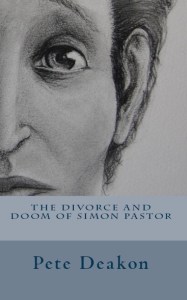 Simon Pastor believed he had never been hurt before. By the time he found himself in an uncontrolled cycle of hurting his wife, he realized that was not true. He felt his wife had hurt him. Then he hurt her. And hurt her. And hurt her. Finally, he divorced her. But that didn’t stop the hurt.
The Divorce and Doom of Simon Pastor is an explicit look at innocence and hurt. It is not about innocence lost, but about innocence never had. It is about the most destructive kind of hurt. A shameful tale of his descent into madness, The Divorce and Doom of Simon Pastor offers an unencumbered look into one man’s failed marriage and failed divorce.
Review of My Church
Well, that’s a lie. It’s not my church. I’ve only been there once. But it was wonderful. And I will be returning every chance I get. The search is over. Finally.
For the record, I am a human. This is worth articulating because, especially when it comes to churches, I want to be treated like a human and not a farm animal. I don’t need to be herded, nor do I want to follow the herd. That said, as I walked into the building I was greeted and I watched as a woman took my name down on some sort of ledger with a pencil. Remember pencils? While there were no children-specific activities that day, I’m certain H- won’t have to be processed and tagged to take part in them next time.
Quickly finding George, I suggested we move closer to the front than where he had chosen and we did. Next thing you know, he and I are standing wide-eyed amidst the seated congregation at the behest of a young women who read off the names of all the guests. Little H- remained seated until our kind neighbors in the pew in front of us urged her to stand when the young woman asked for any guests whom she may have missed to also stand. H- stood proud.
This next part is probably a little too personal, but this is my blog so I’m writing it. It’s been a while since I’ve had much physical contact with anyone but H-. And she’s in that tight spot where I think she does it because she recognizes this. Anyhow, I’ve been thinking this probably needs to change. Touch is important, they say. Well, during an amazing baby dedication that lasted about ten minutes and crowded seemingly an entire extended family at the front, like thirty people, we were asked to stand and next thing I knew my hand was being touched by the lady next to me. I looked down before moving my hand out of her way and noticed that she was simply reaching out to hold my hand during the dedication thing. It was then that I looked around and quickly noticed that everyone was holding their neighbor’s hand. I joined suit and grabbed H-‘s little hand. Next thing I noticed (George too), H- was placing her limp hand in George’s. At the end, my kind neighbor gave my hand a squeeze before she released it.
Did I mention that the three of us were the most under-dressed folks in the entire building. I measured by layers. I had two. All the other men were at least at two, most at three. Probably half the women had hats on. These people dressed with a purpose. And yet they were naked. Can you understand that?
I thought the roof was going to come off at one point during the worship. Talk about Holy Ghost power. A real piano, an un-amplified small drum set, and an organ accompanied a real, though small and old, choir. Though I’m sure no one could hear us, George and I both sang.
Finally, we came to the Word. And here’s where I discovered what I have been looking for all along in a sermon. A sermon shouldn’t be smug. A sermon shouldn’t cause my mind to distractedly go academic on it. A sermon shouldn’t teach beyond its speaker’s–nor audience’s–intelligence, nor should it dumb down that which cannot be in order to meet the audience. We’re talking about a sermon. A sermon shouldn’t be chocked full of witticisms, nor jokes. The preacher needn’t prove “even though I’m a preacher, I can be funny, see?”, nor should he tell some inside joke that requires his giving a politician’s knowing nod to some poor soul who will undoubtedly feel a little too special for the rest of the afternoon and at the same time causes me to wish it had been me. Most important, I realized that I want a sermon which is a sermon. Not a presentation. Not death by powerpoint. Not a motivational speech. And the sermon that day was none of those things. It was more than those things.
Afterward, we lingered. People lingered. We met the pastor. Oh. And did I mention the service’s total duration was over two and half hours? 10:30 start, when it was over I pulled my phone out and it displayed 1:15. And it did this without filler like Broncos mentions, professional videos with floating words, or hollywood movie clips.
Walking to our cars, George said it best, “Pete. This was by far and away the best church yet.”
Review of Entering the Real World, by David Kramer

Christmas is around the corner. Going free association for a minute here, I’m thinking kids opening presents. Kids means youth. Youth means ignorance. Ignorance means needing instruction. Needing instruction leads me to push responsibility to someone who cares to teach and has a knack for it. And that leads to David Kramer. Since he can’t be everywhere at once, he wrote a book. It is called Entering the Real World: Timeless Ideas Not Learned In School. (Buy it today and use promo code RLEGEN14 for 20% off).
Like his namesake, in his new book David stares down and defeats the Goliath that is the real world. Kramer moves swiftly and purposefully through his list of 149 helpful tips. Yet he goes further than most of his peer’s books and provides substantive “take action” steps to help those of us who read this genre and often think, “Great. But how do I actually do it?”
You know who you are. You have children, nieces, nephews, maybe grandkids that need useful gifts this holiday season. Schools don’t teach what we all know would’ve been nice to learn before we entered the real world. David does though. And he’s good at it. Buy the book. Give it to a young person. Improve a life.
Captain’s Log Now On Kindle
I started writing the posts that make up this book April 20, 2012 after serving for eight years as an Air Force Captain and pilot. The most common response readers give is a smiling, head-shaking look of disbelief that is sometimes sprinkled with joy. What no one has said–but I’m confident all feel–is that after reading these posts, after reading this book, they know they are not alone. And that’s the truth. You are not alone. And the only way to get there is together.
From Professor Batman to A Jaw-Dropping Woman, Captain’s Log April 2012-2014 is now available for Amazon Kindle. Purchase it here for only $2.99.
Review of There Will Be Blood, by Paul Thomas Anderson’s Agenda
The only reason anyone works to pump oil out of the earth is greed. Greed only spawns more greed which eventually creates (or perhaps is a catalyst for) a downward spiral of human vice that passes through selfishness, hate, betrayal, and ultimately murder. Or at least that’s what Paul Thomas Anderson’s award-winning There Will Be Blood wants us to believe. As much as false-prophets–con-men–deserve to be hated, it is impossible not to hate Daniel Day-Lewis’s remarkable portrayal of oil tycoon Daniel Plainview more. And in hating Plainview, it’s difficult not to hate oil.
People hate oil.
Funny to read, isn’t it? It rings true, but it really isn’t. It’s no more true than if we said people hate dirt or people hate wood. It is foolish to make these inanimate, naturally occurring objects the object of our hate, just as it would be to make them the object of our love. They merely are. But we can certainly hate people. We can certainly hate ideas.
Maybe people hate oil men. Maybe people hate their own ignorance of geology. Maybe people hate what they don’t understand. Surely people hate greed.
It seems wherever oil is under the earth American troops are over it, and service members who deploy to the middle-east are bombarded by activist’s propaganda filled with facts and figures which encourage hating Texas Oil Men George W. and Dick Cheney. And Halliburton and KBR and Lockheed Martin and every other group of people that could be lumped into the war-for-profit-is-clearly-a-bad-idea category. Tightening the frame dramatically, I needed no encouragement to hate my aircraft commander on my last deployment. I astonished even myself with how little prompting it took for me to heap some hate on my sister and her small group.
Finding myself in the oilfield here in Colorado, I occasionally hated living in the man-camps. I hated being away from my daughter. I hated her mom for wanting to see her for more than her half during my days-off.
Similar to all men, hate and I have had a long and storied history. Luckily, I have a friend named Kirk. One day, years ago, I told my friend that I was floored to discover that a Kelly Clarkson pop song included the sage lyric, “For hating you I blame myself.” Being the good-natured midwesterner that he is Kirk didn’t miss a beat and replied, “That’s right Pete. Hate comes from within.” Doesn’t it though?
And that begs the question, “Will there be blood?”
Anderson made an excellent film. It is an excellent portrayal of greed from both ends of the spectrum. But in making the film relevant for the masses, in using oil as the backdrop, he, perhaps unintentionally, allowed the oil to obscure a greater truth. Hate, greed, everything comes from within.
Review of the Critics of Transformers 4, By Michael Bay
The first Transformers movie will always have a special place in my heart. Instructor pilots of mine piloted the MH-53 that was the movie-opening Decepticon “Blackout”. Michael Bay even hand chose the pilot that marked me “unsatisfactory” once to be the hologram that “piloted” Blackout and later had a scene in the police car that interrogated Ladiesman217 (Shai LaBeouf).
I need a minute.
Okay, back to the review. Then came the second and third installments. Admittedly they were less than inspiring.
Then number four lost LaBeouf, but gained Marky Mark. Not interested enough to see the film in the theater, I started watching it four weeks ago, and finally finished it yesterday. Why did it take so long? And why did I persist, you ask? Because Optimus Prime riding a T-Rex Dynobot only happens once in a lifetime. And because that darn scene didn’t occur until the 133rd minute in the 165 minute film. But I still got goosebumps. It is awesome.
Here’s what some reviewers said about number 4 on Rotten Tomatoes:
“In the end, though, this is still a movie about giant robots fighting each other, which is to say it’s nearly impossible to take seriously on a narrative level.”
“Inflated, interminable and incoherent …”
“Transformers: Age of Extinction is simply more of the same mindless action, flat characters, and utter boredom that we’ve come to expect from these bloated mechanical sequels.”
And my personal favorite:
“Transformers have souls, this movie repeatedly tells us, but does Michael Bay?”
Know what I say? I say Michael Bay has a soul and it is the soul of a genius. Stay with me. I began watching this movie after listening to H- play for hours on end with a Beauty and the Beast doll set. The set included Belle and a few dresses, the human prince, and a Beast suit to put over the prince. (She hasn’t seen the movie yet.) These three characters became Belle, Belle’s father, and Beast (never mind he doesn’t have legs). And soon thereafter a lego character entered the mix so that it was an even two-on-two. Good guys became bad guys; characters that died came back to life; Beast was always asleep in the moments before only he could save the day. You know I love this child, but listening to her play can be mind-numbing.
Now, I can memorize a two hour movie’s story-line after one viewing, yet can’t follow, let alone repeat, H-‘s story-lines. Michael Bay, on the other hand, can. If you watch Transformers 4 as if you’re watching a four-year-old holding the actors and robots alike and performing all the voice acting, then the movie is perfect. Simply perfect. All the characters are yelling, injured, needing help, fighting, crying, whining, dying, or repeating some cheesy line they probably just heard the day before on TV. Even the scene where the boy and girl kiss after the victory seems like a child is forcing the two of them together while saying, “Mmua, Mmua” and thinking, “Eww gross”. The poor kid knows kissing is what happens when good guys win, but doesn’t understand why.
The genius of the movie and what the critics forget is that it is quite literally a movie about toys in the first place. Perhaps it is the 2007 installment that should be viewed as the fluke. But now with the fourth installment we’re finally getting to the heart of why Transformer toys and Transformers 4 are so great. And all these nay-saying critics probably don’t recognize that when they got big, they became the guy from Big who thinks that there’s something fun about a building that turns into a robot.
Paperback Giveaway and Future Post Warning
So. Another month of pay after just two weeks. And I’m still alive.
Here’s the scoop. Book sales have stalled out. At six. That’s cool, I didn’t do it to get rich, well, not in money–knowledge rich. And to prove it to you, I’m going to give it to you. I really am proud of the book/blog and want it to be read. So if money is the barrier between the paperback version of this blog and your hands, I’m removing that barrier. Just email me at pete.deakon@gmail.com. Tell me where to send it. I’ll send it. And then you’ll have it. Want a couple? Order away. This is a popularity contest after all people. Read it and tell others!
On a wholly different note, I have written a post that contains the most vulgar language I have ever heard spoken whether in person or film or books or whatever. It is still written by me (though not invented by me) and in the end has my voice/style, but seriously it is trash. No one should read it. By no one, I mean Grandma and Grandpa. Mom. Kate. Dad. Well, all family members. (Scratch that. Sam, you’ll likely chuckle in disbelief.) Friends, please consider proceeding carefully. I am going to password protect the post. But the password will be available on a page at the top of the blog called “password”.
Why did I write it? Because Tolstoy came close. He came really close to sharing locker room talk. But he never did. Maybe other fellas have, I can’t say I’ve ever searched for it. But I am frequently confronted by a feeling of shock when I listen to other people’s conversations, and the conversation that this post records takes the cake. I’m ashamed of it. I’m nervous about being associated with it. I’m embarrassed to have been in the group that witnessed it. But I loved writing it. Just don’t read it. And if you do, remember you’re the one who typed in the password.
Vulnerable and Mature, A Counterpoint Review of Michael Jackson’s “Dirty Diana”
Yeah, yeah, yeah. I get it. People generally wouldn’t say MJ was a mature man. But then again, no one really knew him, did they? Just like no one knows Sam Smith. So, taking their respective singles as simply stand alone art, I see no reason that the man who built Neverland for real shouldn’t get a fair shake.
Have you ever read the lyrics to the number one single “Dirty Diana”? I feel like I have memories of watching the video from childhood, though I can’t place from when or where. I know I certainly didn’t know what the song was about until about a decade ago. Then I was shocked. Who knew he ever sang about such things?
Contrary to Smith, MJ’s masterpiece lacks introspection or self-reflection. It starts slow, builds, and then reaches a climax all the while admitting a terrific weakness of character. For my money, it is perfect art for the precise reason Tolstoy was leery of music’s power. Tolstoy once wrote, “Music transports me immediately into the condition of soul in which he who wrote the music found himself at that time.”* (Since reading that, I haven’t been able to get that concept out of my head. Good art makes the listener/viewer feel the way the creator felt. Nice. Simple.)
And just like Smith, there is something in MJ’s voice that sounds personal. These are two clearly torn artists. But unlike young Smith, not-quite-as-young Jackson didn’t feign insecurity or doubt about his station in life. He knew the score. And that was in 1988, which was a few years before Smith was born. Point being, when will we ever learn? Jackson didn’t want to do it, but did. Smith did it and now questions his decision. Me? I’m with MJ on this. At twenty-two, Smith is too old to waffle. Ignorance is not bliss. You knew what would happen. Grow up. Everyone has to.
I guess I’m just bothered because I liked the song. And I wasn’t alone in liking it. But then I saw that it wasn’t what I thought. And I don’t like being taken. Argh!
*Tolstoy, Leo. Master and Man ; The Kreutzer Sonata ; Dramas. New York: Charles Scribner’s Sons, 1904. Print.
Correction to Friday’s Post
A mellow friend of mine informed me that Sam Smith is gay. The interwebs confirm this is true. So, in my last post about his song, I’ve gone back and edited three words. In the third paragraph, the word “girl” is now “guy” and “her” is now “him”, and then in the fourth paragraph “her” is now “him.”
Please accept my apologies for this error.

