Tagged: physics
Re-Learning Biblical Hebrew While Keeping an Eye on Starship Flight 10
Seriously, could my life be more interesting?
Why learn Biblical Hebrew? Well, as the scholars put it 100 years ago, to avoid being a “helpless plaything” in the hands of biblical critics. The Bible is always under attack. If you don’t know how to work with the original languages, you are not on solid ground.
Why watch Starship Flight 10? Well, because it’s incomparably awesome and beautiful to watch and incomparably compelling and poignant to contemplate.
The Game of Telephone: Why You Need To Read More
The game of “Telephone” among famous scientists does not start and stop with Newton and the apple that he never wrote about.
Check this out.
Bertrand Russell was born in 1872. In 1897 he would have been 25 years old. In 1897 he published a fellowship-winning thesis. It was entitled, “An Essay on the Foundations of Geometry.”
Read this.

Those words were published in 1897 (same year as Russell’s first book) by William James. (See highlighted parts.)
Now read this.
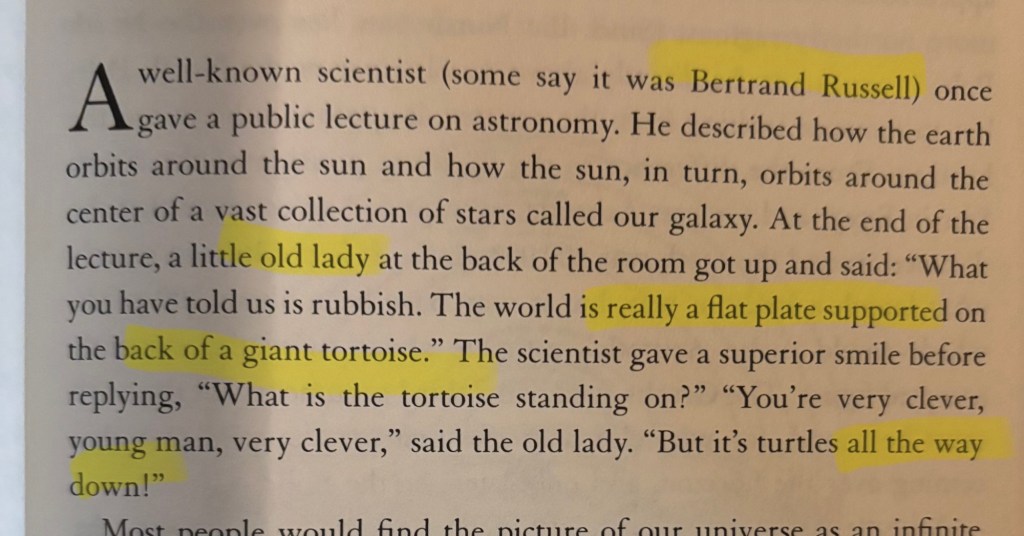
Those words were published by Stephen Hawking in 1988. (91 years after Russell was 25 years old and published his thesis; 91 years after James’ words were published.)
Sure. I grant you that it is possible that Russell gave lectures to little old ladies in 1897, despite his being 25 years old and having only published a thesis on geometry that no little old lady would ever be interested in (or aware of). But that only solves the lesser problem. How does “rock” become “turtle”?
Seriously.
Obviously the nature of the situation is Hawking placed the importance of “truth” well below standards when deciding how to open his best-ever-selling book (that is seriously flawed for more than this reason).
****
This is why you need to read, and read, and read, and read, and read. The solution is more reading.
And So It Begins, Again
Just when you thought the legacy media might finally be getting a clue, SpaceX loses a Starship and there is blood in the water for the Left’s propaganda machine.
The obvious curiosity is, “Is Musk up to the challenge of being hated?” Second to that one, “Will imprecatory chants towards SpaceX have effect?” And, if so, “Does the Left own their alignment with the devil?”
Up until DOGE, he was generally beloved.
Here’s what I know from all my reading—specifically from Machiavelli’s The Prince: Leaders must avoid being hated.
We shall see.
Shaking My Head/Nerd Alert!, A Review of A Brief History of Time, By Stephen Hawking
The Spiderman of physicists, Stephen Hawking, introduces the second edition of his book with, “The success of A Brief History indicates that there is widespread interest in the big questions like: Where do we come from? And why is the universe the way it is?”
Just past halfway through the book, in his chapter titled, “The Origin and Fate of the Universe”, he suggests, “The whole history of science has been the gradual realization that events do not happen in an arbitrary manner, but that they reflect a certain underlying order, which may or may not be divinely inspired.”
In the final chapter (before the Conclusion), he writes, “We would then be able to have some understanding of the laws that govern the universe and are responsible for our existence.”
In the final paragraph of the book (excluding three brief and meaningless portraits of Einstein, Galileo, and Newton) he suggests, “However, if we do discover a complete theory, it should in time be understandable in broad principle by everyone, not just a few scientists. Then we should all, philosophers, scientists, and just ordinary people, be able to take part in the discussion of the question of why it is that we and the universe exist.”
Firstly, for context, the second bestselling book in that chart is—self-help/dating/pop-psychology. Third is a cookbook. In other words, while I love that Metallica’s Black album is the bestselling album since certain record-keeping data began, while I think they deserve all possible head-banging praise from us mortals, the number two is Shania Twain. Put another way, Mr. Hawking got his 15 min of fame, surely. But his staying power is yet to be seen—and I wouldn’t bet on it. Additionally, “pity” is a very real motivator. My money says give mobility of limb back, and the Brit’s wouldn’t have paid to see the five foot man-eating-chicken carnival act.
Next, close as you look, you will find no written record of a belief that life unfolds arbitrarily. Instead, you will find people have always believed in order—but they got the order wrong. Pointedly, then, Hawking and contemporary physicists are in nowise special. They’re just doing their best like everyone before them.
Thirdly, “govern” and “responsible for” are not synonyms. You want to tell me that the sensation when an elevator starts up and the sensation of being stuck to the ground are indistinguishable? Great. But the idea that the aforementioned sensation(s) are responsible for my being is laughable. Get outta here!
Lastly, no, thank you. This idea that I have to wait upon “my betters” (or anyone) to finish their navel-gazing before I can opine as regards the nature of existence is just silly. Telescopes and microscopes are cool. But truth is not some distant or small object.
Previous authors, like Einstein, Jeans, and Eddington, among many, many others, wrote in order to explain what they were doing. Hawking, conversely, writes to announce his conclusions. The effect of their books could not be more striking.
It reminds me of the time I met an unmarried Major while I, too, was single (though a lowly First Lieutenant) in the Air Force. He was such a loser. He did precisely what he wanted all the time—and loved every minute of his life. Nobody liked him. He had no friends. To add one dollop of paint to the portrait, I’ll share this. When we drove around the base in Iraq in the big van, he would lie down on a bench seat for fear of the enemy targeting him because he was a Major. The point is not his earnestness, the point is the unhinged-ness. Anyhow, I recall thinking, immediately after meeting him, “I must get married.”
Likewise, had I read Hawking before Einstein, Eddington, and Jeans, and their predecessors, I would have never picked up another popular physics book. As it stands, my foundation is unshaken (thankfully) and the topic still interests me. But Hawking does not.
Should you read this best-seller? Nope. Life is too short. Start with Einstein’s The Evolution of Physics.
Reading Log 2.21


Seems like I’ve been saying it for so long that everyone should know, but ICYMI, Last of the Mohicans is actually one of five (5) books Cooper wrote starring Natty Bumpoo/Hawkeye/Deerslayer/Pathfinder, or more commonly, Daniel Day-Lewis. The Pathfinder is 3 of 5, taking place after LOTM events—and without reference to them.
It is just great. I have read three now and plan to pace the remaining two Leatherstocking Tales so that I don’t peak too soon before death. Nothing makes me want to go camp and hike and scout and track like Cooper’s tales.
The Aliens epic collection was alright. Nothing great. But it did have some interesting storylines and the art was beautiful. One thing that that volume unexpectedly contained was a sort of short story, written in prose. And that story was graphic as anything I have come across. I have previously been made acquainted with the works of an author named Neil Gaiman and these cause one to blush. This story was along those lines. Most Alien stories have the lead as female, and this time she is only able to perform her heroine duties because of the abuse she suffered as a little girl. Bluntly, parallels are made in the story between her waiting on the monsters, and her waiting on the monster. Sick stuff.
Oh. And like the comment I made about how reading too many comics in a row kinda highlights the undeveloped-ness/infantile-ness of these stories, I now more clearly see that every Alien story ends with the main character learning that despite the recent total victory (extermination), one xenomorph embryo still exists and is poised to makes its way to another human settlement. I hadn’t really noticed that just from the movies. Oh well.
Relativity.
Here’s what I’ll do. These are the few summative statements Eddington offers. Comment below if you find them useful.
“A gravitational field of force is precisely equivalent to an artificial field of force, so that in any small region, it is impossible by any conceivable experiment to distinguish between them. In other words, force is relative.”
Actually, that is the only one that makes sense for a blog post. The big analogy that Einstein developed was the elevator (or “lift” if you’re reading in the mother country). Newton, you’ll recall, realized that if “bodies in motion tend to stay in motion unless acted upon etc”, then the Moon would have long ago kept going right past Earth, as Earth would have kept right on going past the Sun etc. The force that keeps the orbits is called gravity. Einstein, then, realized that artificial “gravity”, literally the kind you feel at the beginning of an elevator ride, is experimentally no different than “real” gravity.
Okay. Relativity is interesting but I prefer the universe stuff. (And am scheduled to read more on that next.)
Lastly, I want to conclude with probably the most fun takeaway from the book. It is from the chapter “Weighing Light”.
“It is legitimate to speak of a pound of light as we speak of a pound of any other substance. The mass of ordinary qualities of light is however extremely small, and I have calculated that at the low charge of 3d. a unit, an Electric Light Company would have to sell light at the rate of £140 million a pound. All the sunlight falling on the Earth amounts to 160 tons daily.”
How Do Flat Earth Lunatics Account for the Darkness Between the Stars?
I befriended and consequently wished I had never befriended my first Green Beret at seminary. Suffice it to say, going from US Special Forces immediately to four years of Christian undergrad followed immediately by three years of Christian graduate studies is a bad idea. (All curious souls should be asking, “How does one pay for 7 years of schooling?” Good question. The answer is, “Post 9/11 GI Bill has 36 months of coursework and if you are collecting at least 10% disability ((most vets are)) you get another 48 months!”)
As I had flown operators like him around Iraq, while the rest of the seminarians hadn’t, he and I naturally bonded easily. (I fully aim to cause you to think of the Tesla Green Beret as I relate this experience with one.) He was intense. So am I. Yet I couldn’t help but feel weird around him knowing that at any time he had the upper hand and I was quite literally at the mercy of his mental faculties. He expressed once that one of the softer professors displayed a fear of him, which my friend chuckled off as if he was perfectly harmless.
But then the moment came when he texted me a flat earth meme. From that SMS until a mere couple of weeks later, he couldn’t release. My last text to him was, “I do not care what conception of the universe is in your mind, but I do believe that we should be able to change topics.” And his last text to me (in response to mine) was, “We cannot talk about anything else until you get that (effing) ball out of your head.”
Faithful readers know that I have posted either two or three anti-Flat-Earth-Lunatic posts on here with the purpose of giving easy to use conversational strategies to destroy these lunatics. The first post posited the employment of economics, first question being, “Have you ever started a business?” Last question being, “So you’re telling me hundreds, no thousands of workers (concrete for a rocket pad itself requires the use of Quickbooks to run accurate payroll for all involved) are being duped to work for nothing, but you can’t persuade anyone to give you their money?”
A second post offered, “Have you ever looked at the night sky through a telescope?” And if miraculously they answer “yes” you move to, “At your convenience, I am available these dates, please show me how to identify a planet from a star. They all look the same to me.” And today, I would offer a slight variation to this angle by suggesting we ask, “So, which brand of telescope you rocking these days?”
Recently, with all my reading, I am more and more anti-FELs. Not just for your reading pleasure, then, here is a third method of attack (or consider it training for your children and family).
****
Me: “It’s not the stars that baffle me. It’s the dark.”
FLE: “Huh?”
Me: “I’m talking about the night sky. People are always ooooing and awwwwing at the stars—even creating horoscopes to this day based on them—but that’s not the awe-inspiring part of the night sky by my thinking.”
FLE: “Hmm. Umm. You know the earth is flat though, right?”
Me: “No it’s not. But seriously, think about the dark part of the night sky. The part in between the stars. You can see it right?”
FLE; “Sorry, I was looking at my phone. There’s this video right here that proves the earth is flat. What? Sure. Yes. Well, no. I mean, have I showed you where the Bible says the earth is flat? What do you do with that? You’re a Bible-believing Christian, yes?”
Me: “I think you did. But just look at it all. All that dark. What do you suspect accounts for it? Is it the black paint on Ptolemy’s sphere? Is it countless tubes of nothingness pointed from the bounds of infinity directly at the earth of all places? I mean, it stands to reason that since we can only ever see more and more stars with bigger and bigger telescopes—wait a minute. Have you ever looked through a telescope?”
FEL: “Gee. Look at the time!”
Me: “You want me to believe the earth is flat and yet you believe the dark you see unaided is actually darkness, even when using a telescope? Ha. Haha. Aaaaahahahaha. Okay. I’ll stop. Now what were you saying about some video?”
FEL: (Crickets. And then assuredly they return to not looking through telescopes.)
****
You’re welcome, Blog-O-Sphere.
Just Finished a Book By Einstein; Christopher Nolan is Wrong
The title of the book is The Evolution of Physics.
Given there is still plenty of daylight, but my brain could use a break, I decided to revisit Nolan’s Oppenheimer. Why not, right?
In it, the woman asks, “Can you explain quantum mechanics to me? It seems baffling.”
Nolan has Oppie answer, “It is.”
He continues, “This glass— This drink— Our bodies— are mostly empty space, groupings of tiny energy waves bound together-”
She interrupts, attention laser focused, “By what?”
“Forces of attraction strong enough to convince us ‘matter is solid’.”
I do not know where Nolan got his material. I can imagine that he read Oppenheimer’s own writing and deduced this or—cringe—Oppenheimer even said this. I can imagine it, but I don’t believe it.
The problem with that definition is it neglectfully forgets a key point—or two, to be precise.
First, and this is directly from Einstein, it isn’t merely “tiny energy waves” but should say, “empty space, groupings of invisible energy waves.” And second, add “and energy particles”.
In full, and I hope to bring out for us lay folks the full sense of what I read in the clearest possible manner, if defined by Einstein, according the format Nolan introduced, the answer to “What is quantum mechanics?” when asked by a thin woman as a come-on (sapiosexual) at a bar is, “This glass, this drink, our bodies are mostly empty space—groupings of invisible energy waves and energy particles bound together by forces of attraction strong enough to convince us ‘matter is solid’.”
Put shorter—for illustrative purposes because I know this is uncommon—“Our bodies are invisible.”
Paraphrasing Einstein, for this claim to be true and/or accurate (the claim that “‘our bodies are invisible’ is quantum mechanics”) this claim must be tempered with, “when moving near the speed of light and observed indirectly.”
Now. You. Know.
On the Ol’ “Horse Running Beside the Train in which a Horse Moves to the Front” Thought Experiment
I can’t quite remember his name with certainty, but he lived in the house with the green shutters at the tip-top of the hill. He was right across the street from the bus stop.
One day he says “If nothing can move faster than the speed of light, explain this…” Then he gives the supposedly Einstein-derived thought experiment in which you imagine a train moving at the speed of light, inside which is a horse who moves from the back of the train to the front, and then add to this scene a horse beside the train who is pacing the horse in the train.
I took his point to be the classic midwestern point of “Einstein is wrong” sentiment (falling within the broader category of “bein’ smart ain’t nuttin’”), because the horse beside the train is obviously going faster than the speed-of-light train.
But I am working through Einstein’s own The Evolution of Physics and the truth is far different. Whether the kid knew it or not (it is possible I totally misread the moment), the thought experiment is not the one Einstein proposes (at least in this book) but does capture the concept—being relativity. In short, the speed of light is the limit. The horse beside the train is not going faster than the speed of light. This is Einstein’s discovery or theory or whatever you want to call it.
As with all knowledge, it is the presuppositions that matter and the thought experiment is based on the presuppositions of mechanical physics, whereas—it would seem—reality is not. (Reality is not based on mechanical physics—at least not entirely.)
And, yes, like you, I do have a bit of “so what, Albert?” in me. But then I remind myself that the point of my reading is not to “learn to care”, but to learn so that I can call out BS when I see it.
Final Thought On Gravity/Newton/Apples/Truth Before Moving On
The #1, numero uno, reason it is silly to continue repeating the account of the falling apple is that it is incomplete! It is, forget anything about who witnessed said apple, incomplete to say, “An apple falls due to the force of gravity.” Better, maybe not perfect, would be to say, “That an apple falls taken together with that the earth pulls the apple is an example of the relationship which conventionally has been termed, in abbreviation, gravity.” To reduce that sentence/concept by words or meaning is to lose any meaning/truth.
(These are for you, H-. If you’re still alive.)
Been Reading Some Einstein (and Infeld)
Until you do too, or until you read Newton himself, you just need to trust me. Any chance you get, any time you hear someone associate Newton with an apple falling from a tree, stamp it out—fiercely, ferociously if necessary, but effectively in any case. Newton should be forever tied to a David-esque slingshot. In all honesty, Newton’s influence on life on Earth is probably more profound than the “man after God’s own heart.” But however your rank order of the two concludes, they are both whirling a rock around on a rope—no apples in sight. Just stop it!
 Captain’s Log