Tagged: work
Reading Log 6.9.2025



Heart of Darkness was a spur of the moment addition to what I had lined up. I stepped out of my car in my sister’s neighborhood and the neighbor whose yard I was parking in front of, and of whom I inquired if the parking spot was okay, became chatty and mentioned he’d read the book 10 times. He mentioned many other things about it too. I hadn’t read it in years (there’s a review on here from a decade or so ago). So I figured I’d give it a re-read. It is scary. Definitely not for kids. And yet it is a must read. Also, the film adaptation Apocalypse Now is probably the best adaptation of any book/story ever.
****
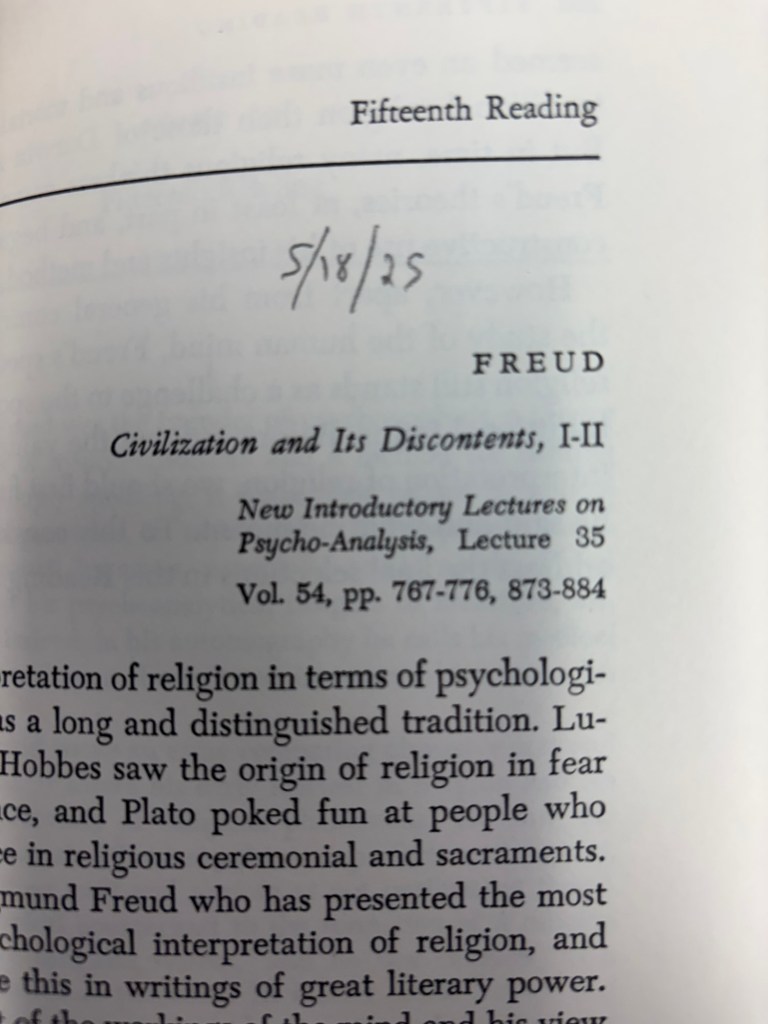
Freud is someone I kinda disdain with all my heart. What a waste.
So everyone is living on the planet, all hunky-dory, and then one man says, “You know that feeling in your belly, the one you get when you haven’t filled your belly in a while? Well, we get hungry and have needs in our minds too, don’t ya know? Oh, and this means we invented religion.”
I enjoy reading people who I disagree with—I like trying to imagine arguing with them. So there’s that. But Freud is someone whose influence I could live without. I will say this, though. Rather, I’ll let him say it.
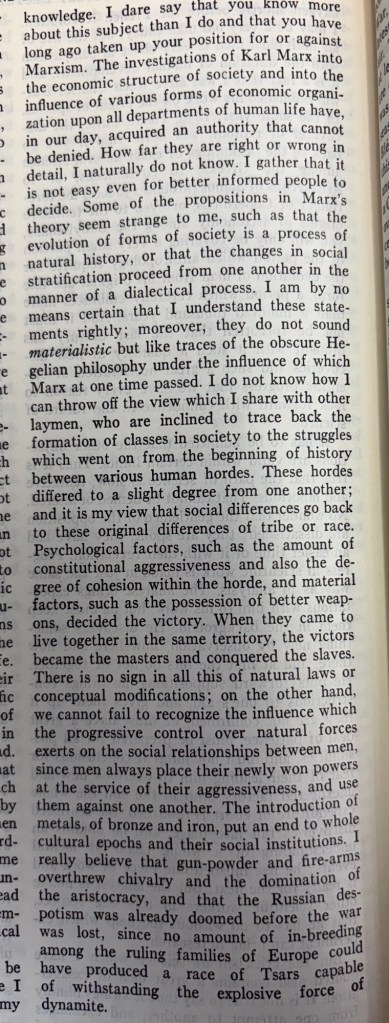
Freud went on to declare that Marxism and its “suffer now, be rewarded later” propaganda was, to him, no different than religion—and needs to go, too. So with that I say, Freud, ol’ buddy ol’ pal, pull up a chair. Let’s get you another round.
****
I had been reading that Eddington for far too long. I am happy to be finished with it. He is exactly my style and we see the same world. The main takeaway that an honest man like Sir Eddington gives is the truth about the speed of light. He very clearly explains that the speed of light is, in fact, not unsurpassable. Instead, what the physicists mean is the speed of light is universal. His analogy is that it is the “wood grain” of the (wood)universe. Even while he was alive they had experimentally collided electrons or whatever together and gone “faster” than the speed of light. But that doesn’t affect the fact that nothing is faster than the speed of light. This is because the speed of light is the separation of time from space. So if you were to go “faster”, you’d be combining time and space, which is clearly unimaginable.
****
I picked up this book on AI for obvious reasons. And guess what? My instincts were right again. There is nothing to fear. AI does not learn. It does not read. It does not understand.
In short, the computer nerds learned from the brain nerds that between 1. a conscious decision to move the body, and 3. the brain-activity that moves the body are 2. many other brain-activities whose purpose is unknown. So the computer nerds built (2.-like) delays between “do this” commands and “do this NOW” action. And then, the computer nerds programmed the “do this NOW” action to respond to “you failed” responses with (actual jargon alert) back-propagation. It is this back-propagation that is “mysterious” and where the nerds say the AI is “learning”. But again, the AI is not learning, it is following commands and making exceedingly subtle adjustments. The trouble for the nerds is the time it would take to map out all the exceedingly subtle adjustments of back propagation is considerable—and even if they took the time, they’d simply have a ton of data points and not really any necessary reason to draw one conclusion from another as to why the program executed either 1. that many actions or 2. those actions in particular in order to not “fail” again.
Talk about navel-gazing.
Regarding handling and “seeing” images, the computer nerds, this time, learned from the eyeball-nerds. In short, the eyeball nerds have learned that there is a distinct method to how we see, which essentially goes from big to small. Like, outside, blue sky, green earth, forest, tree, tree branch, tree leaf, leaf veins etc.
So on an image, the computer nerds tell a program to find edges first, and then go from there. Again, AI does not see anything. It just is really good at the game of “memory” (unless humans screw with images in certain, invisible to naked eye, ways.)
One final comment of recommendation for this book. (You really should admit ignorance and read it.) The author describes the phrases “AI Spring” and “AI Winter”. And she proceeds to use them throughout her description of AI’s history. In short, AI “astounds” someone (Computer beats Chess Champion), and money shows up in large amounts. The computer nerds take the money and promise everlasting life. This is AI Spring. Then the computer nerds fail to deliver. The money dries up. This is AI Winter. The cycle repeats. ICYMI, we are currently in AI Spring, more like AI Monsoon. But winter is coming. It always does and always will. Withstand the hype! You can do it!
On Art and On Health Insurance Costs
These two have nothing to do with each other, so don’t spend any time searching for the connection. Art and Health Insurance Costs have nothing to do with each other. They’re just both on my mind and I’ve been meaning to write about them for some time.
The reason to write about Health Insurance Costs is because I finally know the answer to my long unanswered question, “How does it work?” I usually ask this question when the person taking my money says the word “only”. And the HR folks seem to always say, “You only pay…”
While I haven’t ever googled anything like what I’m about to share, part of the reason for that lack of searching is that I wouldn’t even know how to ask the question. Experience was the way for me to “search it up”.
My company tells me that I can choose between an HSA or whatever the other, more traditional plan is called. Neither the acronyms, nor the explanations of benefits made a difference to me, and the paycheck deduction is near identical. I chose HSA.
Long story short: the HSA costs me (family man) something like $230/paycheck no matter if I go to a doctor or not.
But there’s a $3,000 deductible.
So that means that if you happen to go to the doc, whatever the number the letter in the mail gives you after figuring out what was “covered”—pay attention—must be paid. So if you go and owe $3,000, you’re now paying, over one year (26 paychecks) $345/paycheck ($230+$115). (Luckily, most places don’t charge interest on these year long payment plans—luckily for them, I mean…)
To restate that, if you need to spend your full deductible, you go from paying $460 a month to $690 a month!
Now, once the deductible is met, there is an “out of pocket max”. For my plan, this is—for any one us—$6,875/year. For the entire family it is $8,000. (Don’t quote me on these numbers. They’re close. Who would have them memorized? I have better things to do.)
Again, once some one (1) member gets bills for $6,875, which is only $3,875 more than the “deductible”, the new paycheck-ly cost of the plan is…(total of $3,875 / 26 added to $345)…$494/paycheck! Put plainly, we’re up to $1,000 a month!
If we get bills to the tune of the family out-of-pocket max, that’s an addition of $1,125 (over the course of 26 checks) or a grand total of $537/paycheck!
In short, before all the medical bills become “covered” (natural sense of the word) by my health insurance, I have to contribute $1,100/month or so, or the initial $230 x 26, plus $8,000, for a grand total of $13,980!
I’m not sure the word “covered” really means anything at this point. Maybe we’re “covered” in the sense that a year of mortgage payments “cover” our heads all year.
“What’s your mortgage?” Next time someone asks, tell the truth. Add up both the mortgage and the health insurance.
Now you know. And no one ever had explained it to me before. So I wrote it down today.
Next, unrelatedly, let’s talk about Art. I just listened to a podcast on the philosophy of Art and a super intriguing idea was planted in my mind. The idea? All Art as “work song”.
I like this idea so much, it gives me so much joy, that I’m infecting you with this idea now. Is Art itself merely “work song” for our lives, comprehensively? If so, what does that mean? If not, how is genuine “work song” (like “I’ve been working on the railroad” sung by actual railroad workers while they work on the railroad to pass the time away…) different than Art?
Fascinating to consider. On the one hand, if all Art is work song, that paints a pretty depressing vision of life on Earth—as in, life is so bad we have to sing to get through it. But I don’t see why it has to. I like singing and I like working and I like singing while working. Just did it the other day. Was chatting movies on the leg home and belted out, “Say it soft and it’s almost like praying”. (Name that tune?) Made the crew chatty and made me smile.
As for me, I’m undecided as of yet. But I’m leaning towards siding with the “all Art is work song” crowd. What do you think?
We Are Past the Time of Prophets
The prophetic book of Ezekiel is widely known for one small and relatively (or arguably) minor passage about “dry bones”. Christians (myself included) love the imagery. YouTube has clips upon clips of sermon upon sermon on the passage. The trouble is that the dry bones section is ultimately a very brief part of a larger writing that is of a decidedly less hopeful tone.
The question for today, and I mean the question for April 21, 2020 during the pandemic, is, “Are we past the time of prophets?”
The question came to my mind because I watched a pair of rants by Bill Maher, and was encouraged to do so by a super-conservative blogger on a near-scary news website. Both rants by Mr. Maher were engaging, coherent, and, most importantly, timely. But I felt like a fool afterwards. Bill Maher is a joke. The words in and of Ezekiel have made it nearly 3000 years. Bill’s tone of voice will keep him going for 50+ years, but his words are ultimately empty. Take this assessment of mine together with the fact that I cannot find one commentator who I agree with, and the question came to mind, “Are we past the time of prophets?”
Ezekiel 2:7 has the LORD saying to the prophet, “But you shall speak my words to them whether they listen or not, for they are rebellious.”
Naturally, there have been prophets before Ezekiel got his call. Again, that is not the question. Obviously, and despite the at times anachronistic ordering of the books of the Old Testament, there were prophets after Ezekiel died. That is not the question either. My question is, “Are we past the time of prophets?”
During the #Metoo movement of a bygone era, comedians found themselves defending their barbaric craft. I wonder if during this pandemic prophets should be defending theirs?
The LORD told Ezekiel, “…speak my words…whether they listen or not…” In so doing, one might say, the LORD gave a definition of a prophet. The prophet is going to speak. They don’t care what happens next. They may desire one outcome or another upon hearing, but they, the prophets, believe they are called to speak. The listeners’ response is always contingent on the LORD’s will. And my question is, “Are we past the time of prophets?”
Put another way, “It’s been 2000 years since the resurrection. Are we bound to support a segment of society who simply criticize, people who simply lament, people who simply know better, people who are smug, people who saw COVID coming, people who think the Bible saw COVID coming, people who think the situation is obvious? Are we bound to listen to people who would choose to hold the microphone over all other professions and at all cost? Are we bound to these people?”
I say, “No.”
I say, “Shut up.”
I say, “You’re no journalist. You’re no newsman. You’re no investigative reporter. You’re a prophet. And we are past the time of prophets.”
My Best Conversation Tip When You Know You Are Smarter Than Everyone In The Room
I recently moved. It’s been difficult, but it is a good thing–a great thing. I am flying again.
However, I have been struggling on the social side of life. Many of you may recall that while I wasn’t flying, I was educating myself. More than educating myself, I was learning how we know anything about anything.
When one engages in this pursuit, the pursuit of knowledge, he or she is usually surrounded by other like-minded individuals. In other words, he or she feels normal. They feel comfortable.
But when school ends, reality hits home. No one cares. People not in school simply do not care. To you all, I say, “Cool beans. Good for you.”
But the problem remains. If I walk into a church, I probably have studied biblical history, language history, and the Bible itself more than any two people present combined. If I am among a group of pilots, my military flight training sets me apart from the civilian group for sure, and my having been trained by the Air Force sets me apart from the wannabe Air Force pilots that settled for serving in a flying capacity in one of the other branches.
In short, the problem is conversations become belabored. These days I want to get in-depth on whatever subject matter is of note. I mean, I have questions, man! Soon after, though, they realize that they don’t quite carry the same fire as I do. Consequently, one of us changes the subject to avoid silence.
After much consideration, then, I have discovered the solution. Or at least the following offering is my best conversation tip when you know you are smarter than everyone in the room. (This is both for me and for some of the other smartypants I know who are noisily lurking around out there.)
Ready?
Here it is: Be quiet.
Yup. Stay silent. Keep observing and keep learning. There is no rush.
Okay. That’s all, folks!
PS: Dark Phoenix was great. I think the reason it received bad press was its elevation and commendation of the virtue of “forgiveness”.
Security, Safety, Equality
This is more for me than anyone else. It’s just a musing that I am working out. But I felt like sharing.
“Those who would give up essential Liberty, to purchase a little temporary Safety, deserve neither Liberty nor Safety.” – Ben Franklin
Liberty lives in the heart of veterans like me. Like me, some of my war buddies have an as of yet unaccounted for revulsion to all this talk about equality that is everywhere these days. Girls are equal to boys. Children are equal to adults. All religions are equal. All cultures are equal. All countries are equal. It’s all hogwash–at least according to me and my pals.
Why? Because we didn’t fight for equality. Men don’t fight for equality, certainly not with their flesh. Lawyers and judges and statesmen might consider their fight to be for equality. But the fighting man? The warrior? (And, no, not the metaphorical warrior, folks). No, sir. He fights for freedom. And when he is finished with his fight, then he desires it. He needs it. Why? Because if he can’t have it, then he must fight again.
I want to offer for your consideration something new. I offer the idea that equality is synonymous with security, synonymous with safety.
How would you distinguish them? I no longer see the distinction that might have once been in my mind.
Ever, Ever Again
As a child I remember hearing and repeating one disparaging joke about Ethiopians. That was the breadth of my awareness of that people. As an adult I find myself working alongside them. Just before taking this job, for a different reason, a white South African friend shared with me that what he knows of Ethiopians is that they fight, meaning they still have backbones–regardless of which side they’re fighting for.
A seemingly unrelated second memory from when I was a child is that my dad owned his small business. One day he came home from work and shared with my mom that his secretary essentially gave him the what-for about how he didn’t know how to do anything right. I can’t remember all the details but I remember how angry my mom was that my dad didn’t stick up for himself. My dad would tell you to this day that he does not like or believe in confrontation, and that he intentionally searches for the way forward that includes everyone being happy.
So, here’s the memory merge. Just over one year ago I began this new job. Shortly after beginning in one department I was moved to another. The man that trained me in this new department, on day one, lambasted the workers in our department on the earlier shifts. (It’s a 24-hr factory.) I remember thinking, “If he’s saying that to me about them on day one, then what’s going to stop him from saying that about me if I’m ever on another shift than him?”
Suffice it to say my suspicion was correct. The minute another worker quit, I switched shifts and subsequently discovered that my former-trainer was talking shyat about me during the pass-down every morning.
Dread, in any form, is no fun. Over the course of time I shared the situation with my Ethiopian co-worker and friend, and at first he thought I was probably not assessing things accurately. After a bit of contemplation he changed his mind and said, “You know what? If you’re complaining about him, something is off.”
To my sheer delight, my Ethiopian friend later initiated the following conversation. He said, “You know what, Pete? K- and I used to argue and get into it with each other every day. Then one day I said to him, ‘K-, if you have a question, something work related, you can ask me. Other than that, do not ever, ever, ever, ever, ever talk to me again.’ After that he stopped talking to me. These days we talk, sure. But it was only after a long time had passed.”
The funny thing about the entire thing is that when it comes to watching someone else be attacked, I won’t stand for it for one second, and I will shed any and all concern for myself and my circumstances as I move in to defend. But when I’m the recipient, I just absorb it.
Other advice includes the following gems. My mom says, “Be happy there is only one.” One of the Reverends from church says, “A lady once told me she had a similar situation at work. She prayed that the LORD would bless the co-worker. In three days they were promoted to supervise another department and peace was restored.” A friend from school, also randomly South African, said the biblical course of action would be address the dude one-on-one, then escalate to supervisors and HR when he doesn’t change. He also exhorted that I ask the LORD to change both our hearts.
Here’s what I did. Well, first, you need to know this. One night at the club, one of the girls told me that some guy was getting a little too handsy during the lap dance and so she stopped and then he stiffed her on the money. She came to me because I was the manager at the time. I asked her what she wanted and she wanted both her money and him to be thrown out. After entirely too much talking with the dude, I got her the money, but decided that he could have another chance. When I reported this news to the woman, well, let’s just say that the look this woman gave me was something I would not wish on anyone. I said to her, “Okay. You’re right. He’s leaving now. I’m probably gonna get slugged though.”
Sure enough, I told him I changed my mind and his friend and him had to leave. While looking at his friend, I felt the dude’s knuckles against the back of my skull. After slight and inconsequential chaos he was then escorted out. (It never ceased to amaze me how the party never hesitated, no matter if fights were happening, or where–including on stage between girls. Customers just wanted to get wasted around women, girls just wanted money. But everyone expected these things to happen and the company to have staff that was able to handle them surely and painlessly.)
The lessons were many, but most notable for my current predicament was that I went alone. I should’ve had another guy with me. And I did from then on.
So I didn’t have the one-on-one chat with my co-worker last week. I prepared to head to HR and get the third person involved from the get-go, especially because the problem is exactly that this guy is a hot-head and totally unapproachable. Upon resolving to get HR, I decided I wanted one more instance before I went, and as these things go, the week went off without much drama, especially considering there’s a new trainee that keeps him occupied.
What’s so funny to me about it is that I know myself so well that I know I won’t refrain from answering his BS responses in words and tones that must-needs compel him to action during the consequently never-gonna-happen one-on-one chat.
Is this self-awareness what my dad felt? Is he a all-or-nothing guy that just chooses nothing? Who knows. Pretty sure we’ll chat about it after he reads this.
Okay. Not to be picky, but I’m really only looking for stories about how you got the person fired. We’re fooling ourselves if we think these people change. I can only think of one sure way, but I don’t feel like getting hit. Whatcha got?
Why Did You Pay Me? – Part 2
A few weeks ago I wrote about how I was struggling tremendously with the notion of salaried pastors. I was struggling because I am essentially in training to become a pastor and yet I couldn’t imagine how at the end of my schooling I’d somehow be willing to not need a job anymore because some congregation paid me to be their pastor while they worked their crummy jobs everyday. In an effort to gain insight and make a point, I asked why did you (the public) pay me to be an Air Force officer and pilot. Only a few folks answered and there wasn’t tremendous agreement. But I know why you paid me even if you don’t. You paid me to be virtuous. Sure, military officers are “yes men” and flawed no different than anyone else, but we’d be missing something vital if we didn’t recognize that they still possess tremendous power and regularly refrain from abusing it. Military officers control the bombs. Do we want incompetent liars in control of the bombs? No. (Iowa might). So I say that the reason American citizens pay their military well (sorry folks, but the military is well-paid despite the colloquial wisdom) is because it creates the ability to recruit and maintain a virtuous fighting force.
Back to pastors. And not just any pastors but me and my future as (possibly) one. What would it mean if I took pay to be a pastor and therefore didn’t need a regular job? Here’s how I can comfortably rationalize it. (The following should come as no surprise). Christians believe in purpose. They believe in God, the Father Almighty, Maker of heaven and earth, and in Jesus Christ, his only son, our Lord…insert the rest of the Apostle’s Creed. And yet they live in a world which behaves as if there is no purpose. Therefore, it is very easy to forget that there is purpose. How could they be reminded that there is purpose? By a leader who is designated to keep an eye on the prize, so to speak. (Remember that the reason we know, rationally, that purpose is objectively true is that it is beneficial to live accordingly, which then becomes self-fulfilling as a result.)
I started this blog with the tag line “the only way to get there is together”. I think that that is still true and theologically sound. When I came up with the additional “life on a different plane” tagline I did not intend to capture anything to do with God. Now I do.
When I served, I was a pilot of a crew helicopter. There were six of us on the crew. Four of the six served in auxiliary roles which enabled the two pilots to focus on keeping the greasy side up, as we used to say. Besides simply flying safely, the two pilots were also the ones ultimately charged with completing the mission.
So that’s what I’m proposing now. That’s what I’m comfortable with today. Maybe I’ll be a pastor someday, maybe not. If I am one, the reason I would be comfortable being paid by the congregation for what I would consider “doing nothing” is because I would interpret the monetary part of it to be that my role is again that of a captain which necessarily requires a certain level of discipline. The congregation is no different than the four non-pilot aircrew. They are doing jobs that I view as crummy, but until we collectively come up with something better those jobs are apparently necessary. Necessary? Necessary for what? Necessary to keep the plane (the Church) right-side up, safe, and able to complete its mission, its purpose.
For now, crummy job or not, keep on keeping on. I will too. And together we’ll get there.
Humility
We’re studying source and form criticism of the Pentateuch. Orthodox Christianity has it that Moses is the author, and it was written around 1300 BC. Super smart Germans in the late 1800s AD developed a hypothesis that super smart westerners continue to support that these first five books of the Bible are comprised of material from several sources and authors and with nefarious, political agendas anywhere from 1100 BC to 500 BC.
First question: Does it really matter? Yes. One illustration of why it matters–Jesus of Nazareth is recorded as saying “As Moses wrote…” Things start crumbling if Jesus Christ lied.
Second question: Is humility a virtue (and therefore worth aspiring toward)? Much of the doctrine of this school revolves around orienting the student’s focus during our lifetimes. Are we to be centered on the human or God? Boldly claiming that despite the fact that there is no empirical evidence confirming the “documentary hypothesis” and millenia of tradition rejecting it that you are confident that Moses did not write the Pentateuch is a “human” or a “self-centered” perspective. On the other hand, concluding that while it’s important to account for the Pentateuch’s claims against the archaeological record, a spirit of humility in the concession that thousands of years of tradition probably counts as passing the test of time is “God” centered.
There seems to be a undertone that only academically incapable minds would reasonably conclude humility is the best course. But I’ve been going to school with you, living with you, and listening to you for a total of thirty-four years now. And I’ve out-performed all but the brightest of you–when I’ve cared to–according to the ways we sinners have developed to measure such things. And yet I hear most of you questioning my academic prowess in my confession of humility and vote for “God” centered-ness.
Just a passing thought that intrigued me during class today. On to the opening pages of A New Catholic Catechism and not enough sleep. Wish me luck.
Thank You
Great comments. Thank you for taking the time to share.
Koine Greek is apparently a language where word order doesn’t matter as much as it does in English. A bad illustration of this is in Greek you could say, “Is green the house” or “the house is green” or “Green is the house” and other features of the language render each of those orders equivalent to “the house is green”. I mention this because I attempted to use a tactic of Greek to open yesterday’s post. Since word order is variable within a sentence, writer’s are in a sense more free to make their points via word order. Scholars, then, have concluded that the first word of a Koine Greek sentence contains the emphasis of the thought. And that’s why I began by saying “allegedly”. I wanted to succinctly indicate that I wasn’t beating a drum or jumping to conclusions etc.
Given the all-to-familiar reports of the Columbine murderers’ asking “Are you a Christian?”, and given Evangelical Christianity’s (the brand I’m participating in) tendency to believe the “end times” are near and therefore view any attack on Christians as proof, I too was skeptical of this claim when it was presented. We all have our opinions about the integrity and motives of newspapers, but when the New York Times and Wall Street Journal both include the claim, I would like to believe we can all agree that there is at least a strength to it. Maybe not. In any case, only time will tell if the claim is verifiable and true.
So what was the seminary’s response? Prayer.
Your Turn
Allegedly, the shooter singled out Christians.
Because my ego knows no bounds, after first hearing about this shooting this morning whilst in Greek class at seminary, I immediately thought of you and how surely you’re curious to know how a school bent on training Christian leaders would respond/feel/think/report this shooting. And I’ll tell you–after you tell me what you guess the scene was like. Because I’m desperate to hear reactions from the people on the streets. One rule. Be honest. What was your first reaction to first hearing that Christians were singled out? And what was your first reaction to my question, “I wonder how Pete’s seminary presented/responded to the reports that Christians were singled out?”
Thanks.
 Captain’s Log