Tagged: love
Some Outstanding Quotes From Recent Reads
A book I have always dreaded is, “Up From Slavery” by Booker T. Washington. I viewed it like the pet shop snakes Pee Wee didn’t want to rescue from the fire. I could not have been more wrong. It is astonishing. (For the uninitiated, it was written around 1900; Washington was a former slave turned champion of education and recognized leader of the Negro people in the times that followed their big day.)
“The white man who begins by cheating a Negro usually ends by cheating a white man. The white man who begins to break the law by lynching a Negro soon yields to the temptation to lynch a white man. All this, it seems to me, makes it important that the whole Nation lend a hand in trying to lift the burden of ignorance from the South.”
(Pause here to consider the fullness of love captured by those words.)
“Nor should we permit our grievances to overshadow our opportunities.”
And I add this next one with a special eye affixed on Black Jesus himself. (Please recall this was spoken by a former slave. No bed, no bathing, no shoes, no toothbrush, no mealtimes. Scratchy shirts, no education. Etc etc.)
“The wisest among my race understand that the agitation of questions of social equality is the extremest folly, and that progress in the enjoyment of all the privileges that will come to us must be the result of severe and constant struggle rather than artificial forcing.”
That begs repeating.
“The wisest among my race understand that the agitation of questions of social equality is the extremest folly, and that progress in the enjoyment of all the privileges that will come to us must be the result of severe and constant struggle rather than artificial forcing.”
(It’s only natural to take a quick break before continuing to the next quote.)
Long ago I bought Thomas Aquinas’ Summa Theologica, partly out of interest, partly to impress a girl. I never opened it that paperback copy. But a beautiful hardbound copy was in my Great Books set and the guided reading propelled me to taste and see. So I finally had a chance to discover what it’s all about. Couple to this that back in Seminary (Evangelical, not Catholic) the phrase “intellectual assent” was thrown around like “please and thank you”, usually in a smug, “Faith isn’t just intellectual assent”. (This was said in conversations about apologetics and sharing the Gospel in general.)
“Now the act of believing is an act of the intellect assenting to the Divine truth at the command of the will moved by the grace of God…”
For the thousandth time then, say it with me, “We’re all just little repeaters”. It’s depressing in a way. But it’s also fun to track down the true creators among us.
Next and last for today is Jack London’s White Fang. I can’t recall if I ever read it. I know I watched a movie from the 90s by the same name, but to suggest it was based on the book I am reading would be criminal.
(Keep in mind this quote is about a wolf *wink*.)
“But there were other forces at work in the cub, the greatest of which was growth. Instinct and law demanded of him obedience. But growth demanded disobedience.”
(Another long pause for contemplation is only natural here.)
I write these posts for me. But I confess to you that today I write with the hope of spurring someone, anyone on to the delight of reading Up From Slavery and White Fang. (Aquinas is too much for anyone not professionally interested.)
It Makes Me Want to Teach
[SPOILER] Good sermons make me want to preach, and good movies make me want to teach.
Gladiator II is good. As I said yesterday, it isn’t that good, but it is good. Here are some areas it missed the mark and which hold it back from ever becoming a “classic”. The areas are remarkable because they are so easy to identify. (High notes will be listed at the end.)
- You must know what your movie is about. Gladiator was not about Rome or Maximus’ wishes for Rome. Gladiator was about the penultimate gladiator—Maximus. (Insert infamous “husband to a…” quote.)
- Never, never, never, never believe you can fool an audience. We’re just too smart. No red-blooded American believes you should give up. Ever. Never give up. The idea that it is noble to peacefully and without resistance enter the after-life is un-American. Do not try to show how it contains value of some sort. “Rage, rage!”
- I saw a clip where Ridley Scott answered a question with, “I just know.” The question was about the leading man. This was way too arrogant. Hollywood and entertainment is far more complex than that. Sure, the leading man—unremarkable as he was and will prove to be—was definitely not a let down. But the whole movie wasn’t as good as it could have been and this is obviously because it rested on “I can’t make a bad movie” reasoning, instead of a good story and good storytelling. We’re not paying to see Ridley Scott. We’re paying to see a good story told well.
- While the movie wasn’t “woke”, it could’ve entered the always available ranks of “timeless” by avoiding some obviously “woke” ideology. Again, this did not have to be the case. Specifically the movie had way too many irrelevant BIPOC characters (and close-ups) that contributed nothing but shades of brown to the screen. To repeat: in great movies everything in the movie must have a purpose and that purpose is to tell the story. In Gladiator, the Black and German slaves were there to make us like Maximus even more. It wasn’t about DEI. It was about Maximus—the gladiator. This leads to the next point.
- We never cared about Lucius. This is because we were forbidden to by the first Gladiator. He had been introduced to us as little more than a spoiled rich kid. I think it would have been possible to care about him if we were shown how. I’m thinking that the story would have had to include some highly skilled and discerning followers or servants of young Lucius accompany him to wherever he goes to hide and resent him for their having to give up court life etc. Then over time they come to respect him and are willing to die for him etc. But there are a lot of difficulties with that concept too, so I’d have to give it more thought. The point is we absolutely cared about Maximus every single second of the film. Seriously, what wasn’t or isn’t there to like?
- The villain was too diffuse. Great movies have one villain and he or she or it is identifiable immediately. Surprises work for thrillers, but Gladiator II did not aim to be a thriller. “Temet Nosce” (know thyself).
- Just like life-making love-making, there can only be one climax in a movie. What is weird about this movie is that it has events which in and of themselves didn’t have to be “climaxes”, but were shot/told/scored as if they were the climax. So you feel spent only to now be disappointed that there was more action coming. Again, it’s a simple mistake that hurt the project.
- The final area I want to mention is something which probably has an industry term—I just don’t know it. It’s best exemplified by Expendables 3. There were all these individual scenes dedicated to each action hero on the squad. But the scenes had no “tie that binds.” Gladiator II similarly introduced many characters with scenes that were well-acted and almost interesting, but their presence diminished the movie, instead of augmenting it. Bluntly, by contrast, I cannot think of a character or scene in Gladiator that didn’t make me like Maximus more than I previously did. Characters offered contrast to Maximus, and scenes fulfilled the role that time does in increasing our desire to see new love, in this case Maximus, again. Gladiator II’s non-Lucius scenes merely confused me while creating an atmosphere wherein I did not want to give myself completely to what I thought the story was. And all this because, say it with me, the director didn’t know what the story was.
To conclude, and to balance, here are the obvious positives.
The opening scenes and battle are evidence of Scott’s greatness. Does anyone do epic better? No. He is without peer. They are masterful. He is the master.
No scene taken by itself is low quality—more evidence of greatness.
The acting is top tier.
And despite it being CGI, the CGI is almost transparent. Pointedly—it is probably the best CGI to date. Good job.
No Helmet, A Review of Gladiator II
The refrain, “This is good,” repeatedly sounded in my head for about the first third. And the movie is good. But it isn’t great and it misses for some questionable reasons.
Most importantly, there was no helmet.
Secondly, as in the first film, there is a use of “paper” that is totally a-historical. No one had disposable paper in 200AD.
Thirdly, CGI.
Fourthly, let’s just give Russell Crowe his due. Even his hand in wheat seems divine to this day.
Lastly, there was a moment—you’ll know it when it comes—that I felt disappointed that there was more movie to go.
New Conversational Vocabulary for Resisting the Next Vaccine (Approved and Inspired by Claude Bernard)
While the RFK Jr. news is provocative, I am not persuaded that the lessons the Left learned from COVID and power available during pandemics will ever be forgotten.
I got vaccinated, but not for medical reasons. Like many, I had it at least once.
I am not an “anti-vaxxer”.
Yet, it should not surprise anyone that my sympathies will always lie with people who resist acts of compulsion—notably by the government. Additionally, my own instinct instructs me to recognize that my fellow humans’ instinct which tells them to resist vaccines should be allowed to prevail. In short, “you do you”. But I can’t help but notice the resistance lacked rhetorical skill.
Given my status as exceedingly well-read and becoming more-so daily, I want to lend a hand. I wouldn’t spend so much time in the books if I didn’t believe there is practical value inherent.
In this post, then, I want to give any “instinctive” anti-vaxxer the language, the vocabulary as it were, to successfully repel any future mandates, and their inherent conversational societal pressures. In other words, I encourage you to adopt the following as your script when your own family members make outrageous claims to “trust the science”.
****
Smug Relative: “Just trust the science! It’s harmless.”
You: “First, ‘No, thank you.’ First Part B, what you mean by science, and what we both agree is its prime definition, is ‘same conditions, same result—every time’. In short, science is certainty. Anything less than certainty is not science. If I may, you don’t trust the science, because one cannot trust the science, because the vaccine—unless you claim it is certain—is not science.
“To conclude, say what you mean. You’re trusting something—but it ain’t the science.”
“Second, harmless? What is the difference between harmless and failed? Because when you say harmless, you seem to be implying that no one put any effort or investment into the attempt to develop a compound that will teach my body to defend itself from the virus. But I believe people most definitely put effort and investment into developing a material that will teach my body to defend itself from the virus. (And I believe you, here again, actually agree with me.)
“Therefore until they are certain, harmless must mean “they failed.” And I am not interested in putting failure into my body from the outside; I have enough trouble keeping it from being generated in the inside.”
Smug Relative: “There is never going to be certainty in medicine.”
You: “Again, we find ourselves in agreement.”
Smug Relative: “I see. So what? You need me to explain the statistics?”
You: “Nope. I don’t require anything more of you. Thanks for hearing me out. I’m glad we chatted.”
We Are Trump’s Loving Wife
The classic American marriage contains the beautiful scene of a husband unexpectedly finding that his wife has granted permission to “go big”.
My favorite illustration of this was captured by a commercial, some years ago, where after the husband puts the new big screen TV into the TV stand, he stands back, admiring his TV. The wife walks in and is not immediately impressed.
Baffled, and fearing the worst, he asks her, with trepidation, “What?”
She answers, “It’s just that there is a lot of…space.”
The scene continues with the husband microscopically examining the fit of the new bigger screen TV. He is squinting and running his hand along border between the TV and the TV stand. His wife comes in this time, and is visibly strained.
She says, “It is fine.”
He responds and concludes the anecdote with, “I can still see light!”
****
As you no doubt have seen, there are red/blue county maps of America making their way around the web and one headline I saw claimed, “There are no blue states.”
Translation: there are blue counties in otherwise red states, and there are states composed entirely of red counties.
Implication: All of the United States of America, not merely the 75,000,000 voters and electoral college, just told Trump, like a loving wife, “Treat yourself!”
****
Yes, that’s the best analogy of the passing scene, I should think.
Time To Turn Off the TV
I know you don’t agree. I know you don’t. That is the point of this post. There is no topic more detestable to humanity of all stripes than the notion of turning off the TV—and any meaningfully similar source of information.
Yes, I’m happy Trump won. But not for anything to do with politics. I’m happy because while all the republicans and conservatives were wringing their hands, I said over and over that he had it in the bag. And so when I was proved correct, I was happy.
But every moment since then, I have been questioned by friends and family and had my good name challenged because I am not happy that Trump won for the same reason as they are.
I do not believe he is some sort of savior. I do not believe we’ll see a reversion to some past life when groceries were cheap and rule of law was respected and understood. I just don’t see national politics from that kind of perspective.
But the point of this post, again, is to explore that when I share my perspective, which boils down to, “You’re all Henny Penny and if you would just turn off the TV, you’d have profound improvement in your ‘flourishing’,” folks lose their shyat on me. It’s like I’m asking them to give up—not just food but—breathing.
I actually resorted to telling my Ethiopian/African wife (you’ll-understand-this-if-viewed-from-well-known-they’re-more-spiritual-vantage-point), “You love to talk about demons as if it’s still Biblical times—well when it comes to our attachment to TV, I agree. This situation seems at the level that an exorcism may be necessary.” Perhaps unbelievably, this did get through—in its moment.
So I think I’m done. I already do not have a TV at the house. I have cut movie watching drastically back (difficult to cut completely because night work leaves a lot of zombie time during the day). But I’ve been checking news like a junkie of late. It’s time to stop that now. And why? Because, as an human without TV, I can happily report, “The sky is not a-falling.”
My Not-Unanticipated Gloat Text To My Family
I haven’t shared too much directly personal content of late, but for the bigger point, here is the text I fired off to my immediate family (my folks and my siblings and their spouses, only one couple being Harris supporters). I do not believe anyone but my mom or dad will have read it. And I generally only experience glee when picturing my brother-in-law smiling as he reads what he would never say.
After the text I have addd here some much needed commentary—as no one but me seems to enjoy taking writing at face value and thinking about what it means and doesn’t mean.
****
I’ll keep this absolutely predictable text short:
S-. H-.
Gotcha!!
Like you, I feel like the biggest “soul interrogation” just ended and you two failed. Racism (BIPOC are not better), sexism (women are not better), and communism (theft is not better) are evil. And you both have to live with the fact that you voted according to them (and, in spite of at least superficially agreeing with me and being surrounded by people who also agree).
Fear not! It’s beautiful, in a way. That is, it is truly a powerful (think sunrise 🌅 , not democrat machine’s gun-to-head) moment, if you approach this “lived experience” from the twin Biblical perspectives of divine patience and grace, as offered by the atoning sacrifice of Jesus Christ.
The maker and sustainer of the universe has given you more time to repent. Be happy. Consider it.
I, for my part, thank the LORD and will think of you before all others whenever I see a rainbow or cloth representation of a rainbow’s colors going forward and am inescapably reminded of patience.
****
Notice I didn’t say anything about Trump. Do you see? Not one thing was about Trump. This is for many reasons, all equally as noble as the true thrust of the text.
Firstly, I didn’t vote for him, so “my guy” didn’t win. My problem with dems has never been that they didn’t support “my guy” or “Trump.” My problem with dems is their support of evil.
Secondly, and more importantly, nobody voted for Trump because he is a man, or because he is white, or because he is old. Naturally this is hyperbole—I cannot know for certain that those DEI features were ignored by all his voters. But I can say that anyone who did cast such a shamefully-reasoned vote would never admit it. This is also hyperbole. But not hyperbole is the following: any racist, sexist, and ageist voters for Trump had no influence on the contest. And more specifically, I know my Trump-voting family members voted for him for his policies or humor or record or simple hope that his MAGA slogan is his earnest hope and plan.
Lastly, Kamala Harris is so empty, so devoid of reason, so obviously puppeteered that it is impossible for me to be wrong that her voters were voting with evil intent. Besides the manifest logical truth of this claim (you can’t reasonably vote for someone who isn’t for at least one thing), the Harris voters’ own silence on any non-DEI (evil) reasons for their vote is impossible to ignore. 66,000,000+ citizens voted with race, sex, age, theft, and lies as their motivation. 71,000,000+ voted with, at their core, hope as their motivation.
They hoped he wants America to be great again. They hoped he knew he was fibbing all the time he lies. They hoped he wouldn’t put himself before America.
Now we wait.
Watch and Wait
The only thing left to do before the results are declared is watch and wait.
Specifically, we’re watching for the dems to start crafting the inevitable “why we lost” narrative. This is no different than when watching a sports championship and the time is ticking down and the announcers become more cognizant that it is not time to keep saying, “There’s a chance!”, but instead time to say, “It’s looks like it’s gonna take more than…”
Everyone is too self-aware that the internet is forever to keep up the charade until the very end. The end was a long time back. Now we watch and wait.
“So You Wasted Your Vote”
I didn’t get to conclude my, “I wrote in a candidate, which by the way is not as simple as you may think-” before my acquaintance dismally uttered, “So you wasted your vote.”
Just like that, I found myself neutered. The man behind the knife was Puerto Rican, incidentally, and didn’t seem to be in the mood to let the joke pass without consequence (which I have to say the joke has gotten funnier with age—go watch it again if you need a pick-me-up). This means he isn’t voting for Trump either.
But I didn’t take away his manhood when I learned his position. So I count that as indicative of my winning the moral moment.
This post is ultimately about the meaninglessness of all our ballots and the meaningfulness of right action. But first I want to record, for posterity, how a write-in vote works.
- There are only specific candidates who can be inked in. These folks had to essentially apply for the opportunity and you can google your state to see the options. (I may actually run one year. Seems like a bucket list thing to me.)
- In Colorado, the law says you have to write in the last name of both the president and vice-president for the vote to count. (I believe the full names would be fine, too. But the space is limited, and since this is mostly an exercise in futility, let’s not draw it out.) So be sure to read the instructions on write-in voting in full.
- Here’s my ballot.
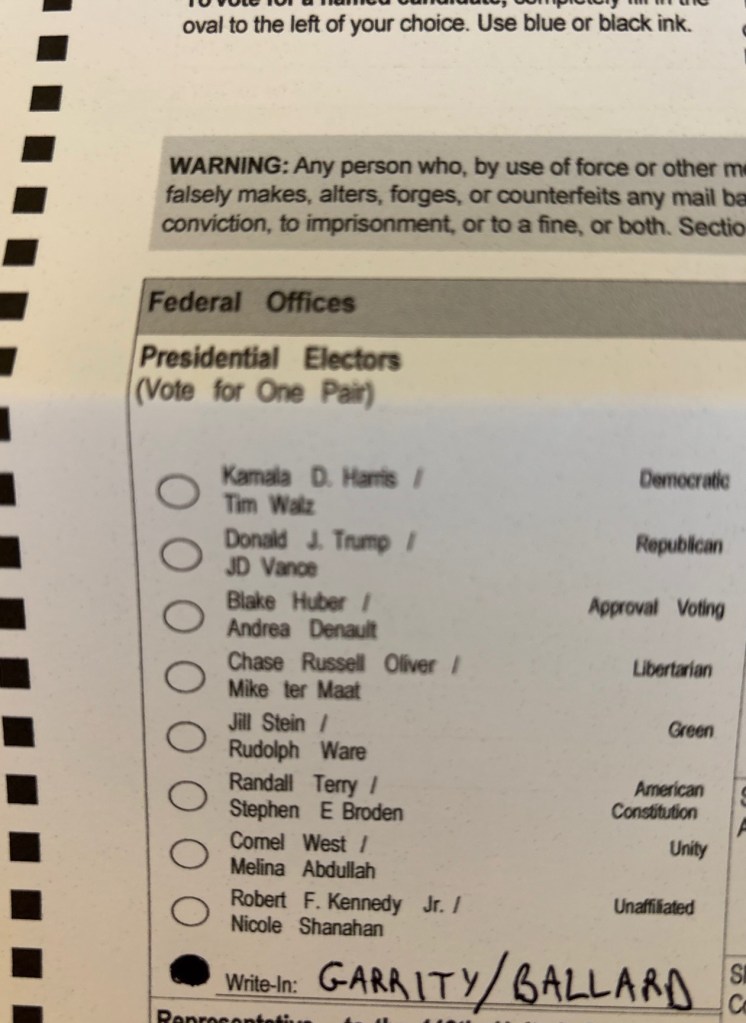
Okay. Back to the debate. Just about everyone on the continent tells me that I wasted my vote. I contend that I did not waste my vote in any sense different than you “wasted” yours. And I counter that it is foolish to believe that if you vote for Trump or Harris you have somehow not wasted your vote, somehow spoken in a more effective language. Or contributed to democracy or the country more than me. Or you have accomplished some civic duty, which I have not.
No, no, no. That’s wrong.
Don’t hear me suggest “fatalism”. I do not dryly believe “what’s going to happen is going to happen.” Please do hear me when I say your actions during this one, seemingly absolutely critical moment in time do not weigh more than your actions during all the other moments. I think I mean this in the biblical sense, introduced by the psalmist and highlighted by my namesake, “one day is like a thousand years, a thousand years like one day.” In short, all our votes are wasted because the notion of voting necessarily implies an incorrect perspective on life—even the life of a country.
Another way to talk about this point of mine that I here offer is to reminisce about the “How did we get here?” question that is terribly fun to debate.
I have yet to hear anyone suggest we got here because of folks’ past voting records (here being these two candidates, after the last two, after the last two, ad infinitum). Instead, the answers given are more provocative. “Education” (or lack thereof). “Immigration.” “Wars.” “Immorality.” “Russia” (meaning anywhere from the theory they have intentionally and strategically taken over the universities to the direct influence on elections). And many, many others. “Welfare.” “Military Industrial Complex.” “End times.” “Democracies only last 250 years, give or take.” Bluntly, then, I mean that if we do not cite our past votes in our answers to “how we got here?”, how could our votes ever be “how we achieve” whatever goal (political or otherwise) towards which we aim?
In the end, no, by writing in, I did not waste my vote any more than you did, you who chose one of the two candidates who possess a proper chance at winning. (Trump has it in the bag, never forget that.) So dismount your high horse, Citizen, and rest assured that in the not too distant future I will be lounging like a tree near streams of water with the knowledge that I didn’t let myself get caught up in the hype anymore than I did for Black Jesus (or Bush or Biden…).
This election is another referendum on how you (we) live your life. It should be interpreted as yet another instance of divine compassion. We’re mucking things up for sure down here. But Voting for Trump or Harris (or anyone) does not change your character. And believing that it does betrays a fundamental flaw in your understanding of life.
Vote or don’t vote, I don’t care. But I do care that you shape up. Turn off the TV. Use the newfound free time to exercise your mind, body, and spirit. The battle rages.
A Little Time Means A Lot Of Focus and Politics is Personal
As election day draws near, I cannot deny that my resolve not to vote for Trump began to waiver. Colorado is solidly blue, so a Trump vote would certainly be a wasted vote. Still, I was starting to feel like it would be fun to tell the grandkids that I was part of the unforeseen popular majority.
As I voted today, I just couldn’t do it. And with time running out, the underlying reason finally surfaced. (I don’t know why I didn’t see this happening; it always does. We veterans prefer working under pressure for the clarity it brings.)
The reason I can’t vote for Trump is because I can’t vote for Republicans. The Republicans were in power during 9/11. They had a chance to accomplish what no humans have yet accomplished, and they blew it—including wasting my time and energy by sending me to Iraq in response.
9/11 should have been used to relegate the false god Allah to the myths and legends section of libraries and bookstores. And the only way to do that is make supporting him deadly—which can be done directly or indirectly, but with intention, nonetheless. So many gods have perished. This shouldn’t be controversial. Instead, and unconscionably, the supposedly great Republican party* decided to lie and wage irrelevant (and illegal) wars under the guise of satisfying all interested players and offending no one.
So, no, I won’t buy into the same system that made that category mistake. Nations are okay, but gods are where the action is at.
Anyhow, I know my opinion is unpopular. So it’s not like I expected to find some candidate who wanted to lead and win the coming Holy War. But I also can’t vote for people who have had the opportunity to do so and dropped the ball. So I found the rules for write-in votes (you can’t just vote for anyone) and there is some random unaffiliated and normal looking citizen that satisfied the requirements for Colorado’s ballot and I voted for him. In other words, literally any average citizen is better than Trump/Harris and the major (and minor) parties. His name is Chris Garrity. Best of luck, man.
In short, with time drawing to a close, I have just now realized that, for me, politics is personal.
*To be clear, the Dems would have done no different.
 Captain’s Log