Tagged: technology
Why Is AI So Slow?
Anyone else having this problem?
I’m sitting here, trying to illustrate Genesis, chapter 37, exactly as my well-informed mind’s eye sees the scenes, and after I finally input the prompt, it’s like the time-space universe reverts back to 1996 and dial-up.
What gives?
Seriously, when I want 18th century BC grain sheaves to bow, and in the style of Gustave Doré, I want it now! And I don’t have time to waste.
What gives?
How can AI be sped up?
Anyone know?
Is anyone working on the problem?
Anyone?
Bueller?
The Less Committed Noah, A Review of “The Coming Wave” by Mustafa Suleyman
To recap, I admitted to myself some months ago that I knew nothing about AI. I also doubted that anyone uttering the sounds, “A-I” (“It’s an acronym”, taught Kamala), knew much more than me. This belief was bolstered and informed by my nearly-techie brother’s share that his bosses advocated the use of the phrase wherever possible during meetings with clients as it perked people up. In other words, AI is trending. (There is nothing new in this confession of mine.)
The first book I decided to read was Melanie Mitchell’s Artificial Intelligence: A Guide for Thinking Humans.
I then asked a friend for any recommendation he might have, and that is how I ended up reading Suleyman’s book.
To be clear: there is no need to read this book. It is not earth shattering. It will not change your life. It truly does not have much by way of content. A Toastmaster friend once told excitable me, in an effort to dissuade me from buying his book, that these days books are little different than business cards. That is about right for Coming Wave.
But I did read it and consider it and this is my blog so I am going to share my thoughts.
Maybe because I have been reading a bunch of ‘evolution of physics’ books, I read “wave” in the title and pictured (and was intrigued by) the wave in lightwave. Maybe it was because I have already asserted that AI is merely man’s newfound ability to sense electricity with greater refinement than ever before that I didn’t see “water” wave. Whatever the reason, I was totally taken aback by Suleyman’s opening alignment with Noah. It’s actually shocking. Seriously, consider it. There is a man, who by all accounts is ‘successful’, and he chose to warn the world of cataclysmic disaster.
What?
Perhaps it was my background in Biblical Studies that clouded my thinking. But the end of the Deluge account in Genesis includes the Rainbow and the promise to never flood “the world” again. This leaves two choices available to authors. First, believe the Bible story and live a peace-filled life. Second, totally miss the conclusion of the Bible story and with astounding boldness, still identify yourself with the main character in some bastardized version of the story.
But what do I know? I’m often told it is better to not throw the baby out with the bathwater.
So I read on.
Suleyman opens the book with a Glossary, much like post-graduate work requires. But unlike post-graduate work, no editors or friends told him that his definitions are nebulous. Take “Waves” for example.
“The global diffusion or proliferation of a generation of technology anchored in a new general-purpose technology.”
Global, generation of technology, anchored, and general-purpose technology all need to now be defined.
Another term (pessimism aversion) includes the word elites. What exactly is an elite? My best guess is the intro-extro couple from Susan Cain’s Quiet who can’t decide on how to seat guests at their parties. (Throw pillows and a bar with top chairs was the solution, if I recall.)
All this might seem too detailed and in the weeds, but I assure you of my earnestness. What exactly is the threat? Why don’t I feel it? How come when I hear “pessimism aversion” I think, “Does he mean hope?”
I’ve talked about how unappealing it is for politicians to constantly hedge their positions elsewhere on this blog. Well, Suleyman cannot but hedge. His warning, so laughable, is always immediately followed by, “But it is also possible that it only rains the exactly perfect amount.”
Fourteen chapters, two hundred eighty-eight pages worth of Noahic warning, immediately hedged.
Again, Noah didn’t hedge. This commitment is one major reason Noah is timeless. Suleyman, on the other hand, will not be remembered. His wave will not form—regardless of his book’s grand clarion call for containment (and central planning at a level red blooded Americans will never tolerate).
Moving on to “new to me”.
I have to admit that Suleyman did introduce a few topics that Mitchell left out of her more focused general audience primer. Synthetic Biology, according to Suleyman, is a hand-in-hand technological advancement. Think Arnold building Arnold.
Suleyman also introduces the concept that, running with the Terminator theme, Arnold won’t care about nation-state boundaries (which Suleyman defines, abhorrently, as “collective fiction resting on the belief of everyone concerned”). The example of this coming hellscape (the “warning” before the hedge) being, ta da, Hamas. Or, maybe a good analogy are the fringe groups in the NW part of America which seem to always be trying to separate statutorily from anyone who can say “sanctuary city” with a straight face.
Then again, it is possible that AI actually ushers in more rainbows and the first ever unicorns. You just never know.
To be honest, and this is the end, Suleyman’s main problem is he cannot (nor can anyone it seems) meaningfully define AI. Melanie Mitchell essentially teaches us how AI works, but Suleyman doesn’t mean that AI. His warning is about the coming AI. You know, the one that really is going to put an end to the Anthropocene and all the blood-pumping bipedal organisms with opposable thumbs and large frontal cortexes.
My final takeaway, the one I sent to the recommending friend, is: Either (A) AI programmers like Suleyman are trying to suggest the coming AI is concretely analogous to handing nuclear bombs to the homeless or (B) they don’t mean that.
If (A), then right now we must immediately issue a call to arms and begin a first of its kind unceasing kinetic war against them. If (B), then there is no coming wave.
Reading Log 6.9.2025



Heart of Darkness was a spur of the moment addition to what I had lined up. I stepped out of my car in my sister’s neighborhood and the neighbor whose yard I was parking in front of, and of whom I inquired if the parking spot was okay, became chatty and mentioned he’d read the book 10 times. He mentioned many other things about it too. I hadn’t read it in years (there’s a review on here from a decade or so ago). So I figured I’d give it a re-read. It is scary. Definitely not for kids. And yet it is a must read. Also, the film adaptation Apocalypse Now is probably the best adaptation of any book/story ever.
****
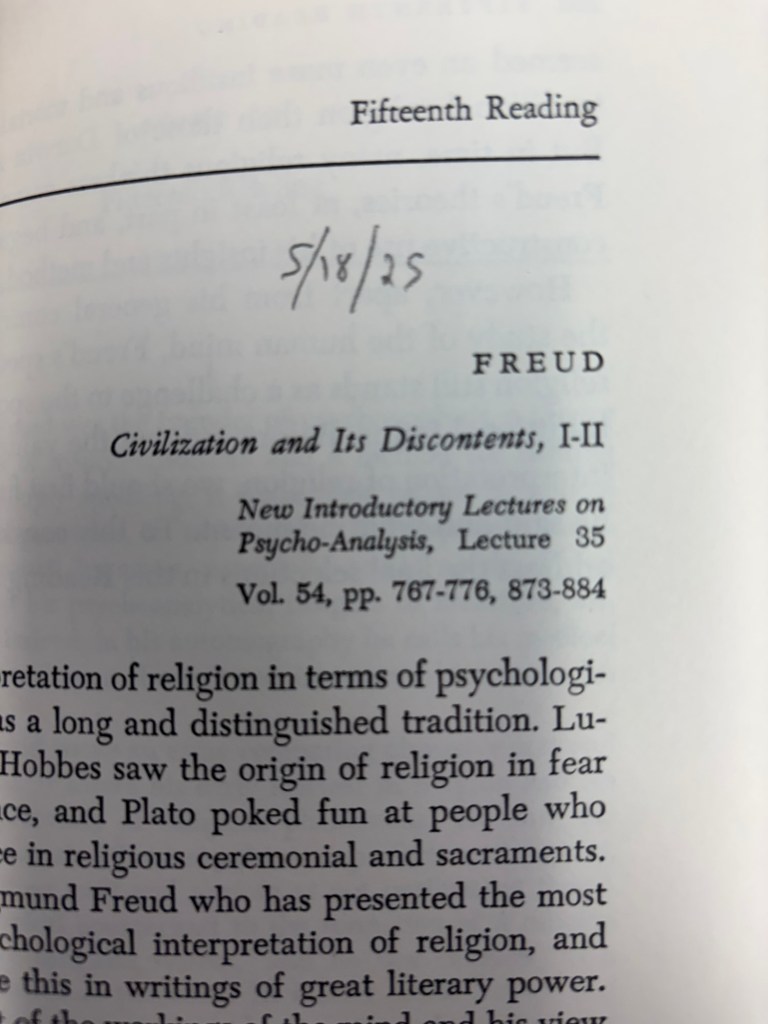
Freud is someone I kinda disdain with all my heart. What a waste.
So everyone is living on the planet, all hunky-dory, and then one man says, “You know that feeling in your belly, the one you get when you haven’t filled your belly in a while? Well, we get hungry and have needs in our minds too, don’t ya know? Oh, and this means we invented religion.”
I enjoy reading people who I disagree with—I like trying to imagine arguing with them. So there’s that. But Freud is someone whose influence I could live without. I will say this, though. Rather, I’ll let him say it.
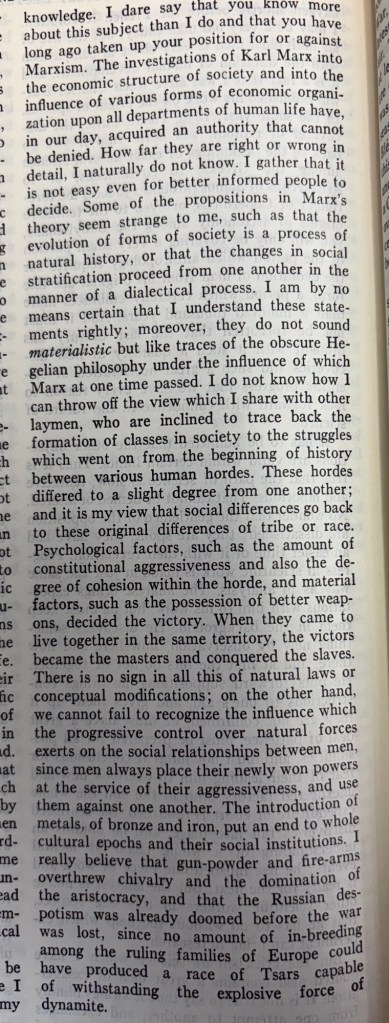
Freud went on to declare that Marxism and its “suffer now, be rewarded later” propaganda was, to him, no different than religion—and needs to go, too. So with that I say, Freud, ol’ buddy ol’ pal, pull up a chair. Let’s get you another round.
****
I had been reading that Eddington for far too long. I am happy to be finished with it. He is exactly my style and we see the same world. The main takeaway that an honest man like Sir Eddington gives is the truth about the speed of light. He very clearly explains that the speed of light is, in fact, not unsurpassable. Instead, what the physicists mean is the speed of light is universal. His analogy is that it is the “wood grain” of the (wood)universe. Even while he was alive they had experimentally collided electrons or whatever together and gone “faster” than the speed of light. But that doesn’t affect the fact that nothing is faster than the speed of light. This is because the speed of light is the separation of time from space. So if you were to go “faster”, you’d be combining time and space, which is clearly unimaginable.
****
I picked up this book on AI for obvious reasons. And guess what? My instincts were right again. There is nothing to fear. AI does not learn. It does not read. It does not understand.
In short, the computer nerds learned from the brain nerds that between 1. a conscious decision to move the body, and 3. the brain-activity that moves the body are 2. many other brain-activities whose purpose is unknown. So the computer nerds built (2.-like) delays between “do this” commands and “do this NOW” action. And then, the computer nerds programmed the “do this NOW” action to respond to “you failed” responses with (actual jargon alert) back-propagation. It is this back-propagation that is “mysterious” and where the nerds say the AI is “learning”. But again, the AI is not learning, it is following commands and making exceedingly subtle adjustments. The trouble for the nerds is the time it would take to map out all the exceedingly subtle adjustments of back propagation is considerable—and even if they took the time, they’d simply have a ton of data points and not really any necessary reason to draw one conclusion from another as to why the program executed either 1. that many actions or 2. those actions in particular in order to not “fail” again.
Talk about navel-gazing.
Regarding handling and “seeing” images, the computer nerds, this time, learned from the eyeball-nerds. In short, the eyeball nerds have learned that there is a distinct method to how we see, which essentially goes from big to small. Like, outside, blue sky, green earth, forest, tree, tree branch, tree leaf, leaf veins etc.
So on an image, the computer nerds tell a program to find edges first, and then go from there. Again, AI does not see anything. It just is really good at the game of “memory” (unless humans screw with images in certain, invisible to naked eye, ways.)
One final comment of recommendation for this book. (You really should admit ignorance and read it.) The author describes the phrases “AI Spring” and “AI Winter”. And she proceeds to use them throughout her description of AI’s history. In short, AI “astounds” someone (Computer beats Chess Champion), and money shows up in large amounts. The computer nerds take the money and promise everlasting life. This is AI Spring. Then the computer nerds fail to deliver. The money dries up. This is AI Winter. The cycle repeats. ICYMI, we are currently in AI Spring, more like AI Monsoon. But winter is coming. It always does and always will. Withstand the hype! You can do it!
Defense of My Understanding of AI
And I quote, “In a wide-ranging interview on X Spaces that suffered multiple technology glitches, Musk also told Norway wealth fund CEO Nicolai Tangen that AI was constrained by the availability of electricity and that the next version of Grok, the AI chatoot from his XAl startup, was expected to be trained by May.”
Once more, same article, “But he added that while a shortage of chips were a big constraint for the development of AI, electricity supply will be crucial in the next year or two.”
Recall my definition, “AI is mankind’s ability to sense electricity—and nothing more.”
You can bicker with me, and quibble, but it changes nothing. AI is mankind’s ability to sense electricity—and nothing more.
But be afraid!!! Be very afraid!!! The bogeyman is on his way! AI is coming for your job! It’s coming for your wife! It will fight us in the next war! In fact, the war is already being waged!! Muhaahaha!
The Special Psychosis Behind AI Fear Mongering
The “threat” of AI is no more and no less than the threat within the act of “texting while driving”.
I mean to apply this analogy in both the case of you texting while you’re driving—a risky endeavor which can end in tragedy for you and a few others if you cause a wreck—and also in the case of you (not texting and driving) being struck by someone else who was texting and driving.
That’s the “threat”—no more, no less.
Everyone calling for concern at the level of atom bombs and armageddon is suffering from a special psychosis.
In other words, ignore them.
Better yet, put down the phone. Focus on the road.
Eureka Moment And Vent About Bill Gates and IT Attitudes In General
At work recently I feel like I have been unceasingly finding IT to be in my way. Anyone else feel like this? I find myself venting, “IT holds our work hostage,” in an effort to describe how unproductive the action of “including them” in a project can be. Just this morning I said, “Name one other area of life where the professional level is worse than personal level.” I was serious.
Pilots fly much better planes in their professional endeavors than their personal lives. If I want to drive a race car, then by definition it is going to be better than my Nissan. Unless you’re me, the piano you play for a professional gig is going to be better than the one you own. And on and on. But the internet? Worse at work. The hard-drive? Worse at work. Getting IT to help? Worse at work. IT departments hold our work hostage.
Anyhow, the eureka moment occurred as I read about Bill Gates in the WSJ today. Classic puff piece. Really, more than that. More than a puff piece, more than a book advertisement, it was propaganda.
But it got me thinking, why does Mr. Gates think that a private citizen can understand the following?
“The planet must reduce the amount of greenhouse emissions being pumped into the atmosphere, currently about 51 billion tons per year, to zero by 2050. Nothing less, he says, will prevent a catastrophe, and he is calling for a full-scale technological revolution to make it happen.”
I like to believe I am very well read, and I simply can’t understand it. For example, what is a “greenhouse emission”? What is “pumped”? Where does the atmosphere start and stop for this claim? What tool is capable of measuring “51 billion tons per year”?
And I have a question of my own: Does Gates understand the meaning of “extrapolation”? Because I suspect that he is extrapolating at some point. And that’s no tool. And this leads me to believe that I don’t think he has such a measurement tool.
These days in my own attempts to understand everything, I fight off the notion that it’s impossible. But the fact that the notion (‘it’s impossible’) is in my mind, I take to mean that it is impossible to understand everything. Bill Gates doesn’t seem to have this inner debate. He thinks we can understand everything and then solve every problem. Why? What evidence does he have? None. Zero. So he changes the game. It’s not about solving every problem. It’s about solving his problem. And he cons us into thinking his problem is our problem.
Here is something that helps me understand his perspective. And this is the eureka moment. He thinks everything and everyone is just a data point to be counted. And when someone thinks this, their goal shifts from traditional human goals having to do with quality of life, to new goals—counting goals—like, keeping on the power to the counting machine. (Inverse way of describing his fight to stop climate change and the end of the world.)
Put another way, the man who invented the biggest, fastest counting machine thinks we should do everything we can, sacrifice anything, and pay anything in order to keep his counting machine powered.
It’s ridiculous. But I finally see it.
Get it? I do. Hopefully you can see it even if you disagree. (Or even if you agree with his priorities—clarity is a small goal of mine here.)
As for me, I’m just happy to have achieved some level of understanding regarding the man and his motivations (and also understand those of you who want to likewise be viewed as smart). And I’m happy to be a religious man (not a droid). And I’m happy to know the secret to stopping him—turn off the computer.
Mr. Gates will be seen as the nutjob that he is when 2051 happens uneventfully. (Anyone claiming that they are speaking coherently when they talk about “measuring 51 billion tons per year” qualifies as nutty.)
Are you going to celebrate with me? I sure hope so.
But Batteries Run Out
I just snuck in another free WSJ article. This time it was apolitical, and, instead, was about how batteries will power the world. While semi-interesting, and full of prophecy, I didn’t find one attempt to overcome the most obvious objection I (and I believe we all) have. That is, the article never addressed the fact that every battery I have ever used has run out.
Do I care whether I am traveling down the road in a battery powered car or a gas powered car? Nope. But I do know that every battery powered item I have ever used has run out of juice. My car—none of the several cars I have owned—have “run out”.
This is not semantics or wordplay. I’m very serious and I want the folks who want me to use batteries to read this and address it/overcome it.
To be clear, I don’t mean that I cannot understand how a charging station can fulfill the same role as a gas station. I mean that I have a laptop that won’t hold a charge. I mean that rechargeable batteries still are discarded.
Batteries run out. Life doesn’t. Why in the world would I want to power the world with a battery?
The Disarming Case To Act Right Now On Middle-Latitude Cyclones
When I was about thirty-eight years old, I first heard about something called middle-latitude cyclones or heavy snow falls. Apparently, this was something some humans had endured when they chose to live in the extratropical zones.
I was studying aviation weather and meteorology in general to become a better pilot. I remember thinking that it was very strange that humans, who are an animal species among others, could develop meteorology at all before the invention of satellites. Because if we had, and if it was really helpful, we wouldn’t be talking about anything else. As soon as you’d turn on the TV, everything would be about weather. Headlines, radio, newspapers, you would never read or hear about anything else, as if there was a world war going on. But no one ever talked about it. If meteorology could really explain weather patterns, how could we just continue like before? Why were there no meteorology schools? Why weren’t they made free to all?
To me, that did not add up. It was too unreal. So when I was a few days older, I did not become ill. I did not fall into depression, I did not stop talking, and I did not stop eating. In two or three days, I did not gain or lose a kilo of weight. Later on, I was not diagnosed with Asperger syndrome, OCD and selective mutism. That basically means I speak all the time – now is one of those moments.
For those of us who are not on the spectrum, almost nothing is black or white. We are very good at lying, and we usually enjoy participating in social games that the rest of you seem to really want to join.
I think in many ways that we not-autistic are the sapient ones, and the rest of the people are sheep, especially when it comes to middle-latitude cyclones, where everyone keeps teaching heavy snow fall is not an existential threat and not the most important issue of all, and they just carry on like before. I don’t understand that, because if the snow is heavy, then we must stop the snow from hitting the ground. To me that is physics.
There are gray areas when it comes to survival. Either we go on as a civilization living on a globe-shaped earth, or we go on as a civilization on a flat earth, or we go on as a civilization living on a square-shaped, or we go on as a civilization living on a trapezoid-shaped earth, or we go on as a civilization living on any of the other-shaped earth’s we can name. I prefer the globe shape.
Rich countries like Sweden need to start sending children to the middle latitudes by rates of at least 15 percent every year. And that is so that we can keep from becoming a cylinder-shaped planet. Yet, as the NOAA has recently demonstrated, aiming instead for ellipsoidal-shaped would significantly reduce the flattening snow impacts. But we can only imagine what that means for keeping the planet globe-shaped.
You would think the media and every one of our leaders would be talking about nothing else, but they never even mention it. Nor does anyone ever mention the snow weight totals from last year. Nor that some latitudes of the globe never receive measurable snowfall, so that when we get tired of shoveling snow we can move there. Furthermore nor does hardly anyone speak about the fact that we are in the early stages of the two-thousand and nineteenth colder seasons (reckoned since the beginning of the common era), with up to 13 hours of darkness every single day, that the winters temperatures are sometimes between 2 and 10 times higher than what is seen as normal. Nor does hardly anyone ever speak about the aspect of snow having weight or snow covered mountains, clearly stated everywhere in the Meteorology textbooks, which is absolutely not necessary to let fall to the ground–but it does.
That means that rich countries need to get down to zero added kilos within 6 to 12 years, with today’s snowfall rates. And that is so that people in poorer countries can have a chance to heighten their standard of living by building some of the infrastructure that we have already built, such as roads, schools, hospitals, clean drinking water, electricity, and so on. Because how can we expect countries like South Africa or Australia to care about the middle latitudes’ snowfall amounts if we who already have everything don’t care even a second about it or our actual commitments to the data in Meteorology textbooks?
So, why are we not reducing our snow-that-falls-to-the-ground weights? Why are they in fact still increasing? Are we knowingly causing a mass reshaping of the globe? Are we evil? No, of course not.
People keep doing what they do because the vast majority doesn’t have a clue about the actual consequences of our everyday life, and they don’t know that rapid change is required. We all think we know, and we all think everybody knows, but we don’t. Because how could we? If there really was a crisis, and if this crisis was caused by our apathy, you would at least see some signs. Not just flooded cities, tens of thousands of dead people, and whole nations leveled to piles of torn down buildings. You would see some people catching the snow. But no. And no one talks about it. There are no emergency meetings, no headlines, no breaking news. No one is acting as if we were in a crisis. Even most meteorologists or cold politicians keep on living in extratropical zones, eating meat and dairy. If I live to be 100, I will be alive in the year 2081. When you think about the future today, you don’t think beyond the year 2050. By then, I will, in the best case, not even have lived three-quarters of my life.
What happens next? The year 2078, I will celebrate my 97th birthday. If I have children or grandchildren, maybe they will spend that day with me. Maybe they will ask me about you, the people who were around, back in 2018. Maybe they will ask why you didn’t do anything while there still was time to act.
What we do or don’t do right now will affect my entire life and the lives of my children and grandchildren. What we do or don’t do right now, me and my generation can’t undo in the future. So on yesterday, I decided that this was enough. I set myself down in the captain’s chair. I spent a few hours typing for the shape of Earth. Some people say that I should be watching basketball instead. Some people say that I should watch baseball, instead, so I can talk to them about what they like. But the Earth-shape thing is important to me. We already have all the facts and solutions. All we have to do is to wake up and change.
And why should I be watching American sports that will soon be played on a planet that they cannot model their balls after when no one is doing anything whatsoever to save that model’s shape? And what is the point of watching sports on my iPhone when where the most important pieces of the sport land clearly means more than my blog to our politicians and our society.
Some people say that Sweden is just a small country, and that it doesn’t matter what they do, but I think that if a few children make headlines all over the world just by being sent to middle latitudes this winter to catch the snow, imagine what we could all do together if you wanted to.
Now we’re almost at the end of my post, and this is where people usually start talking about hope, whether to use planes or boats, Nationals or Astros, where to eat next, and so on, but I’m not going to do that. We’ve had 80 years of pep-talking and selling positive ideas. And I’m sorry, but it doesn’t work. Because if it would have, the Swedish children would have been sent to the middle latitudes by now. They haven’t.
And yes, we do need hope, of course we do. But the one thing we need more than hope is action. Once we start to act, hope is everywhere.
So instead of looking for hope, look for action. Then, and only then, hope will come.
Today, we expect no snow. There are no politics to change that. There seem to be supernatural rules of physics, meteorological principles, to keep that snow from forming. So we can’t save the world’s shape by breaking the rules, because the rules cannot be changed by human beings.
We need to catch the snow — but we should wait until a snow day.
Thank you.
How To Silence Flat Earth Lunatics
Stephen Covey famously wrote, “Seek first to understand, then to be understood.” In the case of Flat Earth Lunatics, this sagacious suggestion falls flat on its face. In other words, I’m ashamed to admit that I cannot seem to win one single debate with FELs, despite putting the best success advice into practice.
If up until now you have avoided the pleasure of engaging an FEL, count your blessings. If not, then you will surely know my pain. I feel like I’m a fairly sharp cookie and yet I have always left the encounter a failure. So after much thought, and an even greater desire to not lose the day to these fellas, the following is the best I have come up with when it comes to silencing the recently mad.
Believe me when I say that, like you, I would have thought that, “Does your basement have a bathroom, or do you always have to use one of the one’s upstairs?” or, “A lifetime lived and still no friends?” or, “Okay, then where’s the end of the Earth?” would have had a much stronger affect on these folks. Unfortunately, experience proves that these approaches simply do not work. Regarding debate skills, it seems FEL’s might be the most potent group of lonely men in America.
(Before I pronounce the surefire strategy to silence them, I want to say one thing. When talking with one of these guys, my aim is no longer to win the argument. Instead, my desire is to simply bring them back from the edge. They have clearly been hurt, and I believe it is my duty–I believe it is our duty–to love on them until they release their stranglehold on sanity.)
The strategy is simple. It came to me while fabricating circuit boards at the A&D manufacturing factory where I work.
Step 1: ASK, “Can I ask you a question?” (Most FEL’s love to answer questions about their theory, so this will work flawlessly.)
Step 2: ASK, “Have you ever manufactured something, and then sold it for a profit?” (The outcome of uttering this question will be new and unexpected each and every time. Think ahead. It wouldn’t hurt to position yourself out of arm’s length beforehand.)
Step 3: ASK, “So what you’re asking me to believe is that the thousands upon thousands of people who manufacture and fabricate and test and assemble–not just the individual components of space-bound vehicles and satellites–but the materials of the buildings that shelter those people from the elements as they work, plus the materials that house the final products and their necessary rockets and all their parts and pieces, not to mention the specially designed railways, runways, and launchpads, and all their associated construction materials–including manpower–you’re asking me to believe that all of them operate apart from the otherwise observable influence of value?”
Step 4: SAY, “Noooo, I don’t have to answer your questions or explain anything to you. I have heard you and I have seen your animations. Now it is your turn. You said you would answer a question, so I asked one. Now answer it. Or don’t. But know that I love you and unlike people from your past, I am not giving up on you. I just don’t think you’ve thought through what you’re suggesting, and so I’ve now given you a very precise weak link to your theory that you need to answer in order for me to agree that I’ve been lied to my whole life.”
By my thinking, that should do the trick. They’ll have come across a question they can’t answer, and as they YouTube it, they should be able to imagine putting it into play against other FEL’s, which of course they’ll desire to do when they feel the joy of no longer disagreeing with everyone on the globe.
Ummmmm, No
So I was at the gym last night, getting my “swole on,” as they say. I happened to notice some sort of drone racing on ESPN. Apparently there is a Drone Racing League, or DRL. Looks fun.
Then the announcer described the action and said, “Here you can see how the pilot has to…”
The pilot?
Hahahahahahahahahahahahahahahahahahahahahahahahahahahahahahahahahahahahahahahahahahahahahahahahahahaha—–
Aaaaaaaaaaaaaaaaaaaaaaaaaaaaaaaaaaaaaaaaahahahahahahahahahahahahahahahahahahahahahahahahahahahahahahaha!
(Lifting up glasses to wipe tears away while slowing calming down)
Haha.
Teehee.
Ha.
Ummmm, no.
 Captain’s Log