Tagged: reviews
A “Perfect 10” Day
There’s scene in the infamous Nick Cage film “Con Air” where a someone reads a letter from his kid which includes childlike exuberance at all the synchronicity that is unfolding. Something like, “Today is my birthday. Today is my dad’s birthday. Today is the day my dad gets out of jail. Etc etc.”
Heartwarming stuff.
Today, I feel exactly like that kid. It’s going to be a great day!
This is due to the fact that I am about to finish the last 70 odd pages of the 10th Volume of the 10 Volume Gateway to the Great Books series! And today’s date is the 13th, which is 3 plus…10! And right now we’re in the…10th hour of the day! And the authors of the day all once were 10 years old!
Thoughts On Metallica’s Denver Shows
I stood in awe on Night One when they entered Mile High. And I never sat down again. The professionalism, the polish, the poise—it’s perfect. I do not attend many concerts (mostly Metallica and various symphonies) but Metallica is doing something other musicians aren’t. Which leads me to my next thought.
Is it time? Can we finally admit that Metallica just writes better songs? Their songs are just better. That’s why their fanbase is among the largest ever amassed.
Night One, as I said, I stood the entire show. I was in section 309–essentially the fifty-yard line—half-way up the section. Pretty great seats. At times, between songs, I spun around to see how the crowd was doing and was surprised to find them all sitting. “Oh well. No problem,” I thought. “I’ll just motivate them.” And I did. Metallica was down there giving us their all, the least we can do is give our all. Some, not all, got the memo.
Night Two (last night), after Pantera, before they took the stage, I felt a tap on the shoulder and turned around to see a man signaling the lady two rows up is who wanted my attention. As my eyes continued the journey, they landed on what we all would’ve recognized as our high school Algebra 2 teacher. Undeterred from having a good time, I immediately said, “Are you ready!?” She gave me a, “Yes.” And then she proceeded to describe to me how horrible it was on Night One because I stood and blocked her view. Naturally she followed this speech by asking, “At least on a couple songs could you sit down?”
Wow.
Given the movie that recently released, and using the 10% truth rule of Air Force Performance Reports, I asked her, “Did Metallica save your life?”
She didn’t seem to get it.
The other fans were only mildly interested in this back-and-forth. I listened for longer than any heathen fan would have and dryly concluded, “I will be standing.”
She continued to lament to all around her in a whiny, relentless, disbelieving manner (partly ashamed she had asked such a thing, I had to imagine) and I turned to acknowledge her again—again, trying to show respect for her effort. This time, because it was loud, I randomly found myself making the “sorry” ASL fist circle over my heart, which drew a laugh from a mom my age, there with her husband and their teenage daughter. I can’t be sure she “signs” but I think she could “feel” the moment and appreciated my attempts to respect this Miss Nelson, or Mrs. Tietz as it were if memory serves.
“Metallica is Metallica.” Integrity in the flesh. That might sum my thoughts up best. They don’t pretend. They are just simply the best band on the planet, writing the best songs—the definitive band. We can all learn from Metallica. We all owe Metallica. The influence of Metallica is worldwide and enduring.
Was that it? That’s my only question. Will I ever see them perform again? Lars was more vague than normal on his, “Denvah!! We’ll see you again not soon enough!” farewell.
I don’t enjoy the thought that that was it for me. But I do think the world will witness something unlike it has ever seen when the actual end comes for them. What king, what leader, what celebrity has ever accomplished so much for so many?
No, ma’am. People don’t “sit for a couple songs”. When people have taken full account of their lives, people stand for Metallica.
(And for the “W” see this clip from after the show and after the lights came on.)
On the Perfection of the Bite of EMB
When the entire topping comes off the dough at once, the flavor is out of balance.
But let me be clear: when you bite into a slice of Little Caesar’s Extra Most Bestest Pepperoni and the sauce temp and amount is not so hot or plentiful as to give caution to the maneuver, I’m talking about the act of cleanly biting off a piece from the pizza slice, you are nearer heavenly rhapsodies than even the inspired writers of scripture could express in words.
In a word, it is perfection.
Reading Log 6.9.2025



Heart of Darkness was a spur of the moment addition to what I had lined up. I stepped out of my car in my sister’s neighborhood and the neighbor whose yard I was parking in front of, and of whom I inquired if the parking spot was okay, became chatty and mentioned he’d read the book 10 times. He mentioned many other things about it too. I hadn’t read it in years (there’s a review on here from a decade or so ago). So I figured I’d give it a re-read. It is scary. Definitely not for kids. And yet it is a must read. Also, the film adaptation Apocalypse Now is probably the best adaptation of any book/story ever.
****
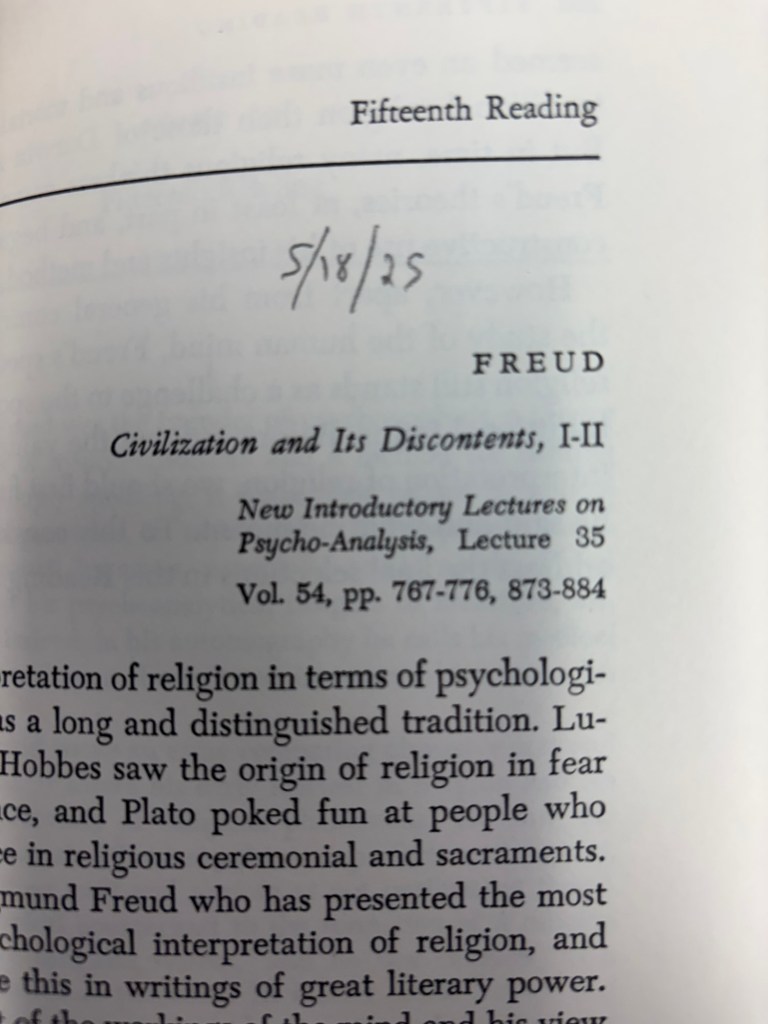
Freud is someone I kinda disdain with all my heart. What a waste.
So everyone is living on the planet, all hunky-dory, and then one man says, “You know that feeling in your belly, the one you get when you haven’t filled your belly in a while? Well, we get hungry and have needs in our minds too, don’t ya know? Oh, and this means we invented religion.”
I enjoy reading people who I disagree with—I like trying to imagine arguing with them. So there’s that. But Freud is someone whose influence I could live without. I will say this, though. Rather, I’ll let him say it.
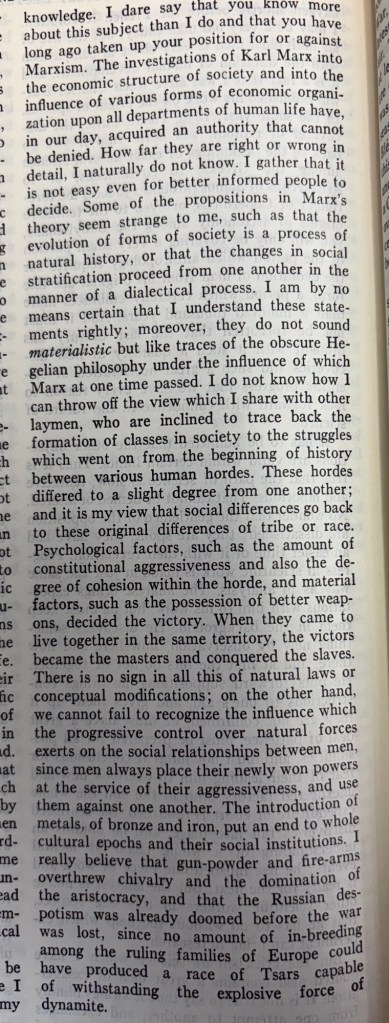
Freud went on to declare that Marxism and its “suffer now, be rewarded later” propaganda was, to him, no different than religion—and needs to go, too. So with that I say, Freud, ol’ buddy ol’ pal, pull up a chair. Let’s get you another round.
****
I had been reading that Eddington for far too long. I am happy to be finished with it. He is exactly my style and we see the same world. The main takeaway that an honest man like Sir Eddington gives is the truth about the speed of light. He very clearly explains that the speed of light is, in fact, not unsurpassable. Instead, what the physicists mean is the speed of light is universal. His analogy is that it is the “wood grain” of the (wood)universe. Even while he was alive they had experimentally collided electrons or whatever together and gone “faster” than the speed of light. But that doesn’t affect the fact that nothing is faster than the speed of light. This is because the speed of light is the separation of time from space. So if you were to go “faster”, you’d be combining time and space, which is clearly unimaginable.
****
I picked up this book on AI for obvious reasons. And guess what? My instincts were right again. There is nothing to fear. AI does not learn. It does not read. It does not understand.
In short, the computer nerds learned from the brain nerds that between 1. a conscious decision to move the body, and 3. the brain-activity that moves the body are 2. many other brain-activities whose purpose is unknown. So the computer nerds built (2.-like) delays between “do this” commands and “do this NOW” action. And then, the computer nerds programmed the “do this NOW” action to respond to “you failed” responses with (actual jargon alert) back-propagation. It is this back-propagation that is “mysterious” and where the nerds say the AI is “learning”. But again, the AI is not learning, it is following commands and making exceedingly subtle adjustments. The trouble for the nerds is the time it would take to map out all the exceedingly subtle adjustments of back propagation is considerable—and even if they took the time, they’d simply have a ton of data points and not really any necessary reason to draw one conclusion instead of another as to why the program executed either 1. that many actions or 2. those actions in particular in order to not “fail” again.
Talk about navel-gazing.
Regarding handling and “seeing” images, the computer nerds, this time, learned from the eyeball-nerds. In short, the eyeball nerds have learned that there is a distinct method to how we see, which essentially goes from big to small. Like, outside, blue sky, green earth, forest, tree, tree branch, tree leaf, leaf veins etc.
So on an image, the computer nerds tell a program to find edges first, and then go from there. Again, AI does not see anything. It just is really good at the game of “memory” (unless humans screw with images in certain, invisible to naked eye, ways.)
One final comment of recommendation for this book. (You really should admit ignorance and read it.) The author describes the phrases “AI Spring” and “AI Winter”. And she proceeds to use them throughout her description of AI’s history. In short, AI “astounds” someone (Computer beats Chess Champion), and money shows up in large amounts. The computer nerds take the money and promise everlasting life. This is AI Spring. Then the computer nerds fail to deliver. The money dries up. This is AI Winter. The cycle repeats. ICYMI, we are currently in AI Spring, more like AI Monsoon. But winter is coming. It always does and always will. Withstand the hype! You can do it!
On The Highly Placed Women Of Mission Impossible: The Final Reckoning
The only criticism I dared mention to my group after the movie (it was midnight and we were tired) was, “I think they went a bit overboard on the ‘women as leaders’ part. I mean the President, the aircraft carrier boss, the president’s close friend/cabinet member, both Osprey pilots, and even a Navy SEAL with the biceps of a 15 year old boy. It was a bit much.”
For this blog, forget the twin aspects of whether women should be in those roles and whether women ever would be in all those roles together. Instead, consider the following.
Before AI, Hollywood didn’t make movies with that many women in leadership roles.
In other words, the rise of Hollywood’s portrayal and seeming belief that it is important and necessary to portray women in leadership roles if we want women to actually be accepted as leaders across the board, but especially in areas that are traditionally male dominated, has come about at precisely the same time that AI is “taking over”.
Coincidence?
Irrelevant?
Boring to consider?
Or maybe there is fruit in the consideration of just how this pairing happened and its meaning—especially if men invented AI.
Just thoughts.
“Bare All” vs. “For All”, A Joint Review of The Return by Uberto Pasolini and Mission Impossible: The Final Reckoning by Christopher McQuarrie
I have always longed to be absolutely open-minded when it came to art. At an early age I was aware there were art critics who could find and explain beauty and power and relevance in art that I generally found unappealing. “What do they see?” was my question. This was followed closely by, “Will I ever see it?”
Ralph Fiennes has a full frontal nude shot in Mr. Pasolini’s telling of “The Odyssey.” I really want to understand why. My guess and how I understood it was it provides fodder for reviews like this one. He gave me the line, “Like Ralph Fiennes’ bold nude scene, Pasolini’s film presents Homer’s epic as nakedly as ever. It’s a ‘Just the facts, ma’am’ retelling.”
Then I would add, “Unfortunately, whatever he was aiming for, it hits more like a Cliff’s Notes summary of the definitive epic than a masterful adaptation. The poem is more than the naked delivery of facts because beauty, power, and relevance demand more.”
Tom Cruise, on the other hand—while still baring much epidermis—does not bare all in Mr. McQuarrie’s latest and final(?) Mission Impossible installment. Why not? There are probably many reasons. Surely near the top is his desire to make a movie which will entertain every living human on Planet Earth, now and forevermore.
We all already knew China was important to him (ref: Taiwan flag removal on leather jacket in TG2). He released this one in Tokyo, I gather. So there’s that. But we’d be fooling ourselves if we thought only in terms of round eye and slant eye. He wants all of us.
For me, there is a blandness that necessarily accompanies this approach to universal art. It is best captured by how jokes, to be funny, must remain particular. “A priest, a nun, and a monk walk into a bar” works. “One religious man, one religious woman, another variation of a religious man walk into a workspace” does not work.
So when art is made, for me, the same applies. There is a requirement for creating something that ensures there is some level of audience guaranteed to understand it, but if you worry too much about this and try to be certain that everyone will understand and not be offended etc, then you lose the point.
To this I will add and conclude that what TC and McQ made is beyond this attempt at universality. They aimed so high and are such capable men that they achieved something truly remarkable. I mean that I believe they fulfilled their goal. It’s not a perfect movie. But it is a movie that every living human being on Planet Earth will enjoy, now and forevermore.
Reading Log 4.9.2025


Same for Vol 2 as I said about Vol 1, “Grant’s memoir was amazing and astounding on nearly every level. What a time to have been alive.”
****
Re: Pilgrim’s Progress: I will share the text I sent to a friend.
“On another subject, I finally started John Bunyan’s famous ‘Pilgrim’s Progress’.
Four chapters in and I would say this book may be more valuable to Christianity than the Bible itself. One more entry in the matter of ‘what a shame that folks have dropped it out of vogue’.
If you want a copy, I can send one to you. It is part of our homeschool set.”
(Obviously I would need a GoFundMe account to accomplish this for the world’s population. But if you are serious that all you need is a copy to get you reading, my offer stands. Comment below or email me. We’ll get you one.)
****
I have read tons of Mark Twain. Or it feels like it. But I had no idea about Mr. Wilson and the twins. Twain is ridiculous. I always thought he was hilarious, as evidenced here again, but these open the “ridiculous” description too. And watch out! The “n” word is on full display as he calls into question everything you have ever thought about life on earth.
****
The reason you read Pascal is to see for yourself that these “greats” are impossible to justly or sufficiently summarize. The infamous “wager” is far more involved than how it typically is presented.
****
The math essays don’t teach you particular skills, but they are interesting and do contain such marvelous sentiments, found curiously nowhere else, as, (paraphrasing) “We don’t need to think more. We need to think less. We need to accomplish as much as possible with as little thinking. That is true advancement.”
Oh, and if you want a single essay as an icebreaker, to test the waters, it’s Euler’s hands down. “The Seven Bridges of Königsberg.” See here.
****
I like writing these updates. But I wonder if anyone will ever use them as intended. Time will tell.
One Thought While At The Greatest Book Store In America
The checkout clerk soiled the entire experience when he directed me and a pair of crackheads to line up behind the “line starts here” sign that was to my left.
What I thought, but did not say, was, “If you, sir, can paint your fingernails black, then I don’t have to follow any rules, thank you very much.”
The crackheads were more prompt in their obeisance, and also dirty, so I spaced myself appropriately, which landed me in the right direction, but in front of the aforementioned sign.
I told them, “I’ll stand in front of the sign.”
They didn’t seem to appreciate my defiance.
The Game of Telephone: Why You Need To Read More
The game of “Telephone” among famous scientists does not start and stop with Newton and the apple that he never wrote about.
Check this out.
Bertrand Russell was born in 1872. In 1897 he would have been 25 years old. In 1897 he published a fellowship-winning thesis. It was entitled, “An Essay on the Foundations of Geometry.”
Read this.

Those words were published in 1897 (same year as Russell’s first book) by William James. (See highlighted parts.)
Now read this.
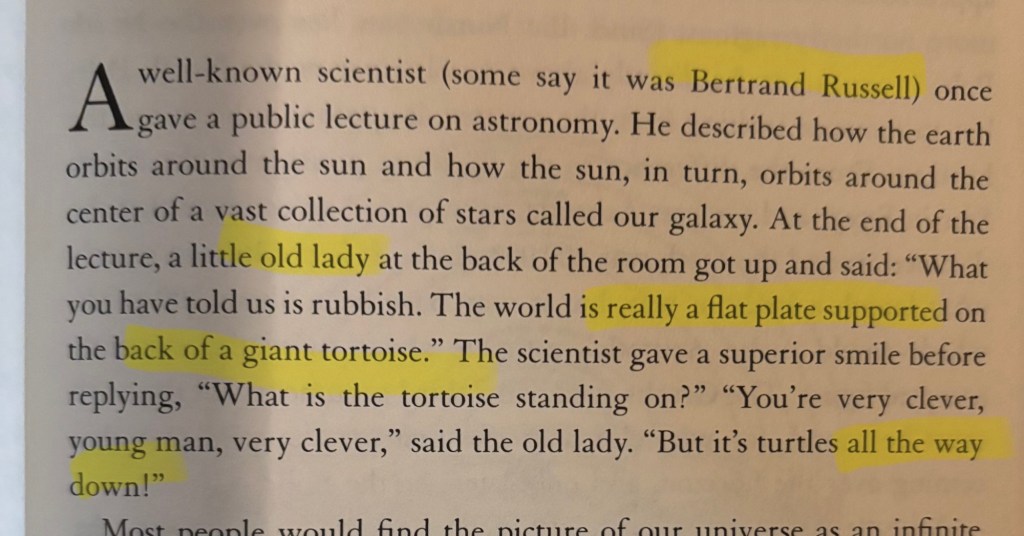
Those words were published by Stephen Hawking in 1988. (91 years after Russell was 25 years old and published his thesis; 91 years after James’ words were published.)
Sure. I grant you that it is possible that Russell gave lectures to little old ladies in 1897, despite his being 25 years old and having only published a thesis on geometry that no little old lady would ever be interested in (or aware of). But that only solves the lesser problem. How does “rock” become “turtle”?
Seriously.
Obviously the nature of the situation is Hawking placed the importance of “truth” well below standards when deciding how to open his best-ever-selling book (that is seriously flawed for more than this reason).
****
This is why you need to read, and read, and read, and read, and read. The solution is more reading.
Shaking My Head/Nerd Alert!, A Review of A Brief History of Time, By Stephen Hawking
The Spiderman of physicists, Stephen Hawking, introduces the second edition of his book with, “The success of A Brief History indicates that there is widespread interest in the big questions like: Where do we come from? And why is the universe the way it is?”
Just past halfway through the book, in his chapter titled, “The Origin and Fate of the Universe”, he suggests, “The whole history of science has been the gradual realization that events do not happen in an arbitrary manner, but that they reflect a certain underlying order, which may or may not be divinely inspired.”
In the final chapter (before the Conclusion), he writes, “We would then be able to have some understanding of the laws that govern the universe and are responsible for our existence.”
In the final paragraph of the book (excluding three brief and meaningless portraits of Einstein, Galileo, and Newton) he suggests, “However, if we do discover a complete theory, it should in time be understandable in broad principle by everyone, not just a few scientists. Then we should all, philosophers, scientists, and just ordinary people, be able to take part in the discussion of the question of why it is that we and the universe exist.”
Firstly, for context, the second bestselling book in that chart is—self-help/dating/pop-psychology. Third is a cookbook. In other words, while I love that Metallica’s Black album is the bestselling album since certain record-keeping data began, while I think they deserve all possible head-banging praise from us mortals, the number two is Shania Twain. Put another way, Mr. Hawking got his 15 min of fame, surely. But his staying power is yet to be seen—and I wouldn’t bet on it. Additionally, “pity” is a very real motivator. My money says give mobility of limb back, and the Brit’s wouldn’t have paid to see the five foot man-eating-chicken carnival act.
Next, close as you look, you will find no written record of a belief that life unfolds arbitrarily. Instead, you will find people have always believed in order—but they got the order wrong. Pointedly, then, Hawking and contemporary physicists are in nowise special. They’re just doing their best like everyone before them.
Thirdly, “govern” and “responsible for” are not synonyms. You want to tell me that the sensation when an elevator starts up and the sensation of being stuck to the ground are indistinguishable? Great. But the idea that the aforementioned sensation(s) are responsible for my being is laughable. Get outta here!
Lastly, no, thank you. This idea that I have to wait upon “my betters” (or anyone) to finish their navel-gazing before I can opine as regards the nature of existence is just silly. Telescopes and microscopes are cool. But truth is not some distant or small object.
Previous authors, like Einstein, Jeans, and Eddington, among many, many others, wrote in order to explain what they were doing. Hawking, conversely, writes to announce his conclusions. The effect of their books could not be more striking.
It reminds me of the time I met an unmarried Major while I, too, was single (though a lowly First Lieutenant) in the Air Force. He was such a loser. He did precisely what he wanted all the time—and loved every minute of his life. Nobody liked him. He had no friends. To add one dollop of paint to the portrait, I’ll share this. When we drove around the base in Iraq in the big van, he would lie down on a bench seat for fear of the enemy targeting him because he was a Major. The point is not his earnestness, the point is the unhinged-ness. Anyhow, I recall thinking, immediately after meeting him, “I must get married.”
Likewise, had I read Hawking before Einstein, Eddington, and Jeans, and their predecessors, I would have never picked up another popular physics book. As it stands, my foundation is unshaken (thankfully) and the topic still interests me. But Hawking does not.
Should you read this best-seller? Nope. Life is too short. Start with Einstein’s The Evolution of Physics.

