Tagged: new books
On Higher Education
I read and I read and I read.
It’s lovely.
But even I have doubts as to what exactly to do with all the knowledge. I am not interested in being a college professor. There was a time when I could almost imagine working hard and becoming an Indiana Jones-style biblical archaeologist (yes, kids, there are archeologists and they really do have dangerous/exciting experiences depending on the types of finds).
But that mood passed.
I ate with an old professor and we briefly discussed the pros and cons of re-engaging formal education. I wasn’t sold that the pros outweighed the cons. Specifically, every part of actual biblical training and academics is losing ground to the soft skills of Christian counseling and other versions of underwater basket weaving. Why join a dying breed? There simply is no demand from the public for an educated pastor. So the degree has to be for teaching or research, and the field is near exhaustion.
This brings me to the catalyst for this post. Check this endnote out. It is from Fr. John P. Meier’s A Marginal Jew: Rethinking the Historical Jesus, Volume 5 “Probing the Authenticity of the Parables”. I have been reading his Marginal Jew books since 2001 (24+ years). I think in the beginning I used them against Christianity as I questioned the Faith, but over time they actually have become some of my favorite books on Christianity-ish, outside of the inspired canon.


All of those listed titles, articles, books etc. are about just one (1) parable. I have been in churches for probably 25+ years and I don’t think I could list that many individuals who have commented (informedly or free-association style) on any one (1) parable. Fr. Meier, on the other hand, read three pages’ worth of scholarly commentary. (And in at least two languages.) Talk about putting me in my place.
I take it all back. I do not read. I do not read. I do not read. And I have no business ever lofting an opinion about anything into the air.
In the end, Fr. Meier and his impossible bibliographies (1) arms me for rhetorical battle with the loudmouth ‘educated’ nonbelievers that I sometimes run into and (2) keeps Christianity larger than life.
I think my favorite title from those listed is, “Excuses, Excuses: The Parable of the Banquet (Luke 14:15-24) within the Larger Context of Luke.” Funny guy.
Also, not that Meier loves its conclusions, but he did reference it enough that it sounded kinda like a definitive work so I did pickup a used copy of Snodgrass’s Stories With Intent—a 900+ page comprehensive look at the generally eloquent parables. I have to admit I haven’t been this excited to read such a book in many years. So add that to Meier’s effects: inspirational.
Trump Is the Content that Knocked “50 Shades” Off The Charts. What Will Displace Trump?
Trump has this thing in the bag and has had it in the bag since 2020. Naturally, the question follows, “How do we reconcile the headlines with this fact?” Answer: His base, his fans eat worry like it’s Wheaties. Trump’s loyalists are like America’s Mom. All worry—no peace. They always have been. They always will be. So no, there will never be “Trump has 10pt Lead in Every Single Swing State, and 30pt Lead in Wyoming!!” doozies on any legacy or otherwise sites.
Instead, the newspaper men and algorithms will continue to “sell” (hear: feed) headlines that there is a close race—maybe the closest ever!!—which necessarily implies both that Trump may lose (eek!!) and that it will be simpler for the Left to cheat (double eek!!!).
And why? Because they are in the business of selling stories.
Surely all of us are actually kinda tired of Trump. Maybe it would have been better if he won in 2020, by any means, just so it would’ve been only 8 years of Trump. Now we’re stuck with 12. Oh well.
But can you imagine what will sell newspapers/clicks when Trump is gone? Like, engage in a thought experiment with me for a moment. What is more, or at least as equally, outrageous than airing a nation’s dirty laundry during a televised, ahem, “presidential” debate.
I mean, I met a man at a Black Church in Denver back in 2016ish. He was displaced to Denver from the backwoods, and backwards, state of Louisiana during Katrina. He freely told me that he killed a goose that he had grabbed from the park. He said, “Peedah, everyone was so shocked and upset when they saw me do it.” Then he knowingly smiled and added, “But you can bet they came a-knockin’ when they smelled me cookin’ ‘im up!”
Now would this man’s story have made national news? Absolutely not. And why not? Because it’s pitiful. (He also shared that his sister drove off without him because she chose to fill her vehicle with “stuff” instead of her brother.)
But the idea that immigrants, illegal at that, are doing the same? That is downright shocking. It is appalling. It is sub-human and brings all manner of uncomfortable truths to the surface (America is different and better than BIPOC countries). No one laughs at the idea like I did with my new friend. So the newspaper men run it. Trump runs it. And we all (you all—I’m no sucker) eat it up. In a sense, Trump is like the EL James of American News—our guilty pleasure. What can follow him? Maybe we should ask, What followed 50 Shades?” Nothing.
Or Trump.
Mom’s read BDSM at the park on their Nooks and Kindle’s. Now everyone reads Trump on every screen, all day long.
What comes next? Something just as laughable, I suspect.
Forest, Forrest Gump, A Joint Review of The Overstory by Richard Powers and Forrest Gump by Robert Zemeckis
The film Forrest Gump is simply a classic. I know it. You know it. And that’s all I have to say about it.
The Overstory, by Richard Powers, while provocative, was written with enough smugness to need this direct accusation of thematic plagiarism to ground it. Here is my accusation in full: In the end, Richard Powers’ The Overstory offers its readers little more than they already experienced in the film Forrest Gump—that is, a nostalgia-filled game of “memory”, though this new version is chemically-boosted by a fun combination of fabulist storytelling and apparently un-simpleton plants (or more accurately plantae or vegetation) as lens.
With that out of the way, let’s get to some detailed analysis. First up, I feel that I owe you, dear reader, an explanation of how I ended up reading this book. I owe this to you, faithful follower, because you know that I have stated many, many times that I have nearly vowed to never read anything newer than 100 years old, because the classics are the classics for a reason—they are better! Why waste time?
Life threw a curveball, however. I recently moved back to Colorado (mental note: never ever leave again) and this event saw me box up my nice library of classic books that I am diligently working through. As a reader and planner, I kept a couple books out, of course. But not enough, it turned out.
On one trip between Minnesota and Heaven, I stayed with my rich brother and his wife and planned to borrow the first of what I recall was a trilogy of fantasy books I had randomly given them at Christmas a few years back. I was jones’n for easy-to-read, escapist fiction. Unfortunately, and tellingly, they couldn’t recall the location of that box set.
None taken.
Genuinely wanting to rectify the situation, my brother looked over a tiny bookshelf—so small—and, like Belle in the bookstore, chose, The Overstory.
“Here. You might like this one. It’s about-”
“-No need, S-,” I cut in. “As long as it’s fiction, I’ll figure it out.
“Oh. And thanks.”
I set off on the second half of my drive and later that week began to read.
It was miserable. Pulitzer Prize? I thought. This is garbage. I think it’s woke, too. Something is off about it. It feels a little too Greta and not enough William.
A few more pages in, and I couldn’t take it any longer. I had to read some of the critical acclaim and the previously forgone description from the back. I had to get some sort of context.
Eco-fiction? I knew it. This is garbage. It’s not even a novel. It’s propaganda. I feel like a card-carrying Nazi.
However, if there’s anything I hate more than eco-fiction antifa propoganda, it’s quitting on a book.
“S-. Did you actually read this? I’m finding it very hard to read.”
“Na. I only made it about 50 pages, if that.”
“Oh. Oh, oh, oh. I see. I’ll relax then. I was getting worried that you thought I needed to read it. Gotcha. Might still be propaganda, but at least it isn’t brother-on-brother crime.”
So I kept reading. Slowly it grew on me. Like most books tend to do.
Then something miraculous happened.
“But one day she’s reading Abbott’s Flatland…” Powers writes.
“No way!” I said to myself.
You see, on a previous work trip for the new job, I encountered the same problem of no easy fiction. So I found a sweet used bookstore in Denton, TX, of all places, and boldly asked the college dude behind the counter for recommendations in fantasy/sci-fi short stories. After he brought me to the appropriate section of the shelves, he lit up as he pulled down Flatland.
“This is a must read!” he explained.
I fully agree.
But how in the world can you explain my having just read Flatland after a random recommendation from a random bookstore I had no business stopping in, and then stumbling onto a second non-classic book which refers back to the previous one as if everyone would obviously have been aware of the merely cult favorite? It defies explanation. But it was all I needed to keep reading Powers.
And I am glad I did.
The Overstory is not poetry in the sense that Shelley meant. It is far too technical and, as mentioned, smug. Too naive. Too progressive. Too dry, at times. But the story is compelling, and buyer beware, if true, the stuff about vegetation’s intelligence and ability (not to mention old, old age) and the detailed accounts of eco-terrorists and their deluded—yet unshakable—belief that we’re all missing something feels authentic.
Onto the terrible. One example of the smug faults of the book must be offered. And it relates back to that used bookstore in Denton. Besides Flatland, the kid also handed me Fragile Things, by Neil Gaiman, accompanied by his opinion that Gaiman is the “greatest living writer”. Wow.
Juxtaposed against the author’s of the “classics”, I quickly noticed how this Gaiman would attempt to show-off his mental powers by summarizing enormous works of classic literature in a word, or worse, one emotion. Smug.
And Powers does the same. A sign of the times, I guess.
But what I am talking about, the one drop of oil that ruins the entire ships water supply, has to do with more than fancy-pants pith. My children are old enough to pick up The Overstory offy shelf. They would not know the references to literary greats. No harm, no foul. But what about this line,
She has told him about the Judean date palm seed, two thousand years old, found in Herod the Great’s palace on Masada—a date pit from a tree-
…wait for it…
–that Jesus himself might have sampled-
…not yet…
–the kind of tree that Muhammad said was made of the same stuff as Adam.
BOOM!
Are you kidding me?
Do you seriously want me to believe that you believe this?
Only a moron in the 21st century would equate Muhammad and Jesus—themselves separated by six centuries of time, not to mention the plane between heaven and hell. And more to the point, illiterate Muhammad most certainly did not offer any commentary—nor could he have—on some particular species of tree that most certainly was not distinguishable from any other tree to this ignorant man who couldn’t distinguish the biblical Trinity—Father, Son, Spirit—from whatever bastardized version he heard about and further twisted in his undiscerning, savage head into “father, son, Mary”. Give me a fucking break, Dick. You go too far.
Excuse me. Something comes out of me when it comes to the name of our Lord and Savior.
Want me to consider your point about deforestation? Okay.
Want me to overlook your hubristic take on religion while doing so? No can do.
But not every book can be a classic. So it’s forgivable. I forgive you, Mr. Powers. Both for the Muhammad thing and for the Forrest Gump thing.
Maybe next time.
As for me, back to the classics.
Buy It Today! It’s Just Us, Daddy, by Pete Deakon and Illustrated by Kaelyn Williams is on sale now
You read that correctly. The long awaited illustrated children’s book is finally for sale on Amazon. Buy it by clicking here. Or here. Or here. You can also click here.
I plan on giving it to Glenn of Glenn Hates Books at the end of next week. Please don’t let his review (as awesome as it will be) be the first/only one posted.

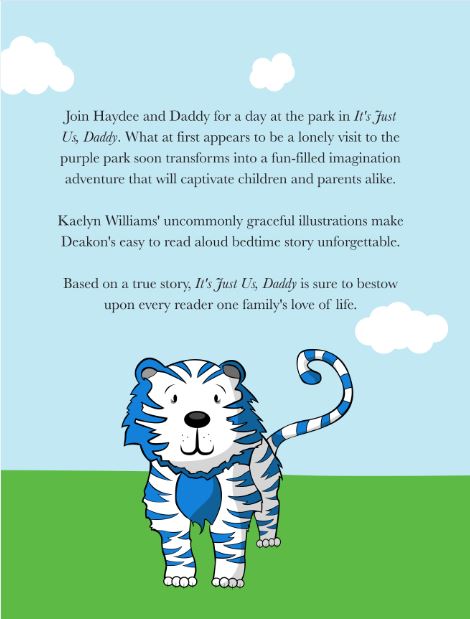
Book Cover for It’s Just Us, Daddy, by Pete Deakon
Review of Glenn Hates Books Vol. 1, by Glenn Conley
I’ll ask you  now to turn with me to Paul’s letter to the Philippians. Philippians Chapter 4, Verse 8. According to the King James version, these words are recorded:
“Finally, brethren, whatsoever things are true, whatsoever things are honest, whatsoever things are just, whatsoever things are pure, whatsoever things are lovely, whatsoever things are of good report; if there be any virtue, and if there be any praise, think on these things.”
May God add His blessing to the hearing, reading, and doing of his most holy word.
With Glenn Hates Books: Brutally Honest Book Reviews – Vol. 1 Conley, unbeknownst to him, reveals himself to be a fervent follower of Saint Paul’s advice. In fact, it is difficult to imagine that a critic such as Conley could even exist if it wasn’t for a childhood diet rich in God’s word. The trouble, however, is young Conley (the boy sitting in the pew who couldn’t get phrases such as “Fuck this shit in the ass!” out of his head no matter how hard he tried) thought that this indoctrination was a matter of the mind, when in fact it is a matter of the heart. And then somehow, despite this mass confusion, he became an adult, got a job, and so on and so forth. Which brings us to the present, where Glenn Conley writes book reviews for fun.
Sticking to the timeless advice that is clearly stamped upon his heart, he writes reviews that are true, reviews that are honest, reviews that are just, reviews that are pure. He claims that he writes these reviews because he hates books. But that’s just a silly marketing ploy to get suckers like me to notice him. The truth is that I know of no one who loves books more than Glenn Conley. He tears through them. A friend once labeled me a “word volcano”. Sticking with the naturalistic theme, if that’s the case, Conley is a “word black hole”. Nothing escapes him. He ingests books at a rate of nearly one a day, and also takes time to consider them and report back to the author–and the world–whether the book had any truth to it. And *big surprise* most do not. Well, most of the books that Conley reads anyway.
We’re here, however, to assess his book. Should anyone read it? To do this, we turn again to the words of Saint Paul. In his second letter to the Corinthians, Chapter 4, Verse 17-18, the King James version has recorded:
“For our light affliction, which is but for a moment, worketh for us a far more exceeding and eternal weight of glory; while we look not at the things which are seen, but at the things which are not seen: for the things which are seen are temporal; but the things which are not seen are eternal.”
That is to say, Conley’s book includes swears and graphic depictions–not just depictions, but longings for–rape, incest, and death. So if the temporal, seen world is the only one that matters, then he has contributed no value and his book is a public nuisance. But if we are all awaiting an eternal, unseen world, then his book is hilarious and well-worth reading. (Follow his blog here.) It is best read and appreciated while taking a shit or doing some other activity whose accomplishment is more prudently advanced the more one is distracted from doing it. Just when you think you’ve read all the possible combinations of his “Green Eggs and Ham” sized vocabulary, a fit of uncontrolled laughter signals he knows no bounds.
Lastly, whatever your stance on the time-space universe, keep this book away from literate children.
Is Buried Within The Sequel To Brokeback Mountain?
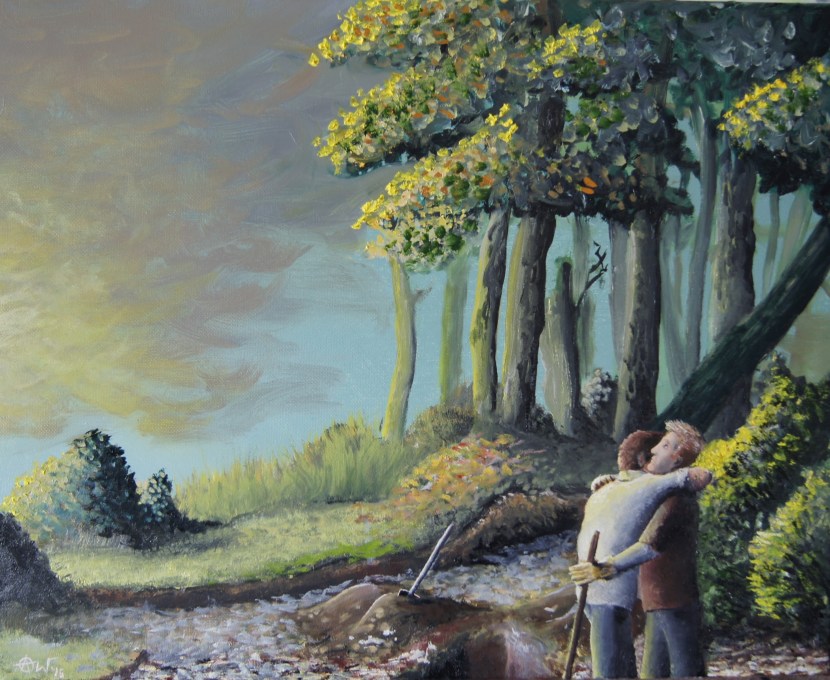
The biggest reason you should know the answer is “no” is that the book isn’t topping any best seller list.
Lesson learned, okay? After seeing The Divorce and Doom of Simon Pastor not sell, I figured this whole writing books thing was going to be about doing it my way. So I asked my friend, the same one who drew Simon’s cover, to do an oil painting this time. He told me, “Sure, but I don’t usually work with oil.” I replied, “I don’t normally write books. Let’s stretch ourselves.”
I happen to think the painting is great. But I can also admit that formatting it for the book cover took away a little bit, okay a lot, of the greatness. What I will never admit is that two men hugging in a forest are necessarily having sex together that night. Yet nearly everyone that I have talked to in person, not to mention Glenn and one other blogger on his review, have expressed that they expected Buried Within to have something to do with gay men or Brokeback Mountain based on the book cover.
What I really want to say to you all is thank you. For a long time I have feared that it would come out that I’m homophobic. What with my fundamental Christian upbringing, my military background, my having been married and having a child, my love of Michael Mann and Tom Cruise, I mean all these things are classic symptoms of homophobia. But then I heard these rumblings about the book cover and felt an immense swelling of pride. It really is a sign of the times, I think, that you think I have it in me to write a story centered on two gay men. (It also seems like you would prefer to read that book ((which is itself fascinating to me–and noted)) over a simple story of male friendship.)
So thank you.
But, unfortunately for my bank account, Buried Within is an exploration into a pair of men’s hearts that reveals a love that transcends sexuality. It is not about burying anything within anybody–forest or no forest.
Now take your mouse or finger and click here to buy the book. Pick up my other two while you’re there. Do it out of pity. Do it out of the acute feeling of guilt you should have for judging a book by its cover. But do it in any case. And remember, buying a book doesn’t mean you have to read it, neither do you need a Kindle to buy the Kindle version for the low, low price of $1.99.
Achieving Goals. Buried Within by Pete Deakon On Sale Now
 When I quit the oil fields, I told myself I would write two books (in addition to posting Mon-Fri) and that they would be on sale by March 1st. Well, without a moment to spare, my new (and second) short novel Buried Within is now available in paperback for purchase on Amazon (kindle version within the day). Here is the back cover text. Hope you enjoy.
Rick and Mark are friends, but they have lots of friends. After Mark’s wife Rebecca is murdered, he does the unthinkable–twice. Would you? Could you?
Pete Deakon lightens the mood, at least a shade, with his second short novel, Buried Within. The story explores friendship, hope, guilt, and ultimately, love.
At times laugh-out-loud funny, through an easy-going style and brisk pace, this contemporary thriller pleasantly affirms and challenges some of Mid-America’s most cherished notions.
****
If you’d like to do a review of the book (that you’d post on your blog and Amazon at least), I’ll email you a pdf. Just let me know. Glenn of Glenn Hates Books has it in his queue already. I’m skerred. Ha.
Chapter Two
 Chapter Two
Simon was no saint. It will become abundantly clear that he had a nasty brutish side. And we must never forget, of course, that he was first and above-all human. I say this to introduce the idea that he found himself approaching his twenty-fourth year of virginity with a tiresome weariness. It had been years since he attended a church service and despite plowing through books on religion, the memory of the why of it all was fading.
****
The fall after he turned twenty-four Simon learned that his friend Kurt was getting married. Kurt asked him to be his best man and Simon figured he may as well learn how to dance for the occasion. He first heard Kerri’s name as the dance studio’s receptionist told him who his instructor would be.
“We do private lessons on Wednesdays, so Wednesday night at 8pm you’ll be with,” the woman paused as she checked the instructor availabilities, “you’ll be with Kerri.”
“Kerri. Got it. Great. See you then,” Simon said. “I hope she’s hot,” he thought, after hanging up the phone.
He had scheduled lessons with high hopes of impressing the bride’s single friends. Simon happily admitted to anyone who would listen that the many ballroom scenes within the recently finished epic War and Peace had a hand as well.
For some men a woman’s smile is the most visible memory of first seeing her. Others can’t forget her eyes. Many find themselves drawn to a woman’s unadulterated laugh. Simon never forgot Kerri’s posture. Arriving a few minutes early for the lesson, he saw a woman who he hoped would be Kerri. She was walking from left to right when their eyes first met. She was expecting him, but didn’t expect him. The way Simon recounted it, she froze solid upon sight of him—her slender neck almost breaking in the violence—though Kerri would coyly never admit to being overly impressed with her future husband that day. He confided to me that he knew in that moment that she was the one. When I pressed him to explain how he knew, he admitted it was very primal. He said that he could just tell that she would give herself to him. Kerri was like that. Her body housed her spirit but was never very good at concealing it.
Too soon, Kurt’s wedding had come and gone and the dance lessons lost their relevance to Simon’s ambitions. Over the duration, however, Simon and Kerri had become quite close. As is often the case with new love, neither of them wanted to stop being around the other. Simon simply couldn’t believe he had found a female that he’d like to have as a friend.
Simon had an uncanny ability to focus on a goal. Since signing that blue oversized “True Love Waits” index card, he viewed all available women as potential wives. Despite viewing marriage as an undesirable institution, he saw no value in befriending a woman who would someday choose another man. If he was going to spend time with a woman, he concluded, it had to be one he wanted to marry. And here she was, slightly tipsy, leaning against his car outside of the restaurant that he had taken her to after his last lesson. Not having any experience to aid his assessment of the unfolding drama, he returned to his safe place—honesty.
“Well, unless we’re going to go somewhere else, I think this is it, Kerri,” he struggled to say.
“Nope, I have no place to be,” she said.
“Oh. It just seems like you’re,” he paused, searching for the most accurate word, “waiting for something.”
“I guess-,” she began.
“Plus, aren’t you cold just standing out here?” he interrupted.
“-I was going to say we could go make out in your car,” she said, laughing at his genuinely surprised reaction to her suggestion, “if that’s okay with you.”
“Hmm,” said Simon as fear swept over him. Simon had never really made out before. But it sounded fun.
“Okay. Give me a second to open your door though. It doesn’t work from the outside,” he said, consciously moving as slow as humanly possible so as to not give away his excitement. Any restaurant staff still cleaning up inside who by happenchance had been peeking out at the scene would have thought Kerri had put a time limit on the offer Simon moved so fast.
Once inside the car, it didn’t take Kerri long to conclude Simon was in uncharted territory, and she laughed as she told him as much. He, in turn, loved both parts of that. She was perceptive and unafraid. Only later did he remember she was also a little drunk. By the end, Simon had told me a hundred times if he told me one time that he always wondered how the relationship would’ve played out if it wasn’t so late, if they weren’t far from both their homes, and if it hadn’t have been that time of the month.
As amazing as the evening had been, Simon was too much a boy scout to not regain control and come up for air.
“Call me when you get to your place. Drive safe,” he said.
“I will.”
Playfully pulling him towards her car, she managed to convince him that just a few more shivering kisses wouldn’t hurt.
****
Continue reading on your kindle here for $3.99. 🙂
Buy It Today – The Divorce and Doom of Simon Pastor, by Pete Deakon
Okay. Here it is. The Author’s Preface and Chapter One are below. Tomorrow’s post will be Chapter Two, but then you gotta buy it. Enjoy! (Click on the image to go to Amazon. Or here.)
Author’s Preface
Looking back, I am certain that in his last months with us Simon Pastor was aware that his journey’s end was nearing. Those of us closest to him have since discussed the sadness his eyes betrayed no matter how large his smile during those last few months. And I, especially, feel a heavy burden because he once told me that when I tell his story (“and tell it you must!” he’d implore) that I need to get it right, that I need to share everything. In honor, then, of Simon Pastor’s wishes I have chosen to write this book. His will granted me access to everything of his, including his laptop and phone. I have, of course, taken dramatic license with some parts of his story, but when you read a text exchange or email exchange, know that it is verbatim, typos and all.
Chapter 1
Men get stuck. Simon Pastor was no different. Like every man he reached a turning point which defined all actions thereafter. Unlike some men, however, Simon fell prey to this moment. It overwhelmed him. It consumed him. And eventually it killed him.
Trauma is usually found within these turning points. I say trauma to emphasize the sheer shock of the event and its aftermath. Combat is the trigger for some, the senseless unexpected death of a loved one for others. For Simon, the event was his divorce.
When men are confronted by these moments, they respond in one of two ways. Either they grow or they get stuck. And I don’t mean to imply that men have an equal chance of responding in either of the two ways, not at all. Most men get stuck. Most are not equipped with the skills and tools necessary to deal with the trauma. Poor Simon wasn’t.
“Simon, here, is a virgin,” said Brian. “He’s holding out for his one true love.”
Simon was, in fact, a virgin. But this did not make him any different from the rest of the eighteen year old college freshmen in the dorm room. The dorm room’s dominant feature was the two twin beds lofted into the air by homemade wooden stands, which made the shape of an L in the corner. The room’s current tenants each hung bed sheets from the ceiling in order to conceal any co-ed sports that may or may not occur on the beds. This was standard practice among the dorm’s residents. The beds being in the air also created more space for the young men to come together for intimate conversations. In the case of Brian’s room, this room, a love seat was under one of the beds. Two more 1950s style wooden desk chairs and one crummy bean bag chair completed the room’s seating arrangement.
“You laugh,” Simon replied, “but I actually did sign a ‘True Love Waits’ card once. With others, I walked it up to the front of the church during a special service and everything. A public vow between God and I. You ever made a commitment to anything higher than yourself before? Any of you?”
It’s what we loved about Simon. He was honest to a fault and all heart.
“That depends on your definition of high, Simon,” Chris offered to a general laughter among the guys.
Rolling his eyes and shaking his head, Simon took a breath.
“Is it on my back? My forehead?” he asked, pretending to wipe off a mark. “Why is it everywhere I go this is the most frequently discussed thing? No, I haven’t had sex. Yes, I’d like to save myself for marriage. And yes, I’m proud of this and could not care less who knows. But I do hope that we can someday talk about something, anything, else,” he lamented. “How about Josh? He was so drunk he pissed on his own computer the other night. Isn’t that interesting?”
General merriment accompanied Josh’s inadequate rebuttal.
For Simon, college was infinitely better than high school in every way save this one. In high school, while every boy talked about having sex, only a select few had actually gained carnal knowledge. In college, however, Simon soon found himself in the minority. And given the general lack of responsibilities that come with attending American universities, everyone soon knew.
He once shared with me, though, that almost to a man, when in a one-on-one conversation, the guys would admit that they respected him for his decision. I knew I did. It was not difficult to see why. Simon believed in principles. He believed in virtue. And that is rare.
****
Buy it today. Chapter Two tomorrow.
 Captain’s Log