Tagged: Christianity
Theologian’s Log?
In a stunning turn of events whose deeper meaning even I am still struggling to discern, I just finished my first week at seminary where I am taking courses which line me up to earn a Masters of Divinity, with a major in theology. Smile, people. I am.
I don’t really have time to be writing for free at the moment, but I just feel like sharing some observations about this new journey.
First, this news should come as no surprise to anyone who knows me. I love talking/thinking/studying Christianity and theology. It only makes sense that I’d end up doing it in a formal school.
Second, I can now pronounce and write the Koine Greek alphabet in upper and lowercase.
Third, did I mention I can’t stop smiling? Here’s why. I was late to the orientation where the few other theology majors were chatting with the department heads. When it came time for questions, I asked, “So. Say a person doesn’t really know what theology is. How would you explain it?” My heart was pounding. I didn’t have time to add/drop courses etc, and so I didn’t want to discover that I was in the wrong room. Yet I had to ask the question. When he began to answer I played it cool and listened, though I am sure my eyes had a sparkle. When he stopped, I couldn’t suppress my excitement any longer. Boom. Huge smile. I was in the right place. I said, “You just made me happy.” The two professors couldn’t believe it. Ha. They chuckled and said, “We don’t usually hear students say that…” B, for one of my courses, I have to write a book report on a book called War in the Bible and Terrorism is the 21st Century. Knowing my own stance on war, post military service which included combat, I couldn’t help but feel like I just showed up to an all you can eat pizza buffet and discovered that there was also a dessert buffet. Read and write about whether “love your enemy” stops somewhere short of unless they’re building nukes? Yes sir. I’ll take another piece. And some ice cream.
Fourth, what this really boils down to is “I want to know what I believe.” I just want to know.
Fifth, as I’ve shared what type of Masters program I’m in with non-believers, I have chuckled nearly every time upon the discovery that while I’m the one attending, they seem to know more about my future as they say, “You want to be a preacher?” Ha. I have no idea. I just want to learn for now. It’s funny that learning as a virtue is totally gone. If there is no professional monetary endgame, then people become confused. “Why are you going then?” (Naturally, at this point I have to insist it’s to get in to heaven.)
Sixth, I cannot describe the feeling I get while on campus. Forget Jesus (forgive me Jesus), forget God (ditto), forget theology, forget the Bible (I’m really going to hell now), forget Christianity. Forget it all, and the place is still shocking. Unlike all the jobs and co-workers I’ve had, unlike the folks that constitute my beloved Toastmasters club, unlike those who attended my Mark Twain Listening Club, the seminary is a place filled with people who honestly want to make the world better. They’re not selling t-shirts, they’re not handing out business cards, they don’t have a desperation in their voice about closing the sale, they’re not trying to get the upper-hand in the conversation, they just have come to a place in their lives where they see service to others as their mission and want to do it in an as informed a way as possible. The campus, the offices, the classrooms, the chapel, the coffee shop, it’s just oozing with heart.
Seventh, I will not become a robot. One ex-mormon blogger-friend comes to mind now and I can hear her disdain at this news already. Allow me to rebut. Whatever other seminary’s exist, and what goes on behind their closed doors, I don’t know. So far this one is not a brain washing factory. So far the professors are classic professors. They are extremely well-read (and traveled), they are decent public speakers, they challenge commonly accepted beliefs and paradigms, and they have adorable quirks that can only be developed after years of standing at the front of a classroom and of which they are unaware. Let it be known: If anything gets weird, I’ll share it. And then I’ll definitely stay in the program. Undercover student in a cult indoctrination? That job is almost cooler than actually believing I might be able to learn how best to actively glorify God and perhaps be on the contributor side of the equation that might lead to a pagan experiencing the joyful spiritual transformation that occurs after accepting Jesus as his/her personal savior. You might call that a win-win situation.
Eighth, one of my first devil’s advocate questions to any heathen reader right now is this: “Do you believe human beings possess the parts/capability to discern that a leader is speaking from (brace yourself) God?” Put another way, is it possible for me to convince you that I honestly believe (as a reasonable, sane citizen) that leader So-and-So’s ideas/rhetoric/vision/plan/mission transcends generally accepted scientific knowledge? That they are acting as an agent of some unnamed ultimate reality? Or will you always label me a “sucker” or “delusional”? Why or why not?
Ninth, on a wholly un-theological note, I think God might have messed up. As H- gets older and older it is becoming clear that she is supposed to be the daughter of a blind couple. Does anyone else’s kid announce every single thing they do? “I’m walking. I’m putting on my shoes. I’m jumping. I’m playing. I’m swimming. I’m dancing. I’m raising my hand.” Yeah, H-, I get it. I’m right next to you and can see what you’re doing. These eyes aren’t just for show. Shyat!
My Revision
I mentioned in post number one today that a theologian named Marcus Borg labeled Jesus of Nazareth a “movement initiator.” That’s funny to me because it’s so demonstrative of effort. Borg was a Believer, but he really thought that things weren’t good enough as is. He seemed to think, “Maybe if we change the words and labels more people will buy into this garbage.
“Messiah? Too old testament. Movement initiator? Brilliant!
“Christ? Too Greek. Che Guevara? That’s the ticket!
“Son of God? Too not-atheistic. Barack Obama? Exactly!”
Well, I have a revision of my own that I’d like to share. This one came to me the other morning. Different than a phrase, mine is an image. But I’m no artist, so I’ll do my best to describe the image.
To make it palatable, you need some backstory. The backstory is that a good friend, or former good friend (he has a girlfriend now and naturally we don’t talk anymore), is a little brother. And through conversations he shared with me that he has lent his big brother money and never been repaid–not that he ever expected to be. Why did he lend the big brother the money? Obviously love is the reason.
Most of you know that I, too, have a brother. But in my case, I am the big brother. So the other morning, I am reporting in to my little brother that a big conversation with the ex ended terribly and left me without hope, at least in the financial realm of life. As we chit-chatted via the wonder of texting, I jokingly asked him for money. (Actually, I asked him to buy me a house.) Suddenly, my friend’s situation came to mind, and I felt terrible because it occurred to me that maybe my question, despite being ridiculous and clearly a joke, would actually cause my little brother consternation because of how much he loves me. Still with me? I suddenly feared that I was becoming my friend’s douche-bag older brother who was taking advantage of his position in relation to my good friend. And that was not my intent at all.
Now, whether or not my little brother felt any pang of “maybe I should…” before he texted me a resolute “no”, a new version of Jesus’ attitude/demeanor before/during the crucifixion came to mind.
Mel Gibson and the events as recorded in the Gospels seem to have it that he willfully submitted to the punishment because he knew that it was what had to happen if we were ever to understand the better. But for today, at least, I’m kinda in love with this new revision of his emotional state at that trying time. Instead of willful submission, try picturing Jesus of Nazareth in a discussion with the human race. His side of the argument? “Listen to me. Life because better. I speak the truth.” Our side? “Prove it.”
And much like my friend, Jesus would really prefer to avoid the debate. Not because he doubts himself–no. But because he knows how far he will go to prove his conviction. He knows that he will do anything to convince humanity that he’s telling the truth–that he loves us more than he loves himself and that that’s because we deserve the love that we just won’t accept for some reason. So my revision of Jesus during the passion is an unkemptly bearded man pleading with me, a sure sadness in his eyes, “Please don’t ask me to prove it. Please.” And then to himself only, continuing, “Because I will. You don’t know how far I will go.”
Forgive me, brother. My request was in poor taste.
Simplifying Christianity With The Intent of Increasing Your Happiness
Get excited people. You don’t just get two, but three posts today. The third post on this random August day is coming in an hour. What? I just have a lot to say tonight. Exciting.
Before I became a hero, I always perceived civilians as mocking the military’s love of acronyms. How times have changed. This is relevant to Christianity and happiness (or eudaimonia) because I have simplified Christianity into three words. But I didn’t stop there. I want to promote the three words using their acronym. The reason I think this is the best marketing strategy is because it’s an acronym that sounds remarkably similar to another trending one. My acronym? LBB. See? One short syllable away from LBGT. You civilian pukes want acronyms? Well, this is the only one you need to know.
So what does LBB stand for? Life Because Better.
That’s what Christianity is all about. Better. I don’t think the LBGT crowd will mind too much that I’m ripping them off, because that whole thing is about better in its own way. (Though, I can’t deny that I am utterly shocked and yet wear a larger than life smile of amazement at life’s absurdities to include that anyone would ever celebrate gaining the ability to get married. That is one contract this confirmed bachelor will never enter into again.)
Some of what I’m about to argue just has to be felt in your heart. I’m not right, you’re not wrong. It just is. You either agree or you don’t.
History of Everything: The only relevant lesson.
God creates humanity with free will. Why? Why does he give us life? Because better. Life because better. LBB. In brief, God created humanity. Humanity went to shit (doh, sorry Dad, *). So he destroys everyone but one family and their animals and boat. Then God decides on this second go-around that he needs to be a more hands-on parent. So he chooses a group of people, (Jews), to use to teach the other groups of people that life can in fact be better than the fleeting pleasure found in raping your sister and mom and the livestock. How were the non-chosen people supposed to determine that they were missing out on happiness? They would notice that the Jews win more wars, get out of tight spots more often, and have an uncommon solidarity down through history despite not always, or hardly ever, being recognized as a nation-state. These Jews also had one only God, and a hope for a messiah.
Then, around the time of Jesus’ existence, the Jews really, really believed that a messiah was going to come and violently overthrow their current oppressors, like the Old Testament reported used to happen. But surprise, surprise, the man who claims to be the messiah, Jesus of Nazareth, enters the picture and instead of same-shit-different-day, he says the time has come to open up the ability to be a member of the people of God to anyone and everyone and that it has nothing to do with buildings and geography. He argues that the era of teaching the world what’s up through methods including violent revolution for the benefit of one segment of the population is over. He claims that a new history needs to begin and unlike ever before humanity as a whole is finally ready to accept the notion that life can be better. Life because better.
Life because better. LBB.
The best part of this story? It’s true. Life can be better. We can be kinder. We can not hurt each other. We can love our neighbor. We can be decent. We can respect each other for who we are. We can meet each other where we are.
Or not.
Truth be told, sometimes I like worse life. I like venting and ranting and name calling. I like doing it very articulately as I’ve tried to demonstrate on this blog. I like hating–a lot. Feels good. Not as good as loving, but sometimes really close.
At the end of the day, however, as I lay in bed I dream about the better. I wish I wouldn’t have said things, done things, or contributed to anyone else’s pain.
For me, the only person I’ve ever heard of who gives me hope that I can do life better tomorrow is Jesus of Nazareth. Not the current batch of intelligentsia, not Albert Einstein or Nietzsche, not any living person who thinks I’m totally wrong. You will be forgotten. I will be forgotten. It’s sad but true. Sorry. But he won’t be; he can’t be.
Life because better. LBB.
Americans, especially, the world is watching: Be the better. And give credit where credit’s due. It’s the only hope.
Review of The Message Of The Cross, by Derek Tidball
When I read a book or watch a movie I am on the look out for the one thing upon which the book or film is centered. Sometimes this one thing can be an entire scene, but more often than not, I find that it is one line. As an illustration, I would argue that the entire movie Monster’s Ball was built to make Halle Berry’s guttural “I want you to make me feel good. Can you make me feel good?” confession as powerful as it was.
Which brings me to this book I received from a pastor’s personal stash. It’s all about both the symbolism and (possible) reality of Jesus of Nazareth’s crucifixion. The author, Tidball, is a pastor and the book certainly carries his preaching voice throughout. This is mostly annoying. On the whole, there are all sorts of quasi-theological points and what have you, but unless you’re a Christian looking to invest some time acquiring answers to some very particular questions, I don’t think this book has much value–save one point.
With an emphasis on an “everyone is on their own journey” attitude, one thing that keeps me very interested in Christianity is its prophetic aspect. I wrote earlier about discovering the money-changer showdown prior to the arrest and crucifixion was at the temple, the same one that was destroyed as Jesus seems to have prophesied, the same one whose site is still being fought over today in the middle east.
Likewise, Tidball’s single scene or line in The Cross is found in Genesis 22:6. He calls to our attention that during the infamous Old Testament scene where Abraham unquestioningly follows god’s command to sacrifice his first and only son, the Bible has it that Abraham places the wood for the burnt offering on his son Isaac’s back for him to carry up the mountain. Boom!
Or crickets.
Remember that we’re talking about stories here. Remember also that words are not things, but the way we attempt to describe things.
So you’re telling me that the one true god’s chosen people–meant to be a beacon of hope for the world–out of whom some say the savior of the world was birthed had as their founding father and exemplar a man who obeyed this god’s command to sacrifice his son up to the point of the down-stroke of the knife; you’re telling me that the son walked with wood on his back at some point during the event? And then, thousands of years after this story had taken root, you’re telling me that a man who claimed to be the savior of the world carried wood on his back as he willfully submitted to his own sacrificial execution? In my book, that’s a pretty powerful and difficult to deny theme, a theme that might actively contribute to the claim that one story reigns as the greatest story ever told.
Unfortunately, in my own life of late I can admit that the Christian god has been at the least hiding, at the most absent in certain tribulations. And yet Isaac carried wood on his back long before Rome invented crucifixion or a father god sacrificed his own son.
I don’t know what to do with information like this, but I will say that I find it to be the most pleasant and empowering thing to think on, so I will continue to do so.
Professional Dreams
Yes. Three posts in one day. And it’s not even my day off. Crazy. Like a friend said, word volcano.
It’s probably odd that I’m only a few months into my current job and already writing about dreams for another job. No matter. I’m happy at my current job and don’t plan on leaving anytime soon. But that doesn’t mean I don’t dream of an even better job.
So what’s this better job? Right now I’m dreaming about becoming a preacher. Or maybe a priest. Or a monk. I don’t know the specifics, but I know that I want to be a “man of the cloth” as they say. I want to be a part of a profession of men whose goods are solace and listening. I want people to seek me out. I want people, everyday people from all walks of life to come to my door or invite me to come to theirs. And I want to hear what is going on with them and their life. I want people to share the state of their soul with me. I want that opportunity. I want to do it over food too. Breakfasts, coffees, lunches, dinners, desserts. That’s the ideal job to me. I want to hear from people who don’t necessarily understand the depth of their courage for sharing the most intimate aspects of their eternal struggle on this journey called life. But more than that (yes, there’s more. I dream big when I dream.) More than that, I want to be able to hug these people. Or maybe just hold their hand. And more than any physical comfort, I want to be able to look them in the eye and with the most sincerity and conviction I am able to muster, I want to tell them, “Everything is going to be okay.”
Because everything is going to be okay. Right?
Mildly Depressing Information About WordPress Blogging – Part 2 (The Good Stuff)
“You have to sell your soul at some point if you want to make money,” he says to me. He being my brother, Sam. The reason he said it to me was because I was explaining to him how I was increasing traffic to my (this) blog. Though, to be perfectly clear, the real–the root–reason he said it to me was because we grew up in the bible belt. Anyhow, let’s get to the good stuff–how I gained 1400 followers in 6 weeks’ time.
As a reminder, this all happened last December. December 2014 I was unemployed and living on some savings. I had oodles of time and two books inside me that I needed to get out. Obviously I wanted them to become best sellers and therein give me the means to discover first-hand whether or not the life of leisure was actually for me. Since beginning to blog daily, like a broken record I constantly told my friends and family, “I know the way to get more followers is to be more active in the blogosphere. I can tell that if I just take the time to read more blogs and comment and “follow”, then I’ll get more followers. I just don’t want to spend the time and energy.” I knew this because, like you, I had seen a “like” email and followed the link to the associated blog and often enough liked/commented a post or two and soon made a momentary friend as our two blogs gained a follower.
So while taking a break from writing my first not-best seller, I opened up the WordPress Reader. I was writing a contemporary realism tale of divorce (of course not based on mine, that’d just be silly) so I figured that’s where I’d start. Typing in “divorce” on the left side of the screen, I ended up with a page full of divorce posts. Suffice it to say that after reading a couple of them, I realized this was way too time consuming. How does anyone possibly read a lot of blogs, I asked myself? I think I then decided to just skim the blog posts. But I’m too lazy to skim, so that didn’t work either. Then, I noticed something that I never had before. Right there on the Reader, you can click “like” and “follow”. As in you and I, any WP bloggers, can “like” and “follow” blogs that we haven’t even visited. Understand me? Not just not read, but not visited.
All of a sudden it became clear why I had been getting the like/follow double emails. Knuckleheads were seeing my blog post in their Reader for whatever reason and, like a one-two combination punch, clicking “like” and “follow” from there. Good to know. Next thing I know, I’m mindlessly clicking “like” and “follow” on every blog on the Reader. When I got to the bottom, it’d take a second to load more posts and then I’d continue. But then something hit me. I remembered that I hated getting a pair of like/follow emails. They always felt dirty to me. But what I did like receiving was just a “like” email notification. Hoping to discover you and I were not as unique as we might want to believe, I switched tactics. I just clicked “like” on the Reader on post after post after post.
Here’s where it got interesting. I remember thinking to myself before I hit the limit, “Surely there is a limit to this. I can’t believe their IT guys would let a blogger sit here for hours on end liking posts in an attempt to steer traffic his/her way.” (Please keep in mind I was not working, so I had plenty of time. What’s that saying about the devil and idle hands?) Anyhow, I kept “liking” and scrolling until something goofy happened. The “like” wouldn’t stay orange. It kept bouncing back to blue. Not to be deterred, I actually visited the blog whose post I was attempting to “like”. When I clicked “like” on the actual blog page, it seemed to stick. My icon was added to the group of likers (or often was the first one). But when I refreshed the blog, it hadn’t worked. I had hit some limit WordPress had set after all.
Next, I figured that this was surely a temporary “like” lockout. I do remember panicking a bit. “What?! I can’t like another post? What if I actually do like a post? What have I done!?” I walked away from the laptop for a while. Upon my return, I discovered I could “like” again. So now I figured, “Fuck it. Let’s put them to test.” Long story short, I discovered that I could like 100 posts and then WordPress would lock me out for one hour. As in literally 60 minutes after the 100th “like” I could again “like” another 100 posts.
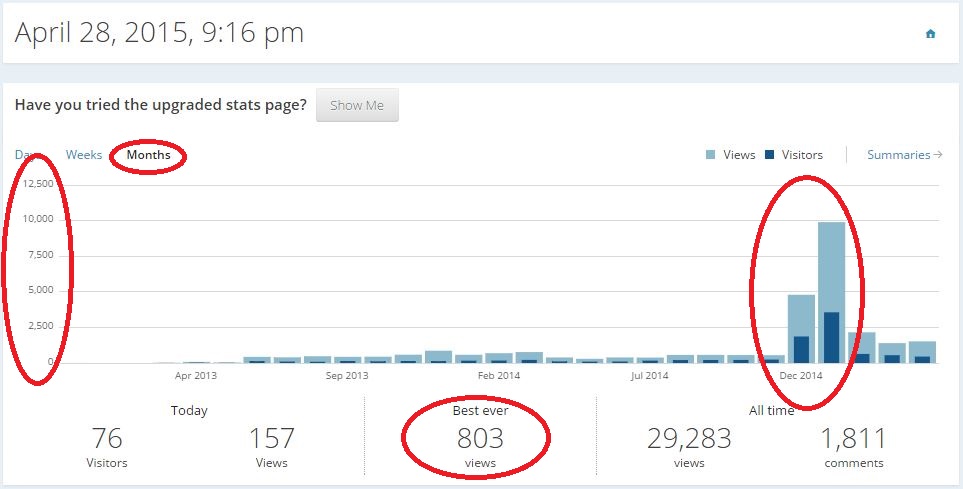
During all of this, something else began to happen. My own blog stats were going through the roof. On average days before this day, I had 30 views. My all-time high was ninety-three. (I must’ve posted something about sex that day.) With my liking a few hundred posts in a day, I was getting nearly as many views in return. 30 became 300. It felt amazing.
But everything I’ve told you so far is just foreplay. Stick with me.
I then found myself manually “liking” 100 posts (takes about 5-10 minutes to click “like” 100 times, depending on whether any headlines/intros are distracting in a good way) and then putzing around for an hour and then doing it again. And again. And again. All day. Can you imagine this? Living life 60 minutes at a time. “Whoops. I’ll call you back. Gotta get back to it.” Then one day my friend George was over. George is a sharp cookie. He is also a programmer by trade. He is also an extremist in nearly every way and so while he was fixing some paleo-bullshyat meal for himself in the kitchen, I told him I needed a few minutes to do my thing. He sees what I’m doing and says, “Hey. Let me have the laptop for a second.” He said this with a look that excited me and I’m sure I looked silly trying to keep a poker face as I answered, “Sure. Okay. Cool.”
You need to be in your web browser for this next part (not your mobile device). Ready everyone? Follow my next instruction very precisely. I know a lot of you aren’t techy, that’s cool, but I don’t want you to take your computer in because of something you can fix yourself. What I’m going to have you do is the same as pressing Caps Lock. Press it once to turn it on, press it again and it turns off. Get it? Okay. Instead of Caps Lock, find and slowly (like give it a second to bring up a new Matrix-y mumbo-jumbo screen before you press it the second time to take that screen away) press the F12 key two times. With me? Okay. So that little half-screen thing is the way you–you know what? I don’t even get it, so I’m not going to try to explain it to you. Skipping ahead, George wrote a script for me to enter into the bottom field of that screen, the one with the “greater than” (>) sign, that would click “like” on all one hundred posts instantaneously, as long as I had already scrolled down enough to load my Reader with one hundred posts. Drum-roll please…
jQuery(‘a.like:lt(100)’).click()
Just highlight and contol-c that bad boy.
I’m not kidding. I now could wake up, fix the girl-child some breakfast, open the laptop, open the Reader, scroll scroll scroll, and then hit F12, cut-and-paste the script above, hit enter, and voila! 100 poor souls would see the Woodpecker image and swing by the ol’ Captain’s Log, discovering how awesome my writing was in the process. I’d then look at the clock and record the time on my white board. (There’s only so much ice for penguins in the old noggin’, as we used to say in the Air Force.) One hour later and I’d do it again.
As for the results? For 6 weeks I averaged 600 views a day (around 2/3rds of my “likes”. I usually had the stamina for 10 rounds of this or 1000 “likes” a day). I gained around 70 followers a day too. I also felt very, very guilty. Know what it’s like to read, “Thank you so much for stopping by my blog” when you didn’t stop by a blog? I do. It doesn’t feel good. But whatever. I knew my writing was not a waste of someone’s time and I was trying to sell my book. Of course, the book hasn’t sold, so please don’t miss the lesson here.
Anyhow, I know you’ve got other things to do today, but here’s a few more lessons learned. You might be sharp enough to ask, “Are there really 1000 new divorce blog posts an hour?” The answer is “no.” In fact, most categories that I tried did not have 1000 new posts a day. So I had to vary it. Poetry and Writing are the most used categories I found. And as you might imagine, they are also the most grateful. Batman, Movie Reviews, Philosophy, Erotica, Affairs–not so much.
You might also be asking, “What about WordPress? Surely they would notice his extraordinary ability to speed read?” They did. One day I discovered a thin red banner across my blog’s dashboard. I “clicked here” to begin to resolve the problem. Kevin, I think his name was Kevin, told me they noticed I was “liking” a lot of blog posts. He then asked how I determined what to “like”. Only mildly worried about losing all my own blog posts over this little stunt, I followed the age old moniker, “Admit nothing. Deny Everything. Make Immediate Counter-Accusation.” It worked. Though I’m still not sure Kevin is human.
While I didn’t think much of it at the time, these days I think I deserve an award for following this hourly schedule for six weeks.
In sum, I went from 400 followers (gained over a year and a half) to 1800 followers in 6 weeks. Since I’ve stopped my mass-liking (is there anything in life that doesn’t get old?), I am back to gaining the I-assume-you’ve-seen average of one new follower per published post.
Regarding “likes”: Before I ever mass-liked and with 400 followers, I had been getting 10 likes a day. Now I get between 20 and 50 “likes” a post, depending on type of content (keep in mind, this small increase is with 1800 followers).
Other lessons. Sex sells. So do father-daughter posts. My daily “views” when I publish are at about 60, up from 30. Though my recent divorce rant with the “c” word peaked at 194. I credit an early use of the “c” word for the extra attention.
Okay. That’s it. Like I said yesterday, I don’t know why anyone would want to use this information to attempt to better their station in life, but now you have it. I also feel like I understand WordPress as a business a little bit more. They provide a super-user friendly way to have a website and virtual community. But they’re the only ones getting rich quick. Oh well. No big thing.
As a final note, I couldn’t stop writing if I wanted to. And I don’t want to stop. I may not post as much as usual in the coming days/week, but that’s just because I am dealing with some other negative stuff in life and don’t want to keep ranting on here.
On a positive note, my illustrated (by a friend) children’s book proof is arriving next week. So that’ll be the next big thing. It’s great.
Actually, while you’re here, click here to buy my books. Seriously. Buy them! Do it now! That’s an order!
And never forget that the only way to get there is together.
PS – Here’s photographic evidence. The middle bar is the rant day. Yesterday’s views are because I wanted to make sure the script I gave you still worked. I was at 92 views yesterday at 3pm (six hours after publishing, most views come in much earlier than that) before I mass-liked 100 poetry posts. Looks like 157 will be it. Like I said, you can expect a return of 2/3rds the amount of “likes” you do.
Mildly Depressing Information About WordPress Blogging – Part 1
Almost from the day I began this blog I had my suspicions about the integrity of the likes/follows my blog was getting, but last Thanksgiving was definitely the turning point. I’m sure that like many of you, I couldn’t help but notice that my posts often got a “like” plus “follow” by another blogger within moments of publishing my newest post. Blinded by the promise of fortune and fame, I would check out the culprit’s blog and see if I thought they were a discerning reader or a machine. More often than not, I allowed myself to believe they were a discerning reader and that their “like” meant that I had published something valuable.
Then came last Thanksgiving. I had been blogging fairly regularly for about one and a half years, and beginning in early 2014 it seemed that this blog was finally gaining some traction with “readers”. Letting myself succumb to the holiday spirit, I decided to write a post “thanking” all the “likers” that, in part, motivated me to keep writing. Of particular note was one particular blogger. She had tens of thousands of followers (30K+ as of today) and yet was liking my blog posts regularly. It felt so good to see that she was reading and liking my writing. I really wanted to throw some blog-love her way (and others) and so I began my thankful post with her name. Surely she would notice this, I thought. I named some thirteen other bloggers (see the post here) before moving to the names of real people that I knew were reading nearly every post–friends and family.
Guess what happened?
Not a single one of those bloggers “liked” the post.
I mentioned this to my sister and she said, “Maybe they don’t like being called out?” Maybe. But no. It soon became clear that the reason they didn’t like my post was it was Thanksgiving–a holiday. And unlike me, they didn’t get on their laptop that day. They didn’t go to their WordPress Reader and click “like” on some dude’s post in an effort to gain a follower.
Another example of this disingenuous tactic was a blogger that has since disappeared. He jumped from 1200 to 4000+ followers in no time. Yet he took the time to read (so I thought) and “like” my posts day after day after day. But I would never “follow” his blog. I’d “like” some of his posts, but it’s like I didn’t want to give him the satisfaction of following his blog, so I didn’t. Finally he wore me down. So I clicked “follow”.
Guess what happened?
You got it. No more “likes” from him.
But it looked so cool that these blogs had thousands and thousands of followers. I wanted my blog to be that cool. It wasn’t. I had been writing for a year and a half. I had published about 300 well-written, engaging, strongly/uniquely-voiced posts and had around 400 followers heading into last December. Remember, I quit my job and was determined to write two books and keep blogging Monday-Friday at this point in time. I also decided while I wasn’t working that I would use the time to gain as many followers as I could by whatever methods were available. (“If you ain’t cheatin’, you ain’t tryin'” as we said in the Air Force.) Being a doggedly determined guy who still held onto a fool’s hope that blog-followers would eventually become book-buyers, I gained 1400 followers between mid-December and late January (six weeks).
Tomorrow I will share how I did it so that you can too, not that you’ll want to. Tomorrow, I will also demonstrate unequivocally why you should learn to honestly stop caring about likes/follows. Tomorrow, I will unapologetically pull back the WordPress curtain.
Review of Glenn Hates Books Vol. 1, by Glenn Conley
I’ll ask you  now to turn with me to Paul’s letter to the Philippians. Philippians Chapter 4, Verse 8. According to the King James version, these words are recorded:
“Finally, brethren, whatsoever things are true, whatsoever things are honest, whatsoever things are just, whatsoever things are pure, whatsoever things are lovely, whatsoever things are of good report; if there be any virtue, and if there be any praise, think on these things.”
May God add His blessing to the hearing, reading, and doing of his most holy word.
With Glenn Hates Books: Brutally Honest Book Reviews – Vol. 1 Conley, unbeknownst to him, reveals himself to be a fervent follower of Saint Paul’s advice. In fact, it is difficult to imagine that a critic such as Conley could even exist if it wasn’t for a childhood diet rich in God’s word. The trouble, however, is young Conley (the boy sitting in the pew who couldn’t get phrases such as “Fuck this shit in the ass!” out of his head no matter how hard he tried) thought that this indoctrination was a matter of the mind, when in fact it is a matter of the heart. And then somehow, despite this mass confusion, he became an adult, got a job, and so on and so forth. Which brings us to the present, where Glenn Conley writes book reviews for fun.
Sticking to the timeless advice that is clearly stamped upon his heart, he writes reviews that are true, reviews that are honest, reviews that are just, reviews that are pure. He claims that he writes these reviews because he hates books. But that’s just a silly marketing ploy to get suckers like me to notice him. The truth is that I know of no one who loves books more than Glenn Conley. He tears through them. A friend once labeled me a “word volcano”. Sticking with the naturalistic theme, if that’s the case, Conley is a “word black hole”. Nothing escapes him. He ingests books at a rate of nearly one a day, and also takes time to consider them and report back to the author–and the world–whether the book had any truth to it. And *big surprise* most do not. Well, most of the books that Conley reads anyway.
We’re here, however, to assess his book. Should anyone read it? To do this, we turn again to the words of Saint Paul. In his second letter to the Corinthians, Chapter 4, Verse 17-18, the King James version has recorded:
“For our light affliction, which is but for a moment, worketh for us a far more exceeding and eternal weight of glory; while we look not at the things which are seen, but at the things which are not seen: for the things which are seen are temporal; but the things which are not seen are eternal.”
That is to say, Conley’s book includes swears and graphic depictions–not just depictions, but longings for–rape, incest, and death. So if the temporal, seen world is the only one that matters, then he has contributed no value and his book is a public nuisance. But if we are all awaiting an eternal, unseen world, then his book is hilarious and well-worth reading. (Follow his blog here.) It is best read and appreciated while taking a shit or doing some other activity whose accomplishment is more prudently advanced the more one is distracted from doing it. Just when you think you’ve read all the possible combinations of his “Green Eggs and Ham” sized vocabulary, a fit of uncontrolled laughter signals he knows no bounds.
Lastly, whatever your stance on the time-space universe, keep this book away from literate children.
Why I Am Glad I Went To Church On Easter Sunday
All she did was remove her daughter’s jacket. Her adult daughter. Her daughter that normally attended the mega-church, but was either guilted into joining her parents at their church or she possibly understood the importance of going with them this one Sunday each year.
It wasn’t really that warm on the sunny Easter morning, but the building’s south facing stained glass definitely did little to shield her from the sun’s heat.
At eleven thirty the service had been going now for an hour and yet there were at least ninety more minutes to go. All this is to say that I can’t put it beyond the young woman that her decision to remove the jacket at that precise moment had nothing to do with the temperature and everything to do with an attempt to increase her busy-ness and thereby make the time go by faster. In any case, it was her mom’s action that caused my attention to remain on the movement taking place on the padded pew in front of me.
Her mom brought nothing less than a mother’s tender, loving care to the moment–and a whole lot more. Her fingers, as they brushed her hand, her fingers lingered. And in that infinite instant lay an entire childhood. In that instant, I saw the reason to grab her hand every time she reaches up for mine, the reason to hug her body every time she opens her arms, the reason to kiss her cheek every time she is about to walk away, the reason to pick her up every dinnertime, the reason to rub her back every bedtime, the reason to never put whatever passing chores life presents ahead of touching her. That instant showed those with eyes to see the inescapable truth. It is its temporary nature that bestows upon touch its insurmountable value.
Are Atheists Arrogant? Yes.
I recently responded to a friend’s seemingly angry comment to my favorable views of Christianity by suggesting she calm down. She did. Then she asked that I watch a presentation (that you can find here) in which a speaker essentially claims that my asking this friend to calm down was an example of me unwittingly antagonizing the social change movement known as atheism. News to me.
The presentation, by a woman named Greta Christina, is very generalized and therefore incapable of doing much more than rabble rousing. However, I would like to address one topic that I find fascinating. Here’s her claim:
“I get angry when believers say that the entire unimaginable hugeness of the universe was made entirely for the human race, [whereas] atheists by contrast say that humanity is this infinitesimal eye-blink in the vastness of time and space. And then religious believers accuse atheists of being arrogant.”
As I see it, we’re all guessing. We’re all looking at the data and drawing conclusions. More than that there are two levels at play here that she doesn’t seem to recognize. One level is the idea. The other is the proponent of the idea. If I expound the believers’ idea, I can also humbly admit that it’s just my best guess. No different than an atheist can admit that they are not certain. However, when the atheist or believer declares that for certain they are right, there is naturally, in both cases, an additional off-putting arrogance. And I am no more a fan of religious zealots who prematurely end the dialogue with claims of certainty than I am of atheists who do so. But in my experience, including this woman, while believers can be annoying in their certitude, atheists rue the day when it comes to arrogance. It’s inherent to their argument, the argument that goes something like,
“There are objective, scientific facts to be known. I know them. As facts are synonymous with truth, I know the truth. Moreover if you disagree with me, you’re disagreeing with the truth and consequently you are wrong. (And stupid).”
Does anyone remember the end of The Matrix Revolutions? (That’s the name of number three). The machines are trying to once and for all defeat humanity. Their agent, Agent Smith, asks our agent, Neo, who won’t stop fighting, “Why? Why, why do you persist?” Neo’s answer: “Because I choose to.” Smith’s question embodies the same argument as the atheist’s, just more eloquently. And it is arrogant. As if life is a computation to be solved and afterwards things will be normal.
Is it an arrogant idea that the unimaginable universe was created for little ol’ me? I don’t know. It doesn’t feel like it. It’s just my freely chosen conclusion–as of today–after studying the historical record and living among you for thirty-three years. Is it an arrogant idea that an infinitesimal eye-blink or even a very numerous group of them have accurately and finally recognized a system of knowledge that answers, “Why?” or “What for?” in a way that demands unquestioning allegiance? Yes. Yes, I’m afraid it is.
 Captain’s Log
