Tagged: book reviews
Letter to My Friend About Publishing The Divorce and Doom of Simon Pastor
Hey Friend,
I’ve been thinking about your phone call last week, about the unnamed feeling you felt. Now, I can’t possibly know what you’re thinking about your book, but here’s what I’m thinking about my book. I’m terrified to put it on sale and have people read it. Terrified. Why? Because on that day the dream ends. I think I told you about my next book, Eight Acres, and that I have always had a problem of fantasizing about the future rather than living in the now. After talking with you the other morning at the Egg and I (and even before then) I’ve been sustained by the dream that The Divorce and Doom of Simon Pastor will really take root. That it will go viral. That men (and their women) will write me to thank me for being the vulnerable one and sharing my experiences with such daring. And oh yes, radio shows. Probably even television will be in the mix, to be honest. And more than that, the dream has included that I won’t have to get a real job again. Because I can’t stand working.
But the day I list the book on Amazon, the dream ends. In its place will be only one simple reality–it won’t sell. Unlike the book version of this blog, Simon Pastor may sell 50 copies or so to family and friends and random blog followers because it is new material. But it won’t go viral. It won’t “put me on the scene”. It won’t prevent me from having to endure a real job again. It might, of course, but it won’t. No, it actually doesn’t even have a might. It just won’t. Make no mistake, I needed to write this book. I needed to write it like I need my next breath. And I need to write my blogs. But that’s a far cry from it selling. I’m beginning Eight Acres this weekend and will likely have it complete before February. But then the money starts running out. The dream will end. And I’ll be putting to test my resolve at being kind to my ex-wife as my new job’s schedule will likely act as a catalyst to backsliding into anger and hurt.
I am happy though. Really happy. I don’t regret anything and I wouldn’t change a thing about how I lived my life since taking the oil rig job. 33 is a big year for me. Laughing, I told George the other day that only after having finished this book did I remember that I predicted back in church camp years ago that 33 was when I’d start my calling. Ha. Everyone else always acted like it was in/around college that they would begin their calling. Well, at 18 I said that I felt mine would begin at 33 because that’s how old Jesus was (give or take) when they killed him. Immature, misguided, morbid, delusional, but true nonetheless. And you can bet I never imagined my calling would be a book centered on divorce. Suffice it to say, I can’t wait to hit 34 and laugh at my prophetic abilities. Either way, I’m certain that no matter what it is going to be a helluva lot of fun.
Okay. Sell your book. Give it away. Get people reading it. And on to the next one.
Pete
PS – James Hetfield of Metallica said, “Music is my therapy. I need to do it.” I’m not sure that’s exactly where you’re at with writing, but I think you can see the value in his honest admission. With this book, I am certain now that money has nothing to do with the fact that I need to write.
Teaser for Pete Deakon’s New Book: The Divorce and Doom of Simon Pastor
You know how movie teasers and trailers are fun in and of themselves? Well, here’s the teaser for my new book. Enjoy!
A black screen disappears in favor of a silent scene of a bloodied, weeping man trying desperately to beat down an apartment door; inside the apartment is a slouching drunk wearing a look of frightening resignation and throwing his nearly empty tumbler at that door; curious music now accompanies the camera as it closes in on the drunkard’s painful expression of doom. As if a film projected onto his eyes we see video of a beautiful woman leaning in expectantly towards that same man, though younger and full of life. His eyes dissolve out of the background and we now see the man jealous of the woman as she dances the night away with others; then an engagement; then the music quickens to frantic as the pace of the montage of already short video clips speeds up until they are not much more than still images in which we see yelling, fighting, painful looks, divorce papers, fear, and hurt.
Then the screen returns to silent black and the text “The Divorce and Doom of Simon Pastor” appears. As it fades away the text “Coming Soon” takes its place almost in a whisper.
Review of Entering the Real World, by David Kramer

Christmas is around the corner. Going free association for a minute here, I’m thinking kids opening presents. Kids means youth. Youth means ignorance. Ignorance means needing instruction. Needing instruction leads me to push responsibility to someone who cares to teach and has a knack for it. And that leads to David Kramer. Since he can’t be everywhere at once, he wrote a book. It is called Entering the Real World: Timeless Ideas Not Learned In School. (Buy it today and use promo code RLEGEN14 for 20% off).
Like his namesake, in his new book David stares down and defeats the Goliath that is the real world. Kramer moves swiftly and purposefully through his list of 149 helpful tips. Yet he goes further than most of his peer’s books and provides substantive “take action” steps to help those of us who read this genre and often think, “Great. But how do I actually do it?”
You know who you are. You have children, nieces, nephews, maybe grandkids that need useful gifts this holiday season. Schools don’t teach what we all know would’ve been nice to learn before we entered the real world. David does though. And he’s good at it. Buy the book. Give it to a young person. Improve a life.
Captain’s Log Now On Kindle
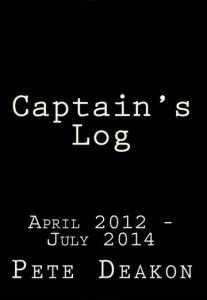
I started writing the posts that make up this book April 20, 2012 after serving for eight years as an Air Force Captain and pilot. The most common response readers give is a smiling, head-shaking look of disbelief that is sometimes sprinkled with joy. What no one has said–but I’m confident all feel–is that after reading these posts, after reading this book, they know they are not alone. And that’s the truth. You are not alone. And the only way to get there is together.
From Professor Batman to A Jaw-Dropping Woman, Captain’s Log April 2012-2014 is now available for Amazon Kindle. Purchase it here for only $2.99.
Review of the Critics of Transformers 4, By Michael Bay
The first Transformers movie will always have a special place in my heart. Instructor pilots of mine piloted the MH-53 that was the movie-opening Decepticon “Blackout”. Michael Bay even hand chose the pilot that marked me “unsatisfactory” once to be the hologram that “piloted” Blackout and later had a scene in the police car that interrogated Ladiesman217 (Shai LaBeouf).
I need a minute.
Okay, back to the review. Then came the second and third installments. Admittedly they were less than inspiring.
Then number four lost LaBeouf, but gained Marky Mark. Not interested enough to see the film in the theater, I started watching it four weeks ago, and finally finished it yesterday. Why did it take so long? And why did I persist, you ask? Because Optimus Prime riding a T-Rex Dynobot only happens once in a lifetime. And because that darn scene didn’t occur until the 133rd minute in the 165 minute film. But I still got goosebumps. It is awesome.
Here’s what some reviewers said about number 4 on Rotten Tomatoes:
“In the end, though, this is still a movie about giant robots fighting each other, which is to say it’s nearly impossible to take seriously on a narrative level.”
“Inflated, interminable and incoherent …”
“Transformers: Age of Extinction is simply more of the same mindless action, flat characters, and utter boredom that we’ve come to expect from these bloated mechanical sequels.”
And my personal favorite:
“Transformers have souls, this movie repeatedly tells us, but does Michael Bay?”
Know what I say? I say Michael Bay has a soul and it is the soul of a genius. Stay with me. I began watching this movie after listening to H- play for hours on end with a Beauty and the Beast doll set. The set included Belle and a few dresses, the human prince, and a Beast suit to put over the prince. (She hasn’t seen the movie yet.) These three characters became Belle, Belle’s father, and Beast (never mind he doesn’t have legs). And soon thereafter a lego character entered the mix so that it was an even two-on-two. Good guys became bad guys; characters that died came back to life; Beast was always asleep in the moments before only he could save the day. You know I love this child, but listening to her play can be mind-numbing.
Now, I can memorize a two hour movie’s story-line after one viewing, yet can’t follow, let alone repeat, H-‘s story-lines. Michael Bay, on the other hand, can. If you watch Transformers 4 as if you’re watching a four-year-old holding the actors and robots alike and performing all the voice acting, then the movie is perfect. Simply perfect. All the characters are yelling, injured, needing help, fighting, crying, whining, dying, or repeating some cheesy line they probably just heard the day before on TV. Even the scene where the boy and girl kiss after the victory seems like a child is forcing the two of them together while saying, “Mmua, Mmua” and thinking, “Eww gross”. The poor kid knows kissing is what happens when good guys win, but doesn’t understand why.
The genius of the movie and what the critics forget is that it is quite literally a movie about toys in the first place. Perhaps it is the 2007 installment that should be viewed as the fluke. But now with the fourth installment we’re finally getting to the heart of why Transformer toys and Transformers 4 are so great. And all these nay-saying critics probably don’t recognize that when they got big, they became the guy from Big who thinks that there’s something fun about a building that turns into a robot.
Paperback Giveaway and Future Post Warning
So. Another month of pay after just two weeks. And I’m still alive.
Here’s the scoop. Book sales have stalled out. At six. That’s cool, I didn’t do it to get rich, well, not in money–knowledge rich. And to prove it to you, I’m going to give it to you. I really am proud of the book/blog and want it to be read. So if money is the barrier between the paperback version of this blog and your hands, I’m removing that barrier. Just email me at pete.deakon@gmail.com. Tell me where to send it. I’ll send it. And then you’ll have it. Want a couple? Order away. This is a popularity contest after all people. Read it and tell others!
On a wholly different note, I have written a post that contains the most vulgar language I have ever heard spoken whether in person or film or books or whatever. It is still written by me (though not invented by me) and in the end has my voice/style, but seriously it is trash. No one should read it. By no one, I mean Grandma and Grandpa. Mom. Kate. Dad. Well, all family members. (Scratch that. Sam, you’ll likely chuckle in disbelief.) Friends, please consider proceeding carefully. I am going to password protect the post. But the password will be available on a page at the top of the blog called “password”.
Why did I write it? Because Tolstoy came close. He came really close to sharing locker room talk. But he never did. Maybe other fellas have, I can’t say I’ve ever searched for it. But I am frequently confronted by a feeling of shock when I listen to other people’s conversations, and the conversation that this post records takes the cake. I’m ashamed of it. I’m nervous about being associated with it. I’m embarrassed to have been in the group that witnessed it. But I loved writing it. Just don’t read it. And if you do, remember you’re the one who typed in the password.
Review of Christian Mingle Movie Preview
Click here if you haven’t seen the preview (it’s worth it–trust me). The subject line I chose when sharing the preview with my brother was “worse each second.” His response included, “Offensive to anyone with a brain.” Another friend said “ridiculous” and meant the word’s literal definition. Running only two and half minutes in length, the damage it causes is immeasurable.
Choosing a place to begin is proving difficult, so I’m just going to go free association from here on out. Who knew you had to be white to be a Christian? Who knew you had to have a full head of hair? And wear checkered button-down shirts tucked into khakis? Actually, I think we all knew that. I didn’t know Christians kissed outside, but come to think of it I should have. I am happy to see that, like in real life, once you have a black friend, you get to tell them they all look the same.
I for one can tell you no matter how happy my family looked in church, discord was the norm at home, especially during the holidays–even the big one. (What Ma?! I’m just acknowledging they were stressful.) But yes, Christians do certainly seem to be happier in public, don’t they? I think it’s because that’s when they try. Oh, and the fact that they have all the answers. And that’s why we should all marry a Christian. Or date one. Or at least subscribe to Christian Mingle. The good news is you don’t even have to be Christian or single to get a credit card.
In conclusion, I’d like to demonstrate my ability to simplify a movie’s raison d’etre from the trailer.
(Summoning deep slow-paced Movie Preview Man voice) Christian Mingle: Because Lord Knows, A Woman Without A Man Is Worthless. (Speeding up now) Coming to a theater near you.
Anna vs. Emma, A Joint Review of Anna Karenina by Leo Tolstoy and Madame Bovary by Gustave Flaubert
Nothing motivates me to write better more than sentences like these.
“As if tears were the necessary lubricant without which the machine of mutual communication could not work successfully, the two sisters, after these tears, started talking, not about what preoccupied them, but about unrelated things, and yet they understood each other (Tolstoy 125).”
“It showed him the eternal error people make in imagining that happiness is the realization of desires (Tolstoy 465).”
“In order to undertake anything in family life, it is necessary that there be either complete discord between the spouses or loving harmony. But when the relations between spouses are uncertain and there is neither the one nor the other, nothing can be undertaken. Many families stay for years in the same old places, hateful to both spouses, only because there is neither full discord nor harmony (Tolstoy 739).”
“As it was almost empty she bent back to drink, her head thrown back, her lips pouting, her neck on the strain. She laughed at getting none of it, while with the tip of her tongue passing between her small teeth she licked drop by drop the bottom of the glass (Flaubert 24).”
“And he at once took down from the shelf Emma’s boots, all coated with mud, the mud of the rendezvous, that crumbled into powder beneath his fingers, and that he watched as it gently rose in a ray of sunlight (Flaubert 174).”
“Emma was like all his mistresses; and the charm of novelty, gradually falling away like a garment, laid bare the eternal monotony of passion, that has always the same forms and the same language (Flaubert 177).”
“We don’t speak on the first floor as on the fourth; and the wealthy woman seems to have, about her, to guard her virtue, all her bank-notes, like a cuirass, in the lining of her corset (Flaubert 215).”
“They knew one another too well for any of those surprises of possession that increase its joys a hundred-fold. She was as sick of him as he was weary of her. Emma found again in adultery all the platitudes of marriage (Flaubert 268).”
So here’s the scoop. Anna and Emma commit adultery. And when they discover this act didn’t end their unhappiness, they kill themselves. These novels are often classified under “realism”, which seeks to be just what you’d expect–realistic. (This, of course, comes in response to the unrealistic stories which rued the day up until writers like Tolstoy and Flaubert (can’t not mention Twain) couldn’t stomach any more of it.) And right up until the ending, I can’t find novels which more accurately describe the human scene. But the suicides struck me as unrealistic. Was I being too literal?
Maybe the suicide is a metaphor? Maybe women who commit adultery long to commit suicide, but lack the courage to do it? Is that what these guys were arguing?
Or are the stories warnings to women? Are they a kind of “cheat on me and you’ll probably want to kill yourself” thing? They are written by men after all.
Or maybe there is something more going on?
Always returning to Tolstoy’s wisdom, I’ve decided that these books’ adultery-leads-to-suicide motif is a warning to everyone. Tolstoy, especially, tips his hand in the quote about about happiness not being the realization of desires. That these books sit on so many shelves across the planet proves we recognize the truth they contain, whether we can verbalize it or not.
If Tolstoy and Flaubert were alive today they might have chosen to write about men ignoring their family in favor of email, or mothers working while strangers raise their children so that they can live in a house that would make the Jones’s proud. Or maybe they’d write about women who wear make-up and men who have hair plugs. But then, I wouldn’t believe men and women would kill themselves after finding their cosmetic choices didn’t bring them happiness. But a spouse watching his or her selfish action destroy a family? Yep, I could see how that might make someone want out of this life. And since it is Tolstoy’s Anna who chooses her lover even when her husband is ready to reunite with her, Anna Karenina wins the better lesson presentation battle. The lesson being happiness is. No fill in the blank, no requisite. Happiness just is.
****
Flaubert, Gustave, Chris Kraus, and Eleanor Marx Aveling. Madame Bovary. New York: Barnes & Noble Classics, 2005. Print.
Tolstoy, Leo. Anna Karenina. Toronto: Penguin, 2000. Print.
Captain’s Log Is Now A Book
For practice with independent publishing, and because I wanted my own tangible copy of everything I’ve written in the last two years, I published a paperback version of this blog. You can click here to buy it from CreateSpace. Click here to buy it from Amazon. There is no ebook available, as that format just seems wrong for this project for some reason.
I’ve asked myself why anyone would buy something that they can read for free, and there’s only one acceptable reason: because they want to. For me, it was a need more than a want, but I think you get the picture. Buy it because you want (need) to. It begins with “Why a log?” and ends with “A Jaw Dropping Woman.”
Now that this little experiment is complete, expect new books in the future. And, of course, I’ll still be publishing as many posts as I can while I’m not away at work.
Oh, and the book makes a great gift. (I’m pretty sure H- would’ve been mad if I didn’t include that last little bit.)
Review of Icarus and the Wing Builder, by Robert William Case
As a pilot, it’s difficult to give a fair review to a book about mankind’s first flying experience. As a friend to Icarus and the Wing Builder’s author, Robert Case, the task reaches impossible heights. Then again, I’m always up for a challenge, so here goes.
Icarus and the Wing Builder is a solid novel that resides in the historical fiction genre. In the prologue, Case mentions that the historical record, if it can be called that, of Icarus and Daedalus (the wing builder) is very lacking. In fact, it seems all we really know is that Daedalus built the wings, and then Icarus used what Charlie Hunnam’s arse-hole character in the film Cold Mountain aptly calls “the confidence of youth” to go and get himself killed. That’s it. (Of course that’s not it. Human flight is something that has always captivated the attention of nearly everyone. To prove this point, during pilot training, our instructors told the story of a few student pilots who crashed and died while having fun in a rental plane over a weekend, and then our instructors provided a home video that some random family took with an air of “look at that plane!” only moments before it slammed into the side of a cliff off camera. The lesson–there are old pilots and bold pilots, but no old and bold pilots. …Re-focusing then…)
Robert has a passion for Greece, a passion for history, and a passion for the plethora of imagery and lessons this unforgettable story has buried within it. As we all know, however, passion isn’t always enough. That’s what sets Case apart. He has already established himself as a credible speaker and storyteller, having been awarded as such by groups who award such things. Icarus and the Wing Builder (which is the first book of a trilogy he is calling The Minoan Trilogy) is the tasty treat created by this combination of passion and skill.
Sure, you could probably go your whole life without reading this book and not be too much the worse for it, but you would be worse. That’s because Case’s book is ultimately about hope. Hope, that pesky concept that just won’t go away no matter how hard we try to blot it out.
Why did Daedalus and Icarus want to fly? Robert would answer that question by asking, “Why did you first want to fly? Because you know you did.” And this fire that is so aptly illustrated by man’s dream to soar through the sky–this hope–needs constant tending.
Getting into specifics now, let’s bring ol’ Mark Twain into the picture. I am a big fan of James Fenimore Cooper’s Leatherstocking Tales, to include the last published prequel The Deerslayer. Mark Twain was not. In fact, Twain wrote a hilarious review of Cooper in which he says Cooper violates eighteen of the “nineteen rules governing literary art in the domain of romantic fiction.”* The first rule Cooper apparently violated, the one that is relevant to my eventual point here, is “that a tale shall accomplish something and arrive somewhere.”* Ever since reading this criticism of Cooper I have kept an eye out for tales which neither accomplish anything, nor arrive anywhere. You can imagine as I was editing Icarus and the Wing Builder that I was anxious to discover how Robert’s story measured up. Let me be the first to say that Case’s tale definitely does not break this rule. The book is chocked full of action, and Case never strays too far from the main storyline. The storyline being, of course, Daedalus and Icarus find themselves paired together by a twist of fate and in need of an escape. Along the way they run into several great characters, to include Naucreta, a former courtesan to King Minos. Case uses this book to flex a variety of writing skills. He plays it safe over all, but clearly has a firm grasp on palpable settings and landscapes, authentic dialogues, and likable characters whose trials and tribulations reflect those each of us face to a lesser degree in our own lives.
In the end, Icarus and the Wing Builder is a page-turning account of the events that led up to and surrounded that first flight. It is entertaining, sometimes surprising, and always well-written. Read it. And then join me in waiting for the movie.
****
*Cooper, James F. The Deerslayer. New York: Barnes & Noble Classics, 2005. Print.
 Captain’s Log