Tagged: bible
One (Actually) Interesting Question For Your Bible Study Group
I find professionally procured Bible Study questions to be, in a word, terrible.
Questions developed on the spot by well-meaning Bible Study leaders are, to be blunt, worse.
Why is it so difficult to ask meaningful questions of fellow Christians? I do not know. I think it has something to do with the idea that “no Christian should feel stupid or challenged in their faith”. (This sentiment, of course, being found nowhere in scripture or defensible as the cornerstone of strong faith.)
The following is one good question. Try it out, if you dare.
“In Aristotle’s The Athenian Constitution we find,
The earliest of these offices was that of the King, which existed from ancestral antiquity. To this was added, secondly, the office of Polemarch, on account of some of the kings being feeble in war.
(Italics mine.)
“In Paul’s First Letter to the Corinthians, we find,
Now there are varieties of gifts, but the same Spirit. And there are varieties of ministries, and the same Lord…But to each one is given the manifestation of the Spirit for what is profitable.
1 Corinthians 12:4-5, 7 LSB
Are these two ideas reconcilable? If so, how? If not, what is the difference?”
Happy studying!
Reading Log 9.20.2025





The Aliens vs Avengers are better than Alien: Paradiso, but both are tremendously better than this random Batman comic.
Not sure what to say about Musk. Fascinating on every level. I guess main takeaways are he has a habit (from the beginning) of using all his money always—ie re-investing profits into new ideas/products. That appeals to me. And it is eye-opening to read about so many individuals who seek out money. I have never really thought about life like that. But Musk has money and is willing to use it to pay for what he wants to build.
Oh, and the part about flying home from Russia without a rocket and his data-based decision to build it himself for cheaper anyhow is the stuff of legends. Archimedes, you wild man of naked street running, watch out!
Plato is always a treat. Apology and Crito are a delight to read, at times laugh out loud funny, and also terrifically on point. For example, Socrates is on trial for his life. The charge: corrupting the youth. (Sound familiar yet?) His defense: the god (not biblical Yahweh, just some general concept) told him (Socrates, not Kirk) he was the wisest man—which he couldn’t believe. So he then decided to roam the country trying to find someone wiser. (Note: Plato wrote this about Socrates over two thousand years ago. Do not think about Charlie Kirk!) But no matter to whom he inquired, he always left disappointed because while they, in fact, weren’t wiser than him (Socrates), they thought they were wise. Socrates considered this as a worse state than his own, because where he wasn’t wise, he knew he wasn’t wise. Anyhow, in the end, he loses the case and was essentially forced to commit suicide. What can you do? It begs the question: What is an uncorrupted youth?
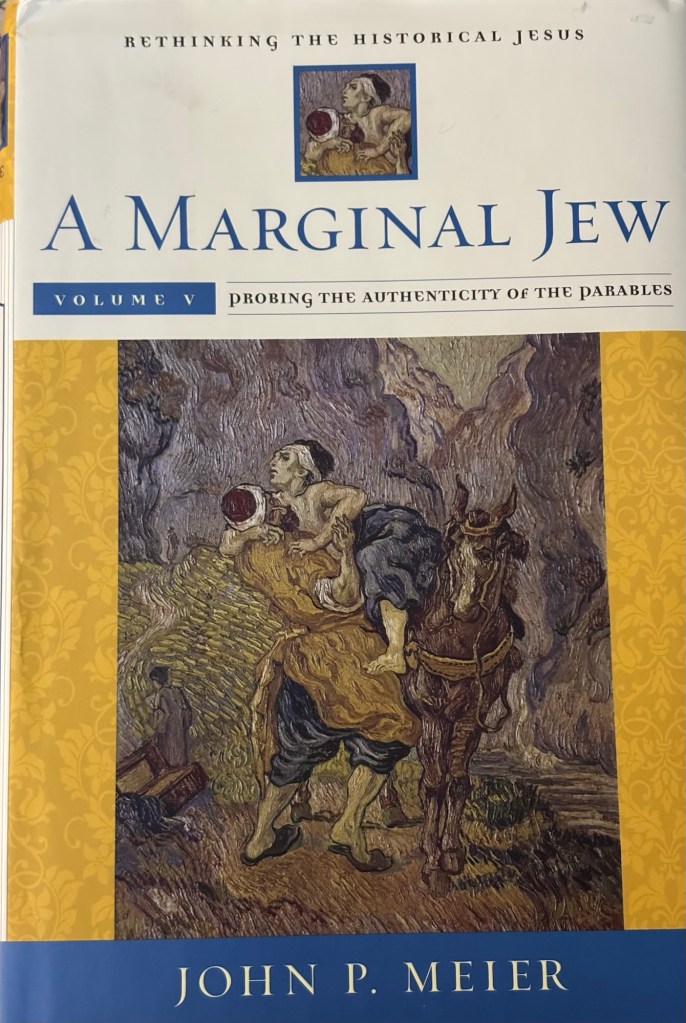
This final volume from Father Meier is excellent for the same reason the previous four are excellent. Meier states his destination and the rules of the road, and then works steadily towards it. This strategy allows the reader to do something even the Bible itself doesn’t: we get to assess his work. Put another way, Meier gives you everything you need to disagree with him. The only real criticism, then, is to discount his destination (an acceptable-to-all historical Jesus) or his rules of the road. (And feel free to do so.) But I love his destination and even if I didn’t agree with his road rules, I agree with the concept and so his portrait of the historical Jesus is fine by me.
To be sure: upon completion of these five volumes, you will never again believe Jesus was hippie-like. You will never again believe Jesus was some wise sage, like Confucius etc. But more importantly, for every stupid thing that you hear non-believers say about Jesus, you will have excellent evidence of where they are wrong. Never forget, the goal with these folks is not some stunning delivery of “you are wrong”, but “I bet you’d reconsider if you had better information. Do you have a second to chat?”
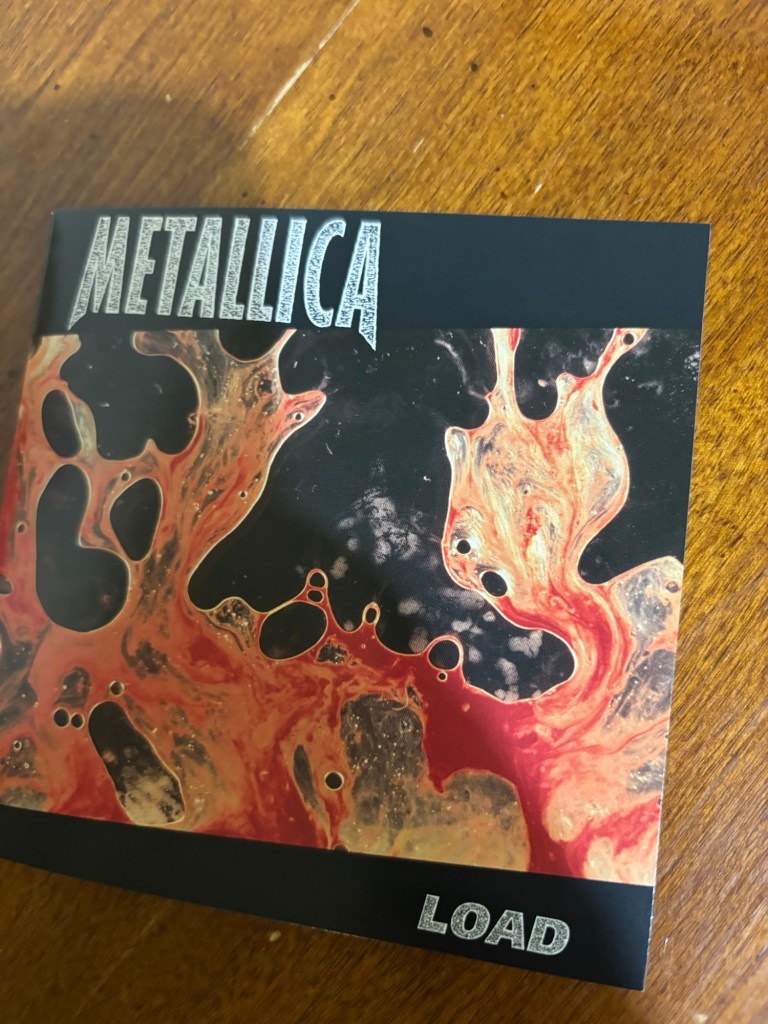
I threw in Metallica’s Load Album book for kicks because (1) I did read it. And (2) it has some pictures that were tremendously nostalgic. (Metallica re-released Load remastered recently.) “Hero of the Day” is far richer, more “Simple Man”, than I ever remember noticing. You will not be disappointed to reinvestigate both.
On Higher Education
I read and I read and I read.
It’s lovely.
But even I have doubts as to what exactly to do with all the knowledge. I am not interested in being a college professor. There was a time when I could almost imagine working hard and becoming an Indiana Jones-style biblical archaeologist (yes, kids, there are archeologists and they really do have dangerous/exciting experiences depending on the types of finds).
But that mood passed.
I ate with an old professor and we briefly discussed the pros and cons of re-engaging formal education. I wasn’t sold that the pros outweighed the cons. Specifically, every part of actual biblical training and academics is losing ground to the soft skills of Christian counseling and other versions of underwater basket weaving. Why join a dying breed? There simply is no demand from the public for an educated pastor. So the degree has to be for teaching or research, and the field is near exhaustion.
This brings me to the catalyst for this post. Check this endnote out. It is from Fr. John P. Meier’s A Marginal Jew: Rethinking the Historical Jesus, Volume 5 “Probing the Authenticity of the Parables”. I have been reading his Marginal Jew books since 2001 (24+ years). I think in the beginning I used them against Christianity as I questioned the Faith, but over time they actually have become some of my favorite books on Christianity-ish, outside of the inspired canon.


All of those listed titles, articles, books etc. are about just one (1) parable. I have been in churches for probably 25+ years and I don’t think I could list that many individuals who have commented (informedly or free-association style) on any one (1) parable. Fr. Meier, on the other hand, read three pages’ worth of scholarly commentary. (And in at least two languages.) Talk about putting me in my place.
I take it all back. I do not read. I do not read. I do not read. And I have no business ever lofting an opinion about anything into the air.
In the end, Fr. Meier and his impossible bibliographies (1) arms me for rhetorical battle with the loudmouth ‘educated’ nonbelievers that I sometimes run into and (2) keeps Christianity larger than life.
I think my favorite title from those listed is, “Excuses, Excuses: The Parable of the Banquet (Luke 14:15-24) within the Larger Context of Luke.” Funny guy.
Also, not that Meier loves its conclusions, but he did reference it enough that it sounded kinda like a definitive work so I did pickup a used copy of Snodgrass’s Stories With Intent—a 900+ page comprehensive look at the generally eloquent parables. I have to admit I haven’t been this excited to read such a book in many years. So add that to Meier’s effects: inspirational.
Re-Learning Biblical Hebrew While Keeping an Eye on Starship Flight 10
Seriously, could my life be more interesting?
Why learn Biblical Hebrew? Well, as the scholars put it 100 years ago, to avoid being a “helpless plaything” in the hands of biblical critics. The Bible is always under attack. If you don’t know how to work with the original languages, you are not on solid ground.
Why watch Starship Flight 10? Well, because it’s incomparably awesome and beautiful to watch and incomparably compelling and poignant to contemplate.
“The Koran” is What “The 1619 Project” Longed to Be
I was writing a friend an email about how inaccurate the Koran was regarding its recounting of events recorded earlier and definitively in the Bible and the thought hit me. The Koran’s relationship to the Bible is essentially what the 1619 Project tried to do to American History.
I share this because I know none of you will ever read the Koran. Yet I know that some of you still are curious about the book, given the state of international relations these days.
For me, I read it almost a decade ago while at a Christian Seminary, on my own initiative, with the intention of finally learning if the jihadic violence was taken out of context. In other words, I was well aware people (opponents and zealots) can take the Bible’s violence out of context. I kept hearing the Koran was a promoter of violence whole-cloth, so I finally got ahold of one and read it.
Surprisingly, I discovered that the calls to religious violence weren’t even the worst part. The worst part was the utter lack of reality in its description of human history, specifically, the events covered (basically exclusively) by the books of the Bible.
Call to Action: (for Christians who base their faith on the Bible) Study the Bible and teach the Bible with an emphasis on accurate transmission of the contents, more than doctrinal conclusions and wild claims about essentially unproven results of Christian living. For example, when I teach my kids the Bible, I end by saying, “The point is that you are going to hear people attack the Bible. But when you know the Bible, you are going to be able to see that they are not actually attacking the Bible. The people don’t know the Bible. Don’t miss this point. They attack straw men. It’s not that the Bible magically compels faith in Jesus Christ. But there is something about the Bible. It has the curious ability to compel or call forth continuous uninformed opinions. Seeing these for what they are allows us to help them see their error, rather than join in their error.”
My Sister Said We Should Sacrifice Everything to Marriage—and That This Is Biblical
My sister said we should “sacrifice everything to marriage—and that this is Biblical.”
Do you agree?
Sounds like a woman’s perspective to me.
She also said, relating to perspective during troubling times, “I think about when I yell at the kids and then imagine, god forbid, if someone dies soon after, and how would I feel? Was it necessary or just nitpicking?”
As an EMS pilot and former combat pilot, I promise that I have thought more about death and regrets than any non-pilot.
Here’s what I think.
I want to live a life that demonstrates to any who knew me—family, friends, co-workers—that they knew a (Pinocchio voice) real boy. I am not a sheep, I am not a drone, I am not a robot.
Did you get offended by me?
-That’s not my problem.
Did you disagree with me?
-You would, because you’ve never even considered the issue.
Did my personality rub you wrong?
-Well, what did you expect from a person? And where did you ever get the idea that people “get along”?
On the topic of marriage, no. No to both. The Bible never says sacrifice all (here read the practical parts of life: financial stability, children’s care, friendships, truth, fact-based systematic reasoning) for marriage. But more, and I know the full scope of what I am suggesting here, the Bible never even gives a portrait of a desirable marriage.
Exhibit A: No woman on Earth in 2025 wants to be ruled by her husband, as scripture suggests is the design of the hierarchy.
Exhibit B: Adam and Eve
Exhibit C: Moses’ marriages. Abraham’s marriage. In fact, all OT marriages.
Exhibit D: Jesus was single. Paul was single. And there is really no part of any NT letter or Gospel which highlights some marriage.
(I am suggesting my sister’s understanding is untenable, not that the Bible is invalid or uninspired etc.)
What to do?
For starters, finish the post. Then file the advice away in the archives under “probably not worth contemplating further” and get on with life.
Attention Black Faith Leaders: We Need Black Preachers
I just read about how you’re trying to boycott Target.
In the comments, I read, “…Thank you.” As a white man, I take this to mean, “Thank you because, as you know, I would prefer to shop with Whites only anyhow.”
So let’s get this straight.
Segregation was real. And you (Black Preachers) got it to end.
Now you (Black Faith Leaders) advocate for segregation?
Seriously, you need to become Preachers again (Gospel Preachers, if you want my honest opinion). Something was lost in the generalization.
I Am Never Ready
These last three days I learned that despite my training and full belief in the Boy Scouts’ “Be Prepared” motto, there are three things I am never ready for.
Firstly, America’s natural beauty, specifically the Rocky Mountains.
I drove to Salt Lake City from the Springs (and back) and while my eyes were necessarily on the road, I could’t help but marvel at the grandeur passing by my right and left.
I have decided that this area will be my kids and I’s new playground.
Secondly, folk’s response to, “What is the gospel?”
“You are insolent,” the friend of my buddy told me, as we sat next to each other late into the wedding reception. This was preceded by, “You are proselytizing.” Which was preceded by a three to five minute recounting of his entire childhood interaction with the Church which concluded, as he could tell he was avoiding the question, with a tremendously subpar answer, which he knew was subpar as he delivered it even before my eyes surely indicated so. This being preceded by his rehearsal of the lunacy of the concept of the “chosen people” and my, “Well, and to be sure—I am giving you my best now, no pulling punches—you must understand the gospel before you can understand or be at peace with any of the rest of it. There is an order of events, so to speak. So I would ask you (you don’t have to answer) what is the gospel?” And of course this was preceded by his, “You’re religious, huh? My problem is…”
I guess I am just an optimist. It’s my only explanation why I am always surprised that such a simple question can evoke such a dark response.
Thirdly, once in a lifetime offers of unimaginable wealth and luxury.
“Are you happy there? Are you happy with your job?”
I said, “Sorry what are you asking?”
“Are you settled in for good? Do you like your job?” the man repeated.
I had just met him. I learned he was a doctor. He was immediately kind. I believe his opening banter was complimenting the toast I had just given/hosted as best man. And, I never confirmed, but I am pretty sure he was a Mormon.
Do you see it now?
He saw what I had just accomplished in the other room and was ready to put those talents to work for the faith—and we all get richer in the process.
But I stumbled. Someone else was nearby and asking those around if they knew the movie that the current bluegrass band’s song was from, and I couldn’t help but ignore my new friend and lean over to answer, “O’ Brother Where Art Thou?!”
By the time that reverie ended, the moment had passed. The “doctor is out”, and never to return.
Oh well. I do like my house and I do like my job. But I also feel shame that I have acted in the same way during similar moments enough times to recognize the physical sensation I get afterwards as the “missed/blown opportunity” one. And this shame is only made worse in that these moments keep happening to me.
Maybe next time, I’ll be ready.
Some Thoughts On Vindictive Little Hussy Tamar in Genesis, the One that Played the Harlot (Not Absalom’s Sister Who Was Raped).
My wife uses the Bible to argue with me. Anyone else have a woman like this at home? It’s wonderful.
Just this morning she brought up “Judas son of Jacob”, from which I can only assume she meant (talk to text doesn’t work well for those with heavy accents) Judah. We’re already in funny-land with this, as it clearly demonstrates why surnames ever came to be. Who? Judas? Which Judas? NT Judas? Iscariot? Oh, Jacob’s son? Oh, Judah. You mean Judah? Judah, son of Jacob? Judah Jacobson. Judah Ben Jacob. Ha.
Anyhow. So the story has it that Judah’s first son, Er Judah-son, is killed by Yahweh for being evil. Par for the course. And his second son, Onan, is unwilling that his biological son become his older brother’s heir and so he will not consummate the deed. Yahweh kills him, too.
Only then do we learn the full nature of the issue. It seems Judah has this idea, perhaps divinely inspired, perhaps not, and holds to it like his last breath, that Tamar (Er’s wife) is owed a son by one of his (Judah’s) sons. So he promises Tamar that when Shelah Judah-son grows big, he can donate his seed to the common cause.
Here’s where the story gets interesting, and not just in Azeem’s, “How did your uneducated kind ever take Jerusalem?” sense.
Er’s widow Tamar (Tamar has no surname, so “Er’s widow Tamar” will have to suffice…for now) hears that Judah Jacob-son is going on a trip. It is this moment of the story that deserves grave attention. Here is the focus of this exegesis.
So she removed her widow’s garments from herself and covered herself with a veil and wrapped herself. And she sat at the entrance of Enaim, which is on the road to Timnah; for she saw that Shelah had grown up, and she had not been given to him as a wife.
“For she saw that Shelah [Judah-son] had grown up, AND she had not been given to him as a wife.”
“Vindictive little hussy” Tamar sounds more appropriate than “Er’s widow Tamar” at this point. But let’s read on.
Judah, now a widower and past the time of mourning, apparently still gets the itch. So when he sees a harlot on his trip, he begins to negotiate. Unlike, or perhaps exactly like, men from every corner and age of the planet, he didn’t think ahead and so now he is stuck. “1. Get laid but have to give her my ID to hold until I can find my darn credit card.” Or “B. Don’t get laid.”
He gives her his ID.
She takes it, gives herself to him, and then runs, never to be seen again—even after he finds his credit card.
But this, to most illiterate preachers, is still merely the setup for the punchline of the story.
(Let’s pause here for an apropos Uncle Remus saying: “You can hide the fire, but wha choo gunna do bout da smoke?!”)
Vindictive Little Hussy Tamar is soon “showing” and the affronted Judah Jacob-son wants her burned.
She wants to live and so offers Judah Jacob-son his ID back.
The next killer-line is:
And Judah recognized them and said, “She is more righteous than I, inasmuch as I did not give her to my son Shelah.”
Oh, the qualifier.
We almost had a perplexing, a-historical, fantasy account on our hands. Without the qualifier, we might have real evidence that scripture is flawed, uninspired, and not the Word of God that we all believe it to be.
So thank the LORD and his precious son, Jesus, for the qualifier.
Judah Jacob-son does not elevate Vindictive Little Hussy Tamar unreservedly, no. That would be the work of the uninspired Woke mob, post-#metoo and George Floyd and all.
Instead, since we’re reading the Word of God—which was written by men who lived thousands of years ago at a time before Jesus fulfilled Yahweh’s plan—there is a qualifier.
Nowhere does the story suggest that Vindictive Little Hussy Tamar was righteous full-stop, but it does convey that Judah Jacob-son now recognized that he hadn’t fulfilled his vow. Or as Apollo Creed says, “Some people gotta learn the hard way!”
Granted, I still have no idea why my boo brought this up in the argument over the kids’ clothes today. And granted I honestly am not 100% certain I analyzed the right story, since “Judas son of Jacob” is not certainly “Judah Jacob-son.” But these are some thoughts on Tamar, the eency-weency-bit-more-righteous woman than the John, Judah Jacob-son, little horn-dog that he was.
When It Comes to Israel, Please Try to Focus
Terrorists—not some internationally recognized State military—executed a terror attack on Israel.
How does the en vogue question, “Whose land is it?” relate to the war?
Debates are being had across the world regarding some idea of “a two-State solution”—has Hamas made such a demand? Have they suggested that they will cease hostilities if only…? Moreover, is anyone in Hamas actually in possession of enough integrity to believe, even if they have?
Some heavy hitters in academia suggest that the claims of Israel’s tie to the Land—especially as it regards the Messiah—within the books of the Bible are irrelevant, having clearly lost out to publicly recorded statements and votes by nearly all leaders, on nearly any level in favor of a two-state solution. Is any Israeli earnestly citing scripture in an attempt to denounce Hamas or secure their country?
Then we come to my personal favorite of the many distractions from the issue, being the cries against violence upon innocents. “But the IDF is killing innocent people!”, they wail.
When it comes to Israel, please try to focus.
There is a difference between an academic discussion, or put concretely, a classroom discussion, and war. By my thinking, the only people who don’t seem to understand this might be thought of analogous to the two apparently ugly and old flight attendants at United who are pissed because they haven’t ever been selected to work as supermodels on Dodger’s charter flights.
Talk that is focused on the war sounds like a yes/no answer to this question: should Israel have your support (indirect as it might be) in their war?
I say, “Yes.”
You may disagree. That doesn’t revoke your US Citizenship. Just please don’t skip to the nuanced reasons for your position before stating it. That’s lazy and cowardly. The question of war is not answered by debate. Focus. Answer the question. And stop pretending that “reasons” are the answer. Please, if you fancy talking about the topic, focus and answer.
 Captain’s Log