Tagged: reading
Reading Log 12.18.2025

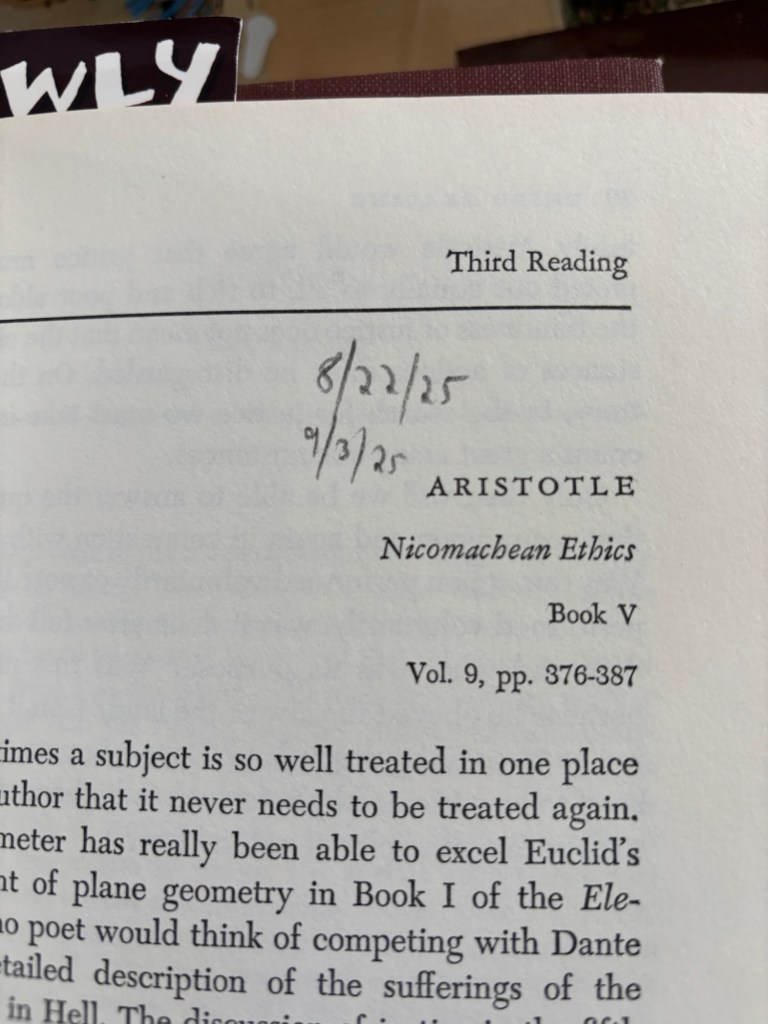
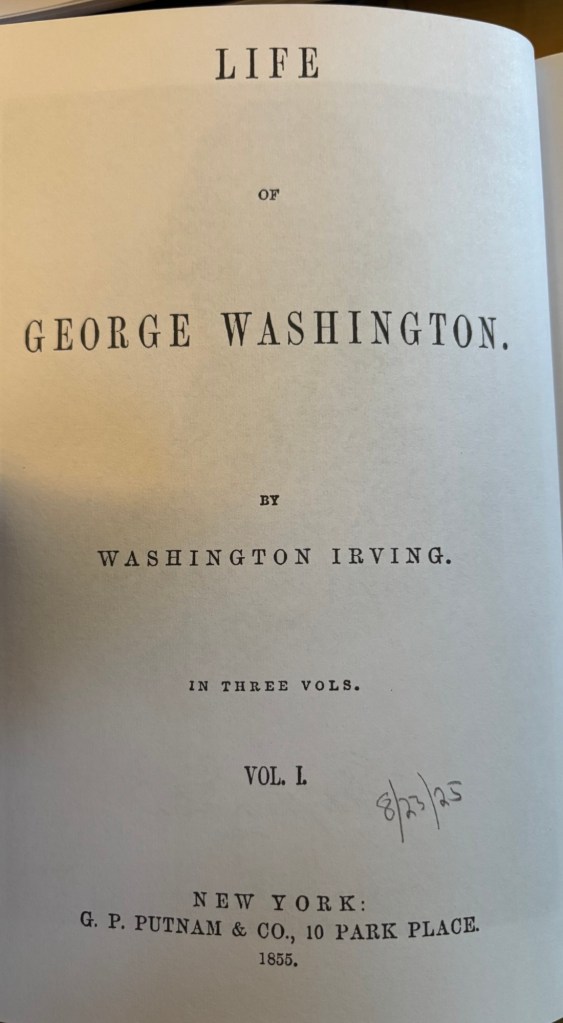
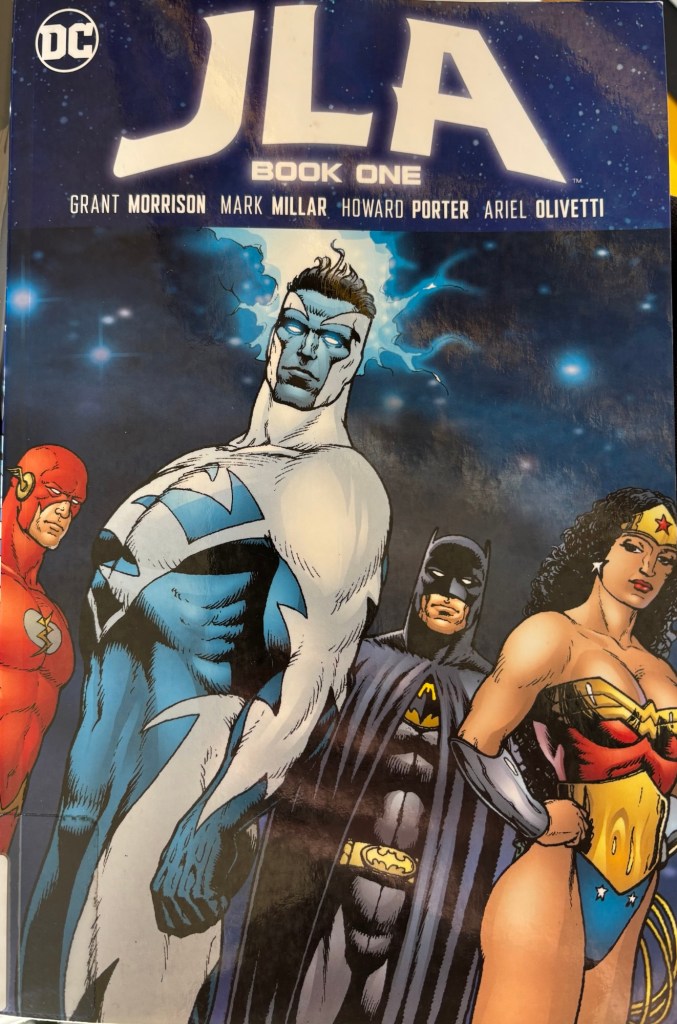
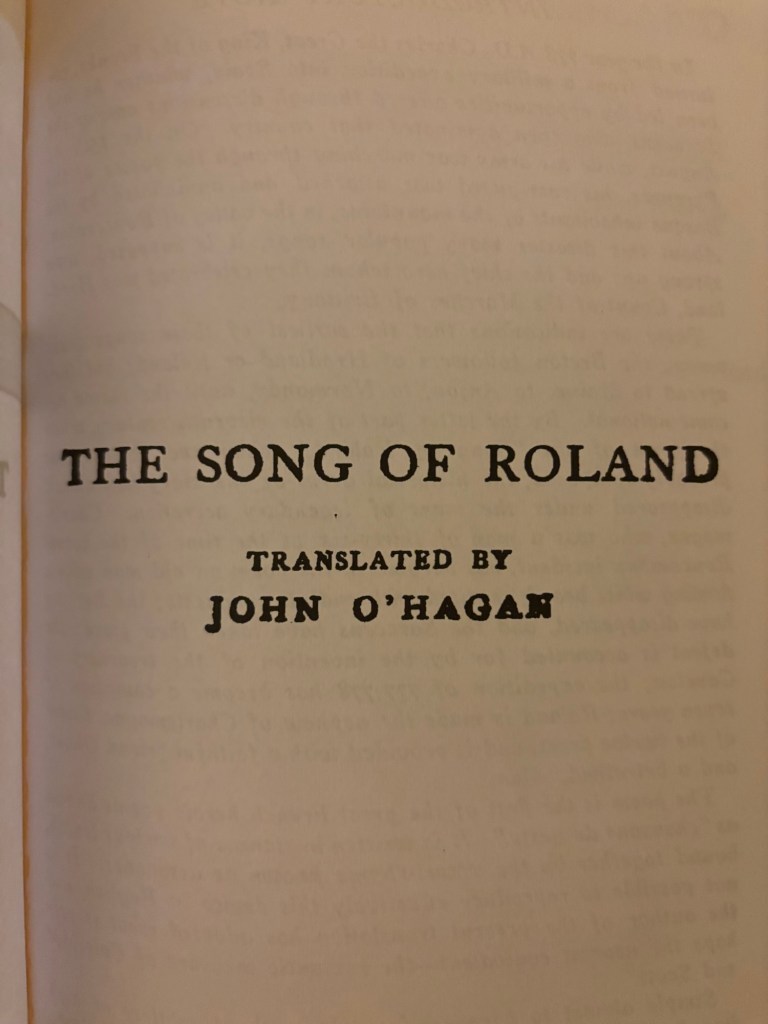
It’s been since September 20th that I posted an updated reading log. These six make it seem like I barely made time for my hobby. I can’t explain it, but except for last hitch, I have been reading as normal.
****
George MacDonald is just fantastic. And any book that includes dialect spelling is fantastic. So be sure to check out his Heather and Snow.
****
The Aristotle Nichomachean Ethics section was exceedingly worthy. Most importantly, the name (Nichomachean) derives either from Aristotle’s father or son. I say Aristotle wrote down what his father taught him. Be that as it may, the lucidity of the ethics are remarkable. Here’s one example for ya. You know how we always hear the BIPOC and BIPOC-infatuated leaders talking about “equity” these days? They throw out some idea like “equity, not equality”, right? Then they proceed to explain the most unequal thing in the most confusing way, right?
Well Aristotle (or his dad) used the word equity in the following way. He said there is the universal law, say, “Do not steal.” Then there is the nuances of the law, to include all the particulars, like, stealing a lot is obviously different than stealing a little. Aristotle (or his dad) uses the word equity to describe the nuanced consequences of the application of the law. In other words, the difference between going to jail and simply giving the stolen good back to the owner was equity. My example is correct in principle, not particulars. No matter how fine the law cuts it, there is gray in between—this is equity to Aristotle.
Here I don’t mean to applaud the idea of equity in Nichomachean Ethics, but to draw out for you that over two thousand years ago one man wrote clearly and it appears the best we can do today is worse.
****
Does everyone understand that George Washington was British? Did you know that Mount Vernon was so-named because George’s older brother, Lawrence, served in the British Fleet under one Admiral Vernon whom he so loved that he named his property after him? Has everyone slept outside in the cold with savages nearby, allies mostly, but likely enemies too? As holy writ declares, “We are but dust,” compared to this great man. You could read and re-read Washington Irving’s biography and never be worse for it.
****
I found this 600 page Justice League America collection of comics at the library. The series came out in the 97-98 time period. They were fun. Who doesn’t love the dynamic between Batman and Superman? And now I know more about Martian Manhunter too. The end of Justice League Snyder Cut always bothered me. But not anymore.
****
How many times do I have to write about the moooslims? One more I guess. That’s what the Song of Roland is about. French Christian Knights vs saracens. I read the long epic poem, supposedly a first of its kind—its kind being nationalistic or patriotic poem—in two days. I go so deep when I read that I don’t recommend this to anyone similarly talented. I mean, for a day or two, I thought I saw everywhere the mooslims were invading our lands.
****
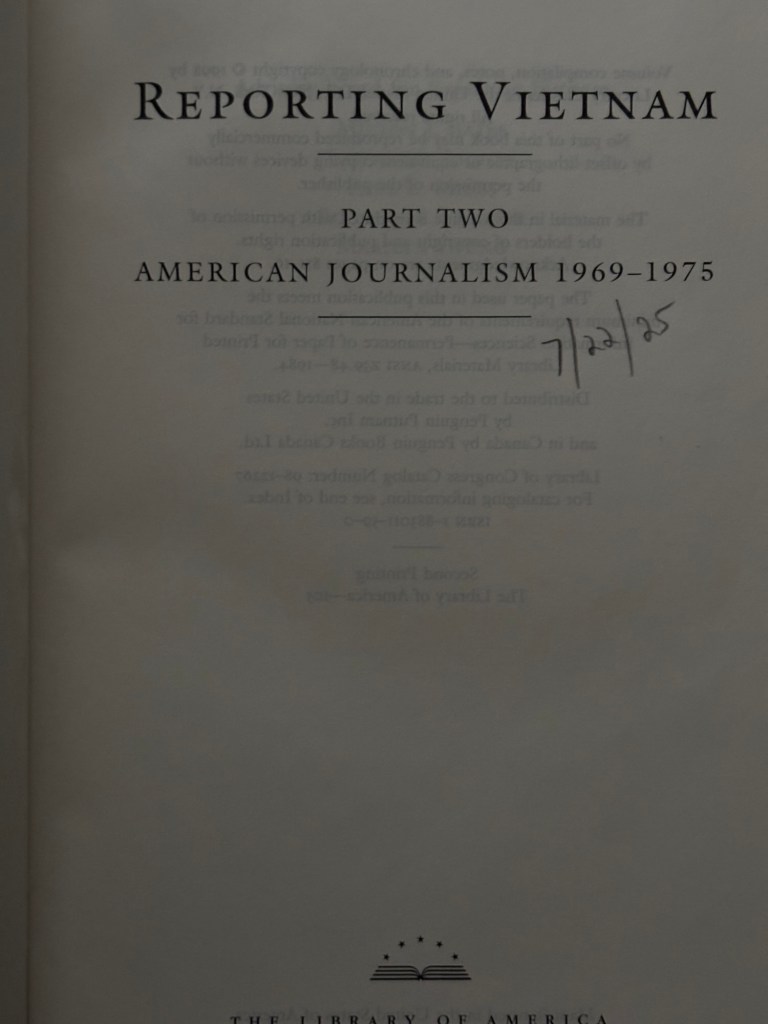
What can I say about finishing the two volume Reporting Vietnam set? Couple things. First, the French had colonies in Vietnam before WW2. (Maybe earlier too.) But the point is that France took such a beating in WW2, geographically situated as they were, that the Allies decided to help them rebuild after the war. That is where America enters Vietnam—what is so wrong about helping French rebuild their colonies?
Second, during WW2, Ho Chi Minh gained power because he wanted all the foreigners out—Japan and France (later America etc). It will be forever debated if he was a communist at heart or just used communism as a timely tool.
Third, I used to think it cool to baldly state, “We lost Vietnam.” I remember even daring my helicopter instructor pilot who fought heroically in Vietnam to admit it, which he did unreservedly, probably for the millionth time to POS’s like me. I will never say this or allow someone else to say it ever again. The US did not lose Vietnam. The South Vietnamese lost. We fought, we left. We did not lose. Losing a war is terrible. Never lose a war. Anyone who says anything to me about America that sounds like they want it to lose a war now gets verbally reprimanded at the highest socially acceptable level. Every person alive should want their country to win any war it engages, at nearly any cost, rather than suffer loss. We did not lose Vietnam.
In addition to having the above new things to say about ‘Nam, I want to share two images that now adorn my house. First, this hangs in my garage.

My gentle wife took days to notice and when she did, she asked, “Isn’t that a bad word?” in reference to the kids growing up with it in view. What a great question. How would you answer her?
Secondly, this is now the backdrop to my beloved piano.

I teach the kids to repeat after me, clockwise from the top, right first, then left, “Nelson (Nelson), Robert (Robert), Miguel (Miguel), Ho (Ho), George (George), Ghandi (Ghandi).” And I ask you, what do these men have in common? Why would I, Eagle Scout, USAF Pilot, Baptist, and Thanksgiving-and-Christmas-working first responder have Ho Chi Minh on my wall, my mind, and my children’s minds?
Hint: the key to life on earth as an American is the Vietnam War. There’s a reason for the current confusion. And it has nothing to do with events of the day or what you consume daily; it has everything to do with what you have never read. Both the reason you have never read it (or been required to—nothing conspiracy theory here—just general shame and incompetent teachers) and the history you will discover upon reading it are relevant.
On Higher Education
I read and I read and I read.
It’s lovely.
But even I have doubts as to what exactly to do with all the knowledge. I am not interested in being a college professor. There was a time when I could almost imagine working hard and becoming an Indiana Jones-style biblical archaeologist (yes, kids, there are archeologists and they really do have dangerous/exciting experiences depending on the types of finds).
But that mood passed.
I ate with an old professor and we briefly discussed the pros and cons of re-engaging formal education. I wasn’t sold that the pros outweighed the cons. Specifically, every part of actual biblical training and academics is losing ground to the soft skills of Christian counseling and other versions of underwater basket weaving. Why join a dying breed? There simply is no demand from the public for an educated pastor. So the degree has to be for teaching or research, and the field is near exhaustion.
This brings me to the catalyst for this post. Check this endnote out. It is from Fr. John P. Meier’s A Marginal Jew: Rethinking the Historical Jesus, Volume 5 “Probing the Authenticity of the Parables”. I have been reading his Marginal Jew books since 2001 (24+ years). I think in the beginning I used them against Christianity as I questioned the Faith, but over time they actually have become some of my favorite books on Christianity-ish, outside of the inspired canon.


All of those listed titles, articles, books etc. are about just one (1) parable. I have been in churches for probably 25+ years and I don’t think I could list that many individuals who have commented (informedly or free-association style) on any one (1) parable. Fr. Meier, on the other hand, read three pages’ worth of scholarly commentary. (And in at least two languages.) Talk about putting me in my place.
I take it all back. I do not read. I do not read. I do not read. And I have no business ever lofting an opinion about anything into the air.
In the end, Fr. Meier and his impossible bibliographies (1) arms me for rhetorical battle with the loudmouth ‘educated’ nonbelievers that I sometimes run into and (2) keeps Christianity larger than life.
I think my favorite title from those listed is, “Excuses, Excuses: The Parable of the Banquet (Luke 14:15-24) within the Larger Context of Luke.” Funny guy.
Also, not that Meier loves its conclusions, but he did reference it enough that it sounded kinda like a definitive work so I did pickup a used copy of Snodgrass’s Stories With Intent—a 900+ page comprehensive look at the generally eloquent parables. I have to admit I haven’t been this excited to read such a book in many years. So add that to Meier’s effects: inspirational.
The Less Committed Noah, A Review of “The Coming Wave” by Mustafa Suleyman
To recap, I admitted to myself some months ago that I knew nothing about AI. I also doubted that anyone uttering the sounds, “A-I” (“It’s an acronym”, taught Kamala), knew much more than me. This belief was bolstered and informed by my nearly-techie brother’s share that his bosses advocated the use of the phrase wherever possible during meetings with clients as it perked people up. In other words, AI is trending. (There is nothing new in this confession of mine.)
The first book I decided to read was Melanie Mitchell’s Artificial Intelligence: A Guide for Thinking Humans.
I then asked a friend for any recommendation he might have, and that is how I ended up reading Suleyman’s book.
To be clear: there is no need to read this book. It is not earth shattering. It will not change your life. It truly does not have much by way of content. A Toastmaster friend once told excitable me, in an effort to dissuade me from buying his book, that these days books are little different than business cards. That is about right for Coming Wave.
But I did read it and consider it and this is my blog so I am going to share my thoughts.
Maybe because I have been reading a bunch of ‘evolution of physics’ books, I read “wave” in the title and pictured (and was intrigued by) the wave in lightwave. Maybe it was because I have already asserted that AI is merely man’s newfound ability to sense electricity with greater refinement than ever before that I didn’t see “water” wave. Whatever the reason, I was totally taken aback by Suleyman’s opening alignment with Noah. It’s actually shocking. Seriously, consider it. There is a man, who by all accounts is ‘successful’, and he chose to warn the world of cataclysmic disaster.
What?
Perhaps it was my background in Biblical Studies that clouded my thinking. But the end of the Deluge account in Genesis includes the Rainbow and the promise to never flood “the world” again. This leaves two choices available to authors. First, believe the Bible story and live a peace-filled life. Second, totally miss the conclusion of the Bible story and with astounding boldness, still identify yourself with the main character in some bastardized version of the story.
But what do I know? I’m often told it is better to not throw the baby out with the bathwater.
So I read on.
Suleyman opens the book with a Glossary, much like post-graduate work requires. But unlike post-graduate work, no editors or friends told him that his definitions are nebulous. Take “Waves” for example.
“The global diffusion or proliferation of a generation of technology anchored in a new general-purpose technology.”
Global, generation of technology, anchored, and general-purpose technology all need to now be defined.
Another term (pessimism aversion) includes the word elites. What exactly is an elite? My best guess is the intro-extro couple from Susan Cain’s Quiet who can’t decide on how to seat guests at their parties. (Throw pillows and a bar with top chairs was the solution, if I recall.)
All this might seem too detailed and in the weeds, but I assure you of my earnestness. What exactly is the threat? Why don’t I feel it? How come when I hear “pessimism aversion” I think, “Does he mean hope?”
I’ve talked about how unappealing it is for politicians to constantly hedge their positions elsewhere on this blog. Well, Suleyman cannot but hedge. His warning, so laughable, is always immediately followed by, “But it is also possible that it only rains the exactly perfect amount.”
Fourteen chapters, two hundred eighty-eight pages worth of Noahic warning, immediately hedged.
Again, Noah didn’t hedge. This commitment is one major reason Noah is timeless. Suleyman, on the other hand, will not be remembered. His wave will not form—regardless of his book’s grand clarion call for containment (and central planning at a level red blooded Americans will never tolerate).
Moving on to “new to me”.
I have to admit that Suleyman did introduce a few topics that Mitchell left out of her more focused general audience primer. Synthetic Biology, according to Suleyman, is a hand-in-hand technological advancement. Think Arnold building Arnold.
Suleyman also introduces the concept that, running with the Terminator theme, Arnold won’t care about nation-state boundaries (which Suleyman defines, abhorrently, as “collective fiction resting on the belief of everyone concerned”). The example of this coming hellscape (the “warning” before the hedge) being, ta da, Hamas. Or, maybe a good analogy are the fringe groups in the NW part of America which seem to always be trying to separate statutorily from anyone who can say “sanctuary city” with a straight face.
Then again, it is possible that AI actually ushers in more rainbows and the first ever unicorns. You just never know.
To be honest, and this is the end, Suleyman’s main problem is he cannot (nor can anyone it seems) meaningfully define AI. Melanie Mitchell essentially teaches us how AI works, but Suleyman doesn’t mean that AI. His warning is about the coming AI. You know, the one that really is going to put an end to the Anthropocene and all the blood-pumping bipedal organisms with opposable thumbs and large frontal cortexes.
My final takeaway, the one I sent to the recommending friend, is: Either (A) AI programmers like Suleyman are trying to suggest the coming AI is concretely analogous to handing nuclear bombs to the homeless or (B) they don’t mean that.
If (A), then right now we must immediately issue a call to arms and begin a first of its kind unceasing kinetic war against them. If (B), then there is no coming wave.
Reading Log 8.6.25



I used to have a several t-shirts which had authors’ faces on them. James Fenimore Cooper was one of them. I just like his books. They feel historical, even though I know they are fiction. If you are open to testing the waters, I’d start with Last of the Mohicans, but eventually Afloat and Ashore should be read.
I will write a proper book review of Suleyman’s The Coming Wave soon. (It’s about AI.) Just know that he opens by expressly saying that he means to call to mind Noah with the word “wave”. Oooo. Scary.
Poems are what they are. Some are fun. Some are painful to get through. Holmes obviously wrote with great ability. But that didn’t mean his poems are all tier one.
Volume 1 of Reporting Vietnam (and what I have read of Vol 2) will change your life. These should be required reading for all American highschoolers. In short, Ho Chi Minh first entered the political scene in a big way in WWII by insisting Vietnam should be independent. Then in an interview in 1962 he said it will take maybe 10 years for America to give up. In 1973, before a full 10 years, America withdrew. Consider these facts. Ask: Why did America oppose Ho? I am of the firm opinion that in the future, it will be common knowledge among American History buffs that Vietnam was the true turning point in American History. Everything occurring today (in politics) goes back to that war. To be clear: The lesson I will distill to my own progeny is the following. “Ho wanted something and achieved it. Why did America even try to stop him? Oh, I know. Communism. Well, ‘F$&* Communism’. Communism makes people lose their minds. Why? It’s not to be feared. No idea is. And hug any Vietnam veterans that you meet. Also, America has no duty to help any country out of some sort of compassion. We now have Vietnam, Iraq, and Afghanistan (hopefully not Ukraine) as proof that the task of “helping” is impossible. People have to help themselves. America should do what we want precisely because we want to do it. Period.”
Aeschylus’ poems are fantastic. They are timeless too. Read and re-read.
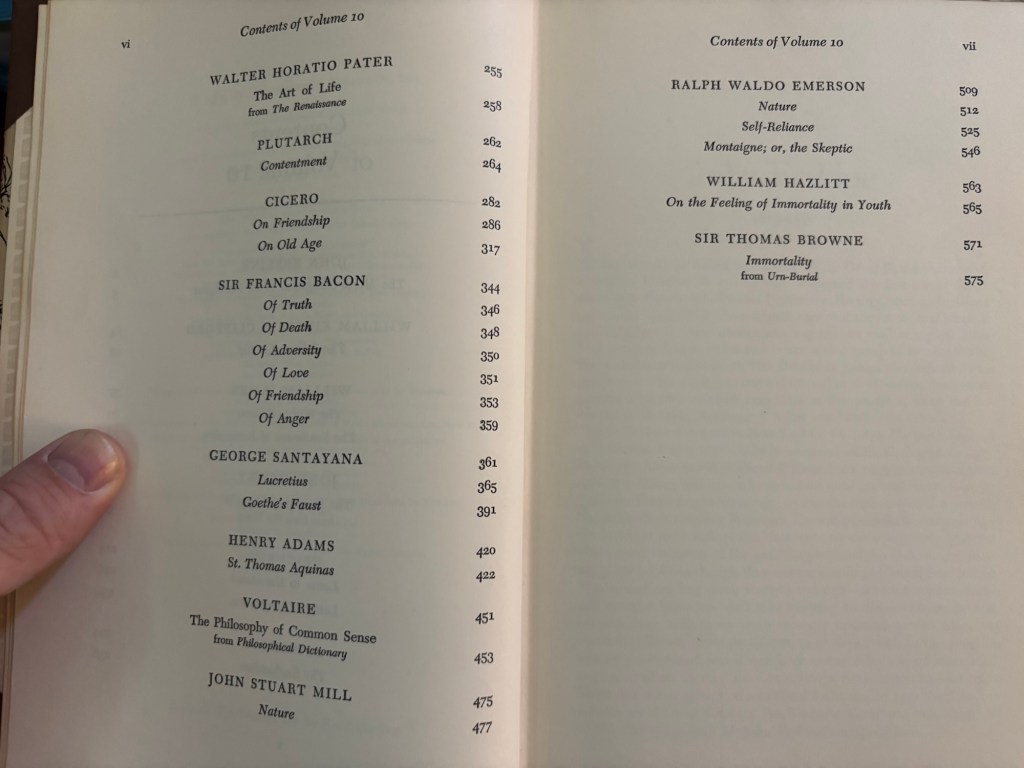
Those essays in Volume 10 (final volume) of Gateway to the Great Books are exceedingly worthy. Of special note is JS Mill and Voltaire. Emerson is a great contrast to Mill. John Dewey is a must-read for anyone in Education—but unfortunately he will never be read by the uneducated. Sad.
Finally, the Vicar of Wakefield. This is a book that “moralizes”. Do you even know what that means? It means to use a story to teach how to act. Our culture, nearly every member, regardless of gender ;), does not believe in teaching morality. So you will not likely see the value of this book. I even doubt that my kids will understand it. But we’ll find out together when they’re old enough. Not the best book. But a good one on how to find happiness during unhappy circumstances.
The Game of Telephone: Why You Need To Read More
The game of “Telephone” among famous scientists does not start and stop with Newton and the apple that he never wrote about.
Check this out.
Bertrand Russell was born in 1872. In 1897 he would have been 25 years old. In 1897 he published a fellowship-winning thesis. It was entitled, “An Essay on the Foundations of Geometry.”
Read this.

Those words were published in 1897 (same year as Russell’s first book) by William James. (See highlighted parts.)
Now read this.
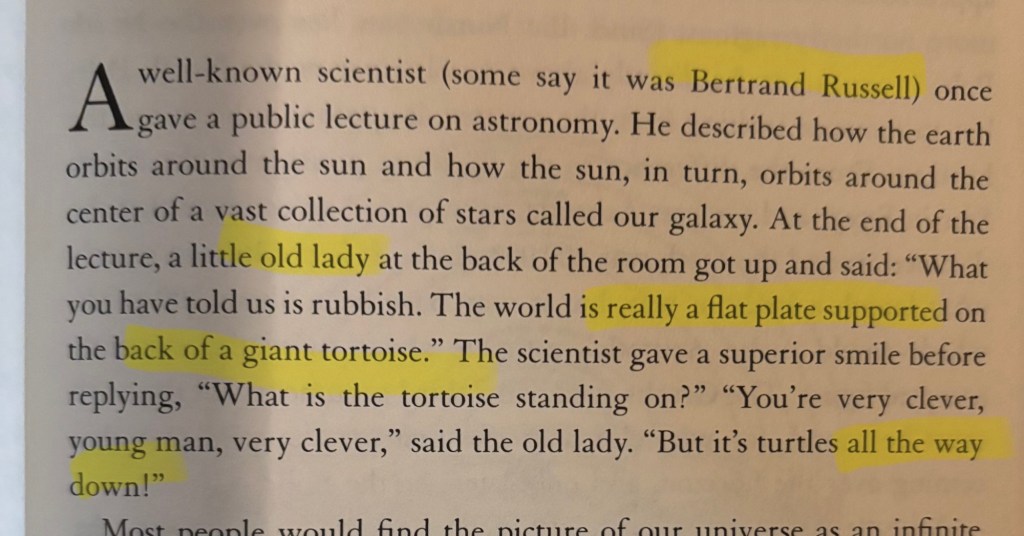
Those words were published by Stephen Hawking in 1988. (91 years after Russell was 25 years old and published his thesis; 91 years after James’ words were published.)
Sure. I grant you that it is possible that Russell gave lectures to little old ladies in 1897, despite his being 25 years old and having only published a thesis on geometry that no little old lady would ever be interested in (or aware of). But that only solves the lesser problem. How does “rock” become “turtle”?
Seriously.
Obviously the nature of the situation is Hawking placed the importance of “truth” well below standards when deciding how to open his best-ever-selling book (that is seriously flawed for more than this reason).
****
This is why you need to read, and read, and read, and read, and read. The solution is more reading.
Reading Log 2.21


Seems like I’ve been saying it for so long that everyone should know, but ICYMI, Last of the Mohicans is actually one of five (5) books Cooper wrote starring Natty Bumpoo/Hawkeye/Deerslayer/Pathfinder, or more commonly, Daniel Day-Lewis. The Pathfinder is 3 of 5, taking place after LOTM events—and without reference to them.
It is just great. I have read three now and plan to pace the remaining two Leatherstocking Tales so that I don’t peak too soon before death. Nothing makes me want to go camp and hike and scout and track like Cooper’s tales.
The Aliens epic collection was alright. Nothing great. But it did have some interesting storylines and the art was beautiful. One thing that that volume unexpectedly contained was a sort of short story, written in prose. And that story was graphic as anything I have come across. I have previously been made acquainted with the works of an author named Neil Gaiman and these cause one to blush. This story was along those lines. Most Alien stories have the lead as female, and this time she is only able to perform her heroine duties because of the abuse she suffered as a little girl. Bluntly, parallels are made in the story between her waiting on the monsters, and her waiting on the monster. Sick stuff.
Oh. And like the comment I made about how reading too many comics in a row kinda highlights the undeveloped-ness/infantile-ness of these stories, I now more clearly see that every Alien story ends with the main character learning that despite the recent total victory (extermination), one xenomorph embryo still exists and is poised to makes its way to another human settlement. I hadn’t really noticed that just from the movies. Oh well.
Relativity.
Here’s what I’ll do. These are the few summative statements Eddington offers. Comment below if you find them useful.
“A gravitational field of force is precisely equivalent to an artificial field of force, so that in any small region, it is impossible by any conceivable experiment to distinguish between them. In other words, force is relative.”
Actually, that is the only one that makes sense for a blog post. The big analogy that Einstein developed was the elevator (or “lift” if you’re reading in the mother country). Newton, you’ll recall, realized that if “bodies in motion tend to stay in motion unless acted upon etc”, then the Moon would have long ago kept going right past Earth, as Earth would have kept right on going past the Sun etc. The force that keeps the orbits is called gravity. Einstein, then, realized that artificial “gravity”, literally the kind you feel at the beginning of an elevator ride, is experimentally no different than “real” gravity.
Okay. Relativity is interesting but I prefer the universe stuff. (And am scheduled to read more on that next.)
Lastly, I want to conclude with probably the most fun takeaway from the book. It is from the chapter “Weighing Light”.
“It is legitimate to speak of a pound of light as we speak of a pound of any other substance. The mass of ordinary qualities of light is however extremely small, and I have calculated that at the low charge of 3d. a unit, an Electric Light Company would have to sell light at the rate of £140 million a pound. All the sunlight falling on the Earth amounts to 160 tons daily.”
A Year of Reading in Review
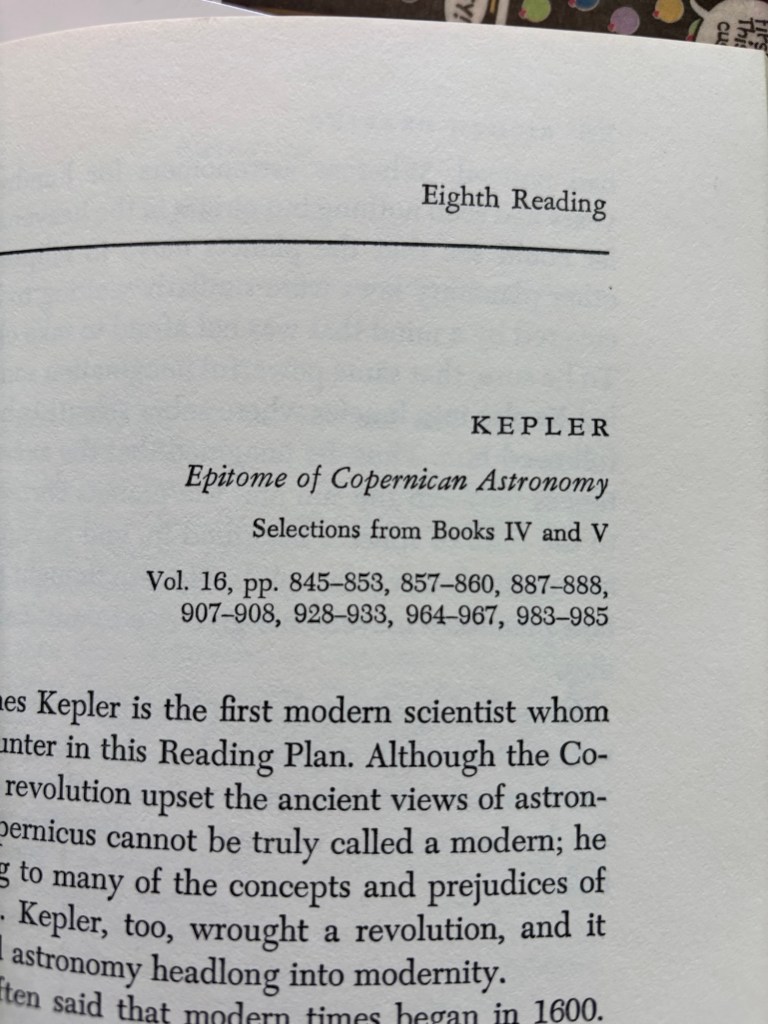
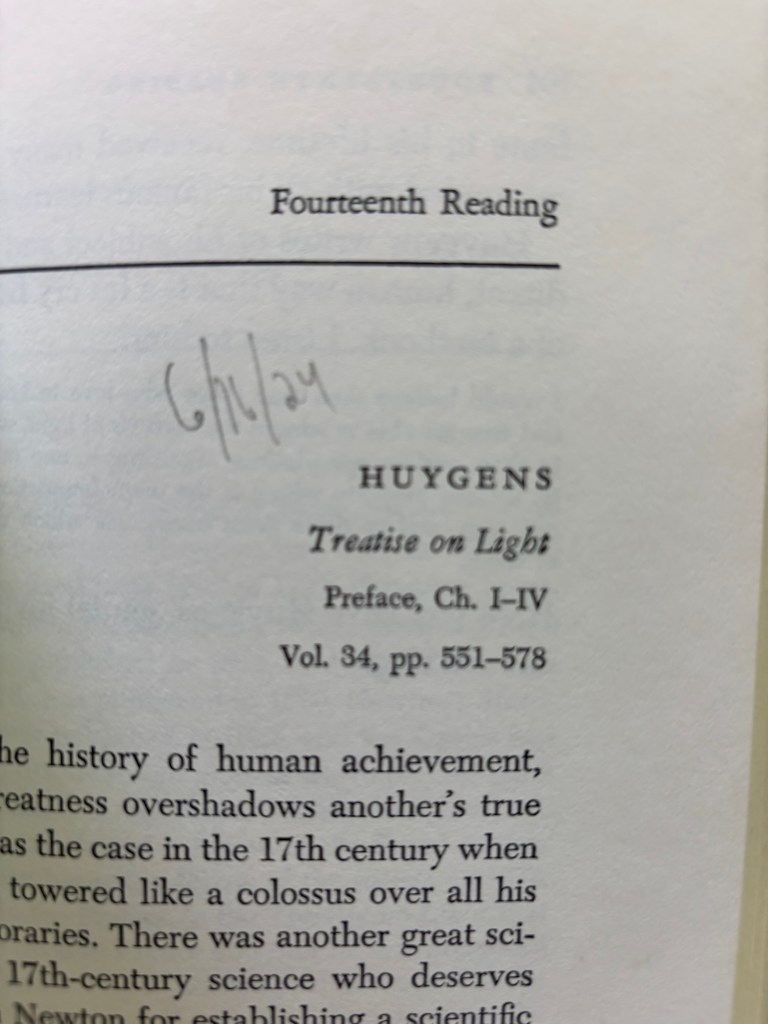
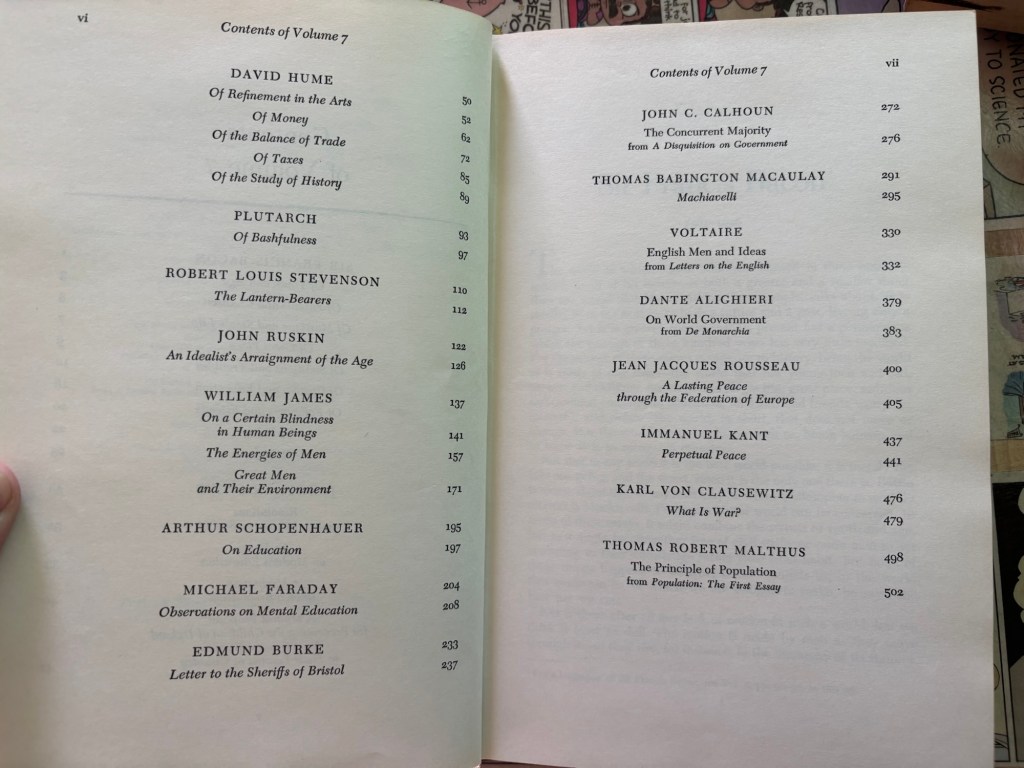
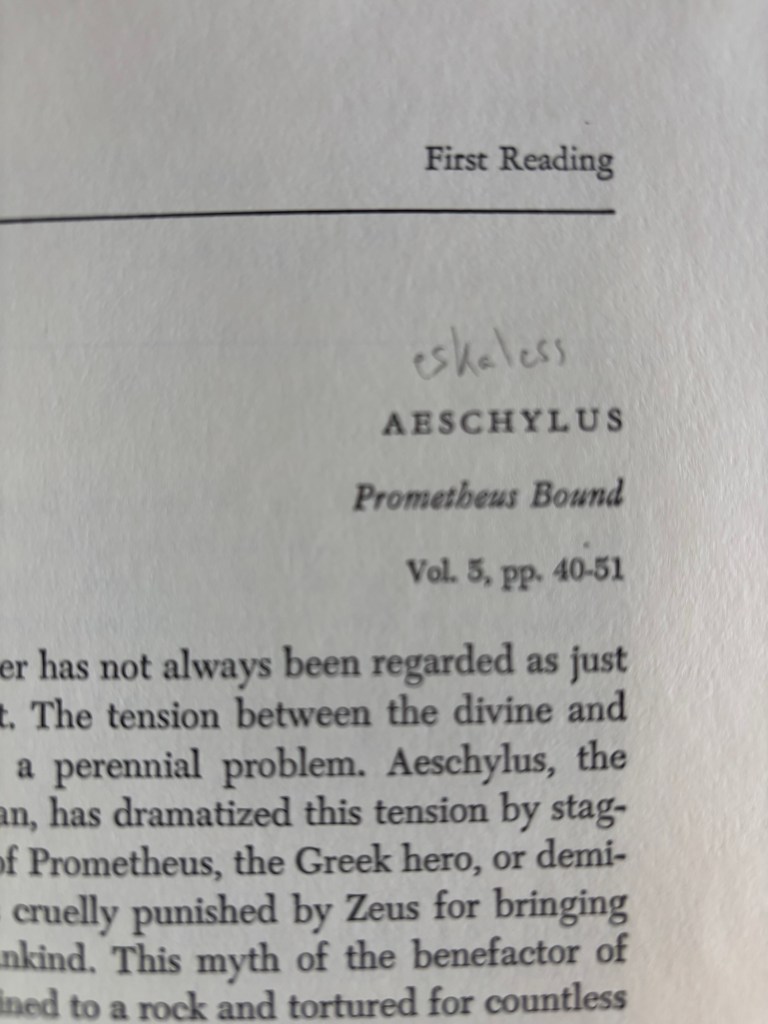
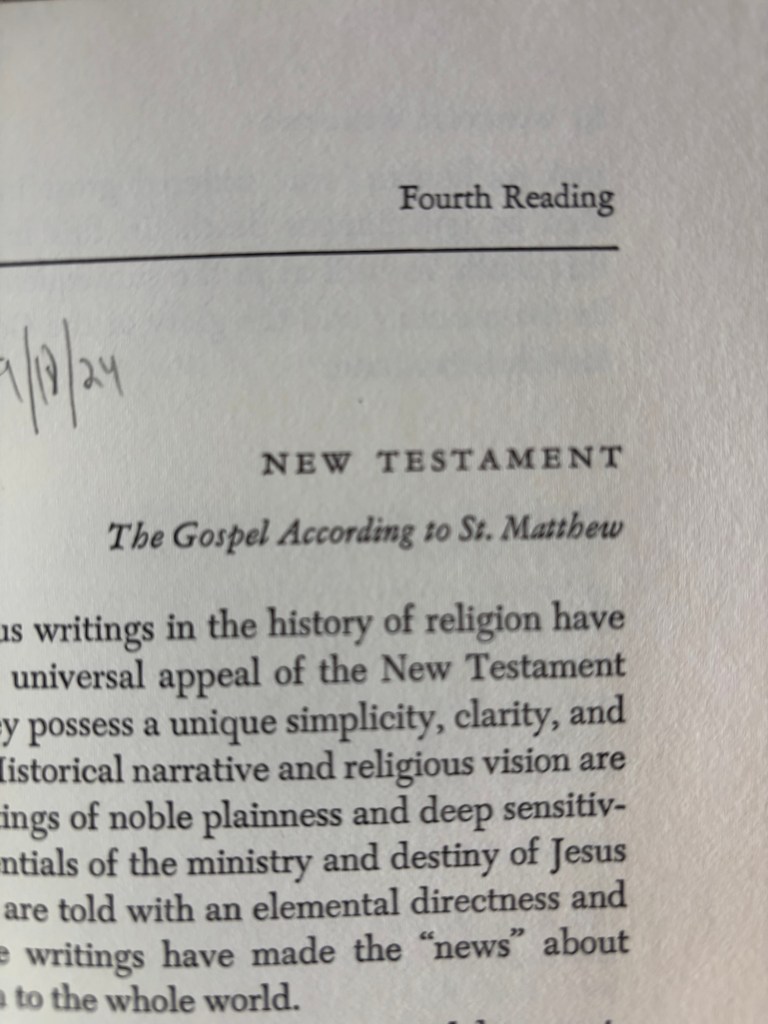
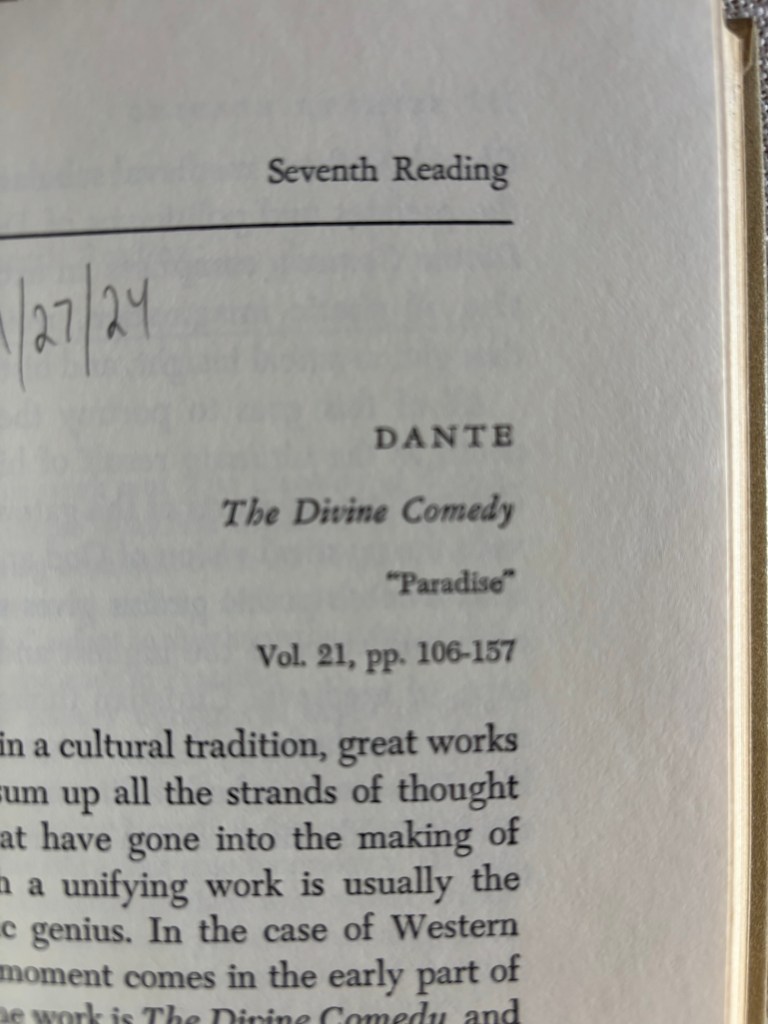
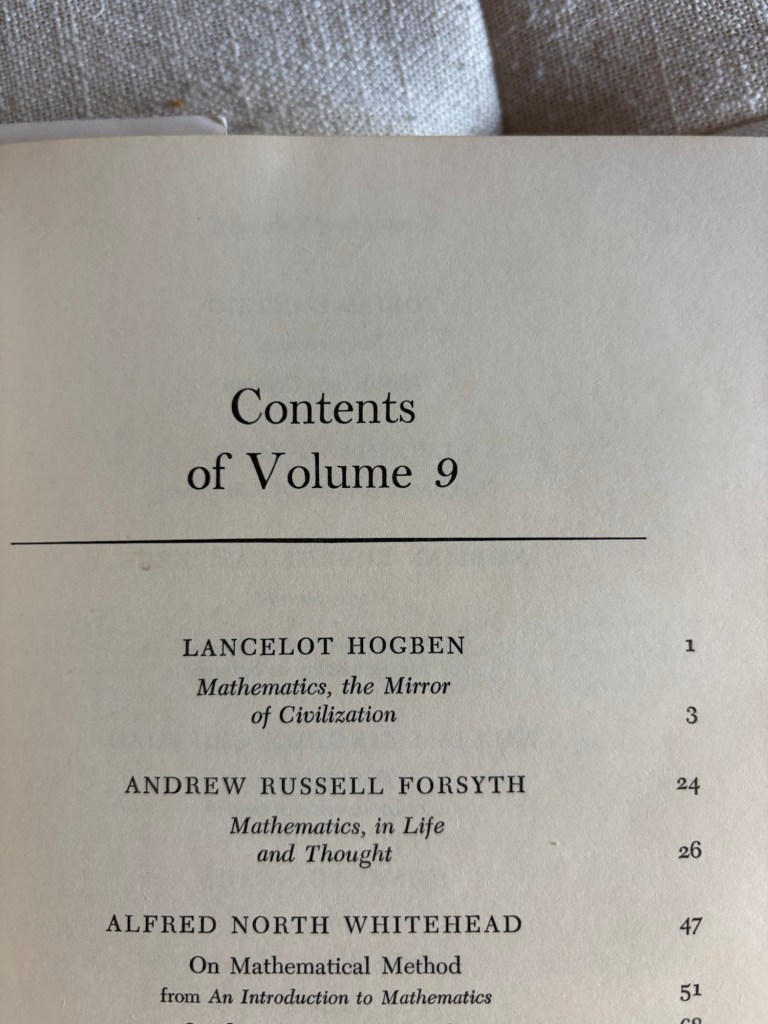
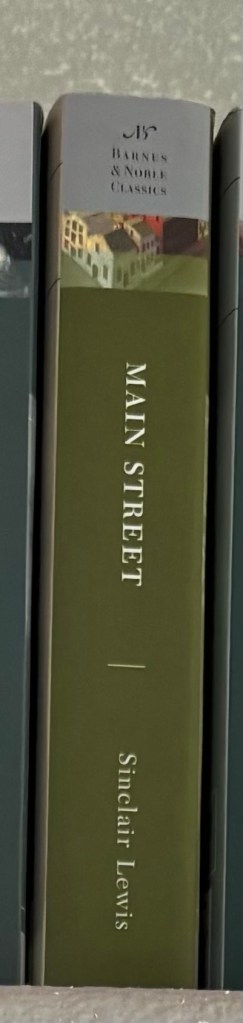
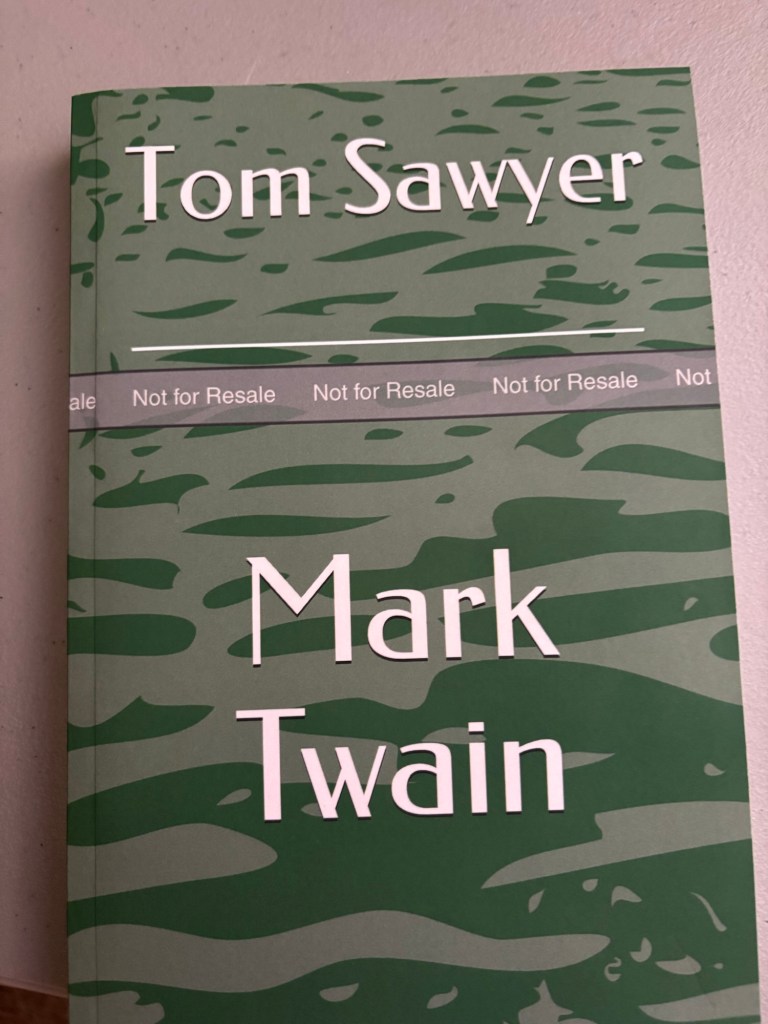
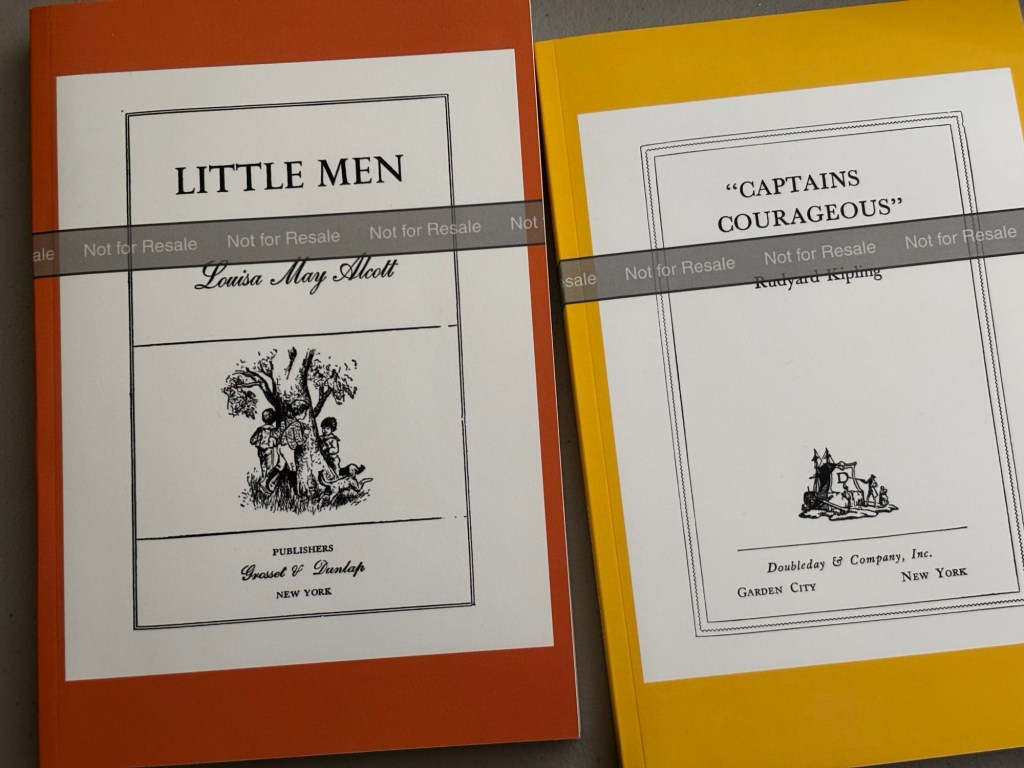
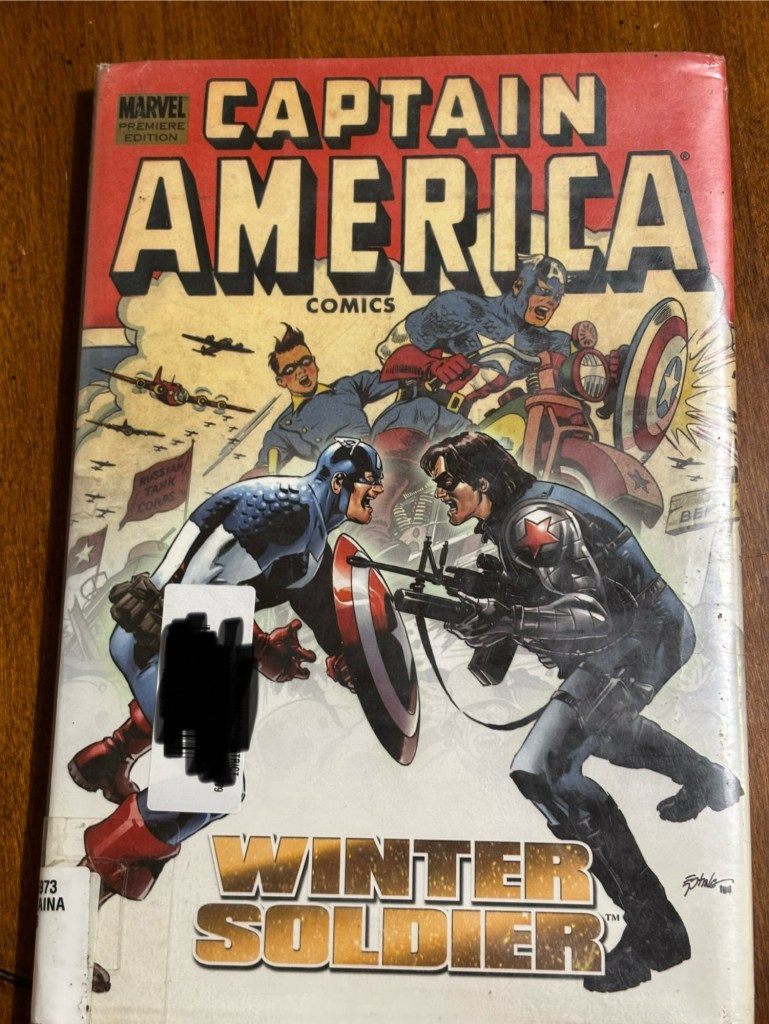
As promised, so far as I remember and/or marked, here’s what I read in 2024. The colorful books with the banner “not for resale” really were just since October—I’ve been on a tear of late. Same with the comic books; when I cut movies (for the most part), I had to find something light and so chose comics that I always wanted to read. You don’t see a few others from a “Predator vs. Black Panther” series and an “Alien vs Avengers” series. A collection of Jack London is the two-page table of contents pic that starts with “The Yukon” and ends with “White Fang.” The individual “First Reading” etc are from the Great Ideas Program. And the table of contents of essays are from Gateways to the Great Books companion set to the GBWW.
I may post again with an answer to the question, “So what did all this reading do for you insofar as tangible results, Captain?” For today, I want to share an infamous quote by Faraday. When he was asked, “What is the point of this discovery of yours?”, he responded, “What is the point of a child?”
Happy New Year!

















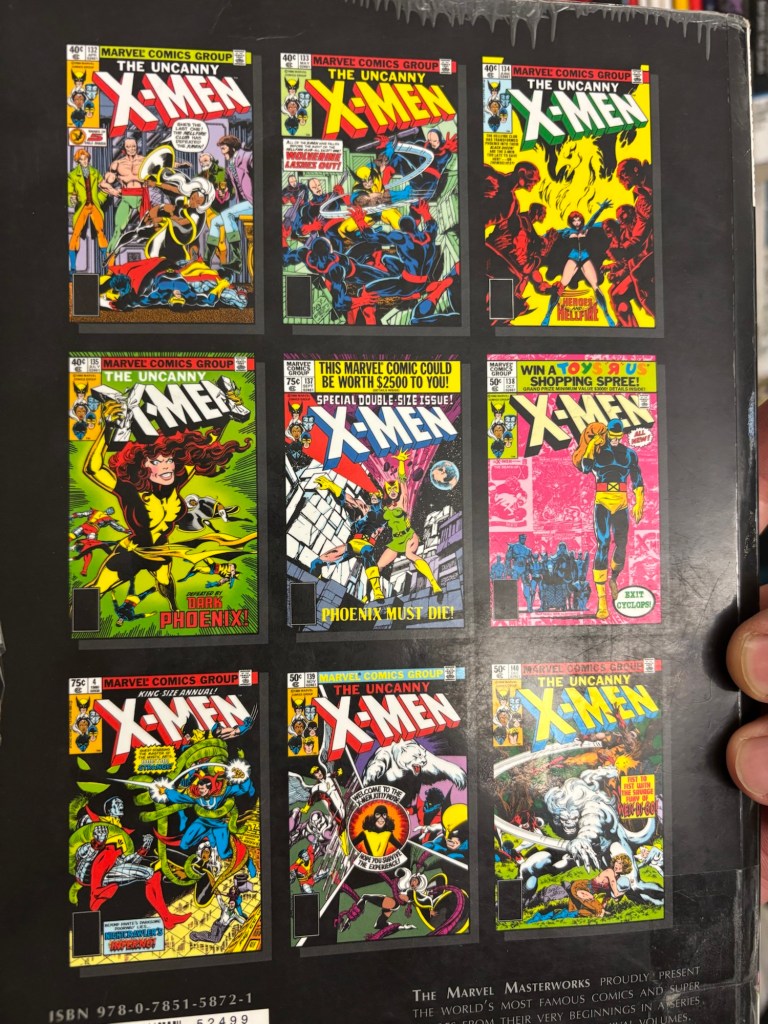


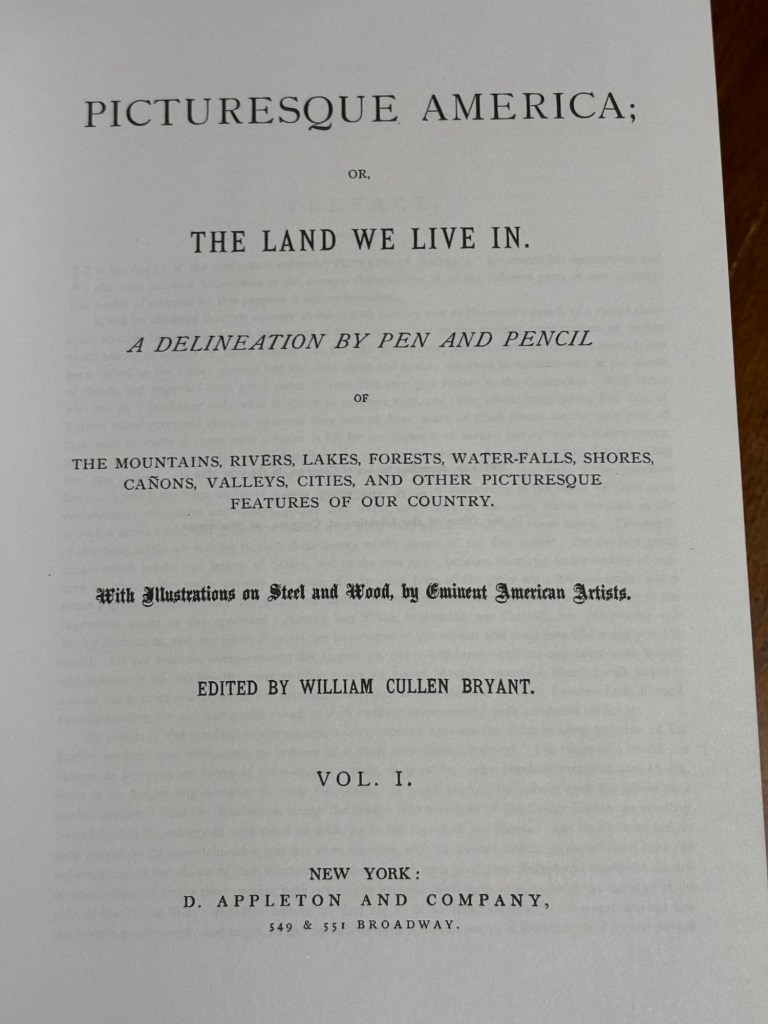
Some Outstanding Quotes From Recent Reads
A book I have always dreaded is, “Up From Slavery” by Booker T. Washington. I viewed it like the pet shop snakes Pee Wee didn’t want to rescue from the fire. I could not have been more wrong. It is astonishing. (For the uninitiated, it was written around 1900; Washington was a former slave turned champion of education and recognized leader of the Negro people in the times that followed their big day.)
“The white man who begins by cheating a Negro usually ends by cheating a white man. The white man who begins to break the law by lynching a Negro soon yields to the temptation to lynch a white man. All this, it seems to me, makes it important that the whole Nation lend a hand in trying to lift the burden of ignorance from the South.”
(Pause here to consider the fullness of love captured by those words.)
“Nor should we permit our grievances to overshadow our opportunities.”
And I add this next one with a special eye affixed on Black Jesus himself. (Please recall this was spoken by a former slave. No bed, no bathing, no shoes, no toothbrush, no mealtimes. Scratchy shirts, no education. Etc etc.)
“The wisest among my race understand that the agitation of questions of social equality is the extremest folly, and that progress in the enjoyment of all the privileges that will come to us must be the result of severe and constant struggle rather than artificial forcing.”
That begs repeating.
“The wisest among my race understand that the agitation of questions of social equality is the extremest folly, and that progress in the enjoyment of all the privileges that will come to us must be the result of severe and constant struggle rather than artificial forcing.”
(It’s only natural to take a quick break before continuing to the next quote.)
Long ago I bought Thomas Aquinas’ Summa Theologica, partly out of interest, partly to impress a girl. I never opened it that paperback copy. But a beautiful hardbound copy was in my Great Books set and the guided reading propelled me to taste and see. So I finally had a chance to discover what it’s all about. Couple to this that back in Seminary (Evangelical, not Catholic) the phrase “intellectual assent” was thrown around like “please and thank you”, usually in a smug, “Faith isn’t just intellectual assent”. (This was said in conversations about apologetics and sharing the Gospel in general.)
“Now the act of believing is an act of the intellect assenting to the Divine truth at the command of the will moved by the grace of God…”
For the thousandth time then, say it with me, “We’re all just little repeaters”. It’s depressing in a way. But it’s also fun to track down the true creators among us.
Next and last for today is Jack London’s White Fang. I can’t recall if I ever read it. I know I watched a movie from the 90s by the same name, but to suggest it was based on the book I am reading would be criminal.
(Keep in mind this quote is about a wolf *wink*.)
“But there were other forces at work in the cub, the greatest of which was growth. Instinct and law demanded of him obedience. But growth demanded disobedience.”
(Another long pause for contemplation is only natural here.)
I write these posts for me. But I confess to you that today I write with the hope of spurring someone, anyone on to the delight of reading Up From Slavery and White Fang. (Aquinas is too much for anyone not professionally interested.)
Foucault’s Pendulum and Spheres and Earth and Friends and More!
Careful readers noticed yesterday that I used the words “pope” and “Copernicus” when dismantling Tesla-lovers’ desire to save the planet while they commute alongside me. I did this because my guided reading through the Great Books of the Western World has landed me in Ptolemy and Copernicus (and now Kepler).
I told a co-worker that I feel like I’m reading sacred scripture when I read these guys’ words. I mean they are it. These are the ones who tackled the big problems and won (and lost). I cannot emphasize enough how interesting and provocative the writings are—especially the ones that have been disproved. Just fascinating. For example, did you know that folks knew Earth was a sphere over 2000 years ago? They knew. And they knew through easy methods that even you and I can understand, the most simple being that during lunar eclipses, the shadow on the moon is always circular. And only a sphere object can do that.
Anyhow, in short, (because I know you aren’t going to rush out and get the set) Ptolemy (and many in his day, circa 100-200AD) thought the Earth was an unmoving sphere inside a larger rotating sphere which was lined with the stars and the other lights of the sky. To be clear, this is a ball within a ball scenario. Like if we go to a planetarium and lay back in the dome structure to “ooh and ahh” the night sky as projected digitally, that’s pretty much what they thought. I mean to emphasize that they did not see the night sky (or day sky for that matter) as “deep”. Had they thought to travel out to the lights, they apparently thought they would hit a wall/boundary. (Keep in mind, they didn’t conceive of traveling off earth.) This, of course, stands against everything we moderns believe, which includes that we can and will journey further and further and further away from the Sun/Earth or really anything out there.
With me?
Next, it was Copernicus who went through the Pope (and had to in 1543–life is so different today—so very different) to correct Ptolemy’s errant belief that Earth was the center of the larger sphere. The Sun was the center—and, put simply, for the reason that it makes the math simpler. Note here that Copernicus still did not believe that space went out and out and out. (He also showed other things, such as the Earth itself moves and this what makes the stars appears to move, not the other way around.)
In the guided reader, they make mention of the types of proofs that Ptolemy and Copernicus were concerned with and this is where it is mentioned that the Foucault Pendulum was finally invented and put to use in 1851. You can look it up yourself; I still don’t fully understand how it works. Maybe you will. But when you look it up, you’ll discover that these pendulums are all over the globe now at various science museums, and they report in to each other. It is this comparison of observations that is truly the mechanical proof of the rotational movement of the sphere earth.
This was a “Eureka!” moment for me.
To rehearse and summarize some of this trivia, Ptolemy really made his mark because he took into account past astronomical observations and added to them an extensive new amount of data. Then Copernicus did the same. (See the methodological trend?) By the time we get to Foucault’s Pendulum, we already have an established pattern of humans using other humans’ information, so the idea of sharing the results from these pendulums that are swinging all over the world is not entirely new.
Are you tracking yet?
(I enjoy leading folks to the conclusion rather than just bluntly stating it, but I’ll be blunt after one more clue.)
Put another way, Ptolemy alone didn’t suggest the Earth was the center and a sphere. Copernicus alone didn’t suggest the Sun was the center and the Earth rotated. Foucault alone didn’t prove that the Earth was a rotating sphere.
People need people! Get it?
We all have encountered Flat Earthers of late. Or most of us have. Guess what? They are alone. They have no friends. Even the others at the conventions aren’t friends. They don’t compare notes and use each others’ new and unique and accurate and confirmable measurable data to develop and defend their idea. They just bleat. Bah bah baaaa.
I am impassioned by this topic because a very good former friend of mine that I met at the seminary revealed his insanity when he one day decided to lob a joke about the earth being round into the fray. When I didn’t buy into his BS, he wouldn’t allow for any other topic of conversation to pass.
Keep in mind I told him, “I don’t care which mental construction of the universe you hold in your mind. I just think we should be able to talk about something else too.”
Nope. He wouldn’t move past it until I agreed with him.
I had invited him in for lunch in my seminary, Steinway-housing apartment. His wife and him (and baby) hosted H- and I for an afternoon meal and relaxing stroll at his place. We were at the seminary together. Man. It was/is frustrating. But it also proves my “newly learned” point. These folks have no friends. (Did I mention he was a green beret? Yeah. Unrelenting persistency does not always pay off.)
Anyhow. Crazy times we live in. The good part, as I have said and wrote time and time again, is we have books. I’m still with TJ, “I cannot live without books.”
Peak Excitement
Most of you know I have been working my way through many writings and volumes of the 60 volume Great Books of the Western World set, via the 10 volume Great Ideas Program guided readings. Most readings so far have tended to be political essays, and so when I saw that the next volume, Volume 3, is Foundations of Science and Mathematics, well, you can imagine my thrill.
I am nearly finished with JS Mill’s On Liberty, meaning tonight may be the night. Queue DeVito’s serenade to Arnold in Twins, “Tonight, is your night bro!”
I have never considered myself a math guy and I hated physics and chemistry in high school. Chemistry was actually the class that ruined my chance to get a motorcycle in high school. Straight A’s? See ya!
But as I attended seminary, I dug into epistemology and all the reasons folks don’t believe in Christianity and the resurrection etc. and have ended up finding myself intrigued to always have a leg up on the ability to intelligently and succinctly speak to the origins and limitations of science and mathematics.
Have I said that tonight could be the night? It could be. Queue Tony and Maria, “Tonight, tonight…”
Usually Tuesday’s are when my wife joins her friends in prayer for hours and I get a movie night to myself. But I don’t think so for tonight. Tonight I get the chance, no, the privilege to open new doors of mind-space.
I ask you, faithful reader, does it get any better than these moments?
 Captain’s Log