Tagged: life
It’s My Birthday
I grew up on the movie City Slickers.
In short, it is difficult for me to not agree with his aging bit.
There’s also the natural element of “taking stock” in any anniversary. This seems to lead to either 1. forcedly happy and mostly untrue feelings or 2. depressing realities.
Something on my mind today is the recent observation (more to follow in my next reading log post) that life is unfolding precisely as we/I want. That is a scary thought, no? In my case, I put up with a lot of depressing shyat because I want to be around my kids as much as possible. But is there a way to be around them with less drama? I don’t know. It doesn’t appear so. But I am working on it.
I leave you with a sad, but I can report 100% accurate, commentary centering on the concept of “natural virtues” (you might say “inherent virtues” in 2025), with a close look at “veracity” and “savages”. JS Mill is the writer.

Thoughts on a Twenty Minute Walk in the Airport
I cannot emphasize enough how genius P.D. Eastman’s “Go, Dog. Go!” is. Nearly every description about the people (and dogs) I just witnessed is contained by that delightful children’s story.
Then again, it didn’t include a woman running in casual attire, or a pilot in the shoe-shine station informing ShoeShine Joe that his pants were tight.
It didn’t include a dad yelling out to his kids that while they were allowed to pointlessly ride the moving sidewalk, they could not run on it.
It didn’t include a man declaring, “He doesn’t even know how to build a client!” into his phone, or a pretty boy young man who made the command, and ill-advised, decision to wear boat shoes—without socks—as a complement to his fashionable ensemble and who now had his (red achilles adorned) heels on the outside/top of the back, almost like they were the newer convertible house shoes I have seen purpose-built with an optional fold-down heel, but, of course, his shoes didn’t have that feature.
The many heathen tongues abounded, too. P.D. didn’t see that coming.
Overall, it was another reminder that it’s a big world, full of people trying to go places. Most are ugly and won’t look you in the eye.
Our Betters
You know those semi-recent additions to highway signage? The huge black digital signs?
Well, last night, my windshield wipers were going so fast and making such a racket that I almost couldn’t read the message some of our betters felt necessary to share with me: “Rain and Wet Roads. Caution.”
This is as bad, probably worse than, as texture-less braille on the sign at the local park.
Filling Space
George Carlin joked about how people acquire space—then we fill it up. Something like, “Look! There’s some space! Let me put something there!” (It’s Saturday. I know. I’ll help if you’re not yet bright-eyed and bushy-tailed. Think of our closets, rooms, trunks of cars, open land etc.)
Isn’t the same thing true for mental space? I’m thinking specifically about “misinformation” “delusions” “lies” and the like. What is our problem? We just can’t keep mental space empty? We can’t admit “I don’t know” and wait to fill it until we do? Does there have to be a filler for every single topic that enters our mind?
Is that healthy? Does it even accomplish anything? We all just walk around spouting lies as if no one can tell, even though we also, on some level, know we “don’t know” everything?
Is it really so hard to keep a clean mental house? Is it really so hard and inhumane to tell your conversant, “Now, you know that’s not true”?
What is it? Is it that we need people in proximity to us so desperately that we’d rather put up with their incessant, void-preventing bullshyat than call them to try harder to keep their integrity?
I don’t get it.
On The Highly Placed Women Of Mission Impossible: The Final Reckoning
The only criticism I dared mention to my group after the movie (it was midnight and we were tired) was, “I think they went a bit overboard on the ‘women as leaders’ part. I mean the President, the aircraft carrier boss, the president’s close friend/cabinet member, both Osprey pilots, and even a Navy SEAL with the biceps of a 15 year old boy. It was a bit much.”
For this blog, forget the twin aspects of whether women should be in those roles and whether women ever would be in all those roles together. Instead, consider the following.
Before AI, Hollywood didn’t make movies with that many women in leadership roles.
In other words, the rise of Hollywood’s portrayal and seeming belief that it is important and necessary to portray women in leadership roles if we want women to actually be accepted as leaders across the board, but especially in areas that are traditionally male dominated, has come about at precisely the same time that AI is “taking over”.
Coincidence?
Irrelevant?
Boring to consider?
Or maybe there is fruit in the consideration of just how this pairing happened and its meaning—especially if men invented AI.
Just thoughts.
Reading Log 5.18.25



****
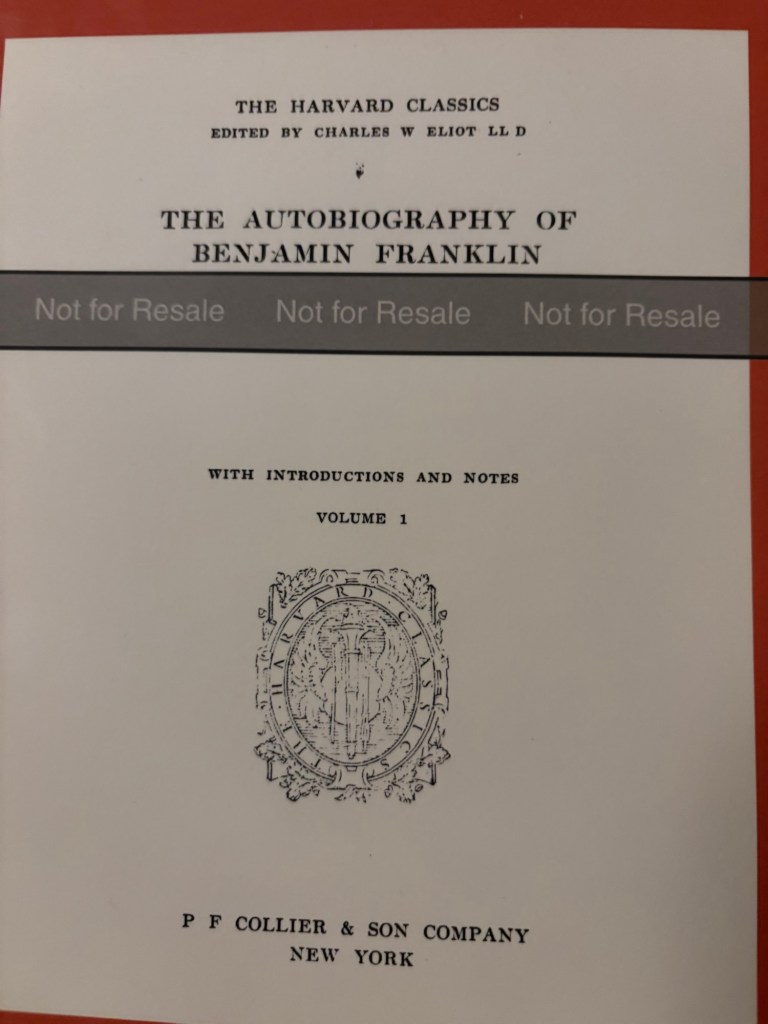
Ben Franklin is a remarkable man. Plenty of little nuggets throughout, but the overall sense is probably no one was adapted to his time better than BF.
****
Too much of my life has included the cultural icons, “The X-Men”. So it only made sense to get their original comics. They do not disappoint. The main, concrete benefit is the movies are more enjoyable. Coming in close second—the first comics can be rough around the edges and highly “experimental” or very “willing to take chances and then adjust”. So besides the inherent story that resonates so well with coming-of-age, we find an example of how to pursue your passion.
****
Locke and Hume are worth reading, but I can confess that their ideas are so foundational for our society that they only pack a punch if you have the uncommon ability to imagine what life was like before them.
****
Jordan Peterson loves Brothers Karamazov. Ooh. So sexy sounding, no? It’s one of those “tells you more about him than the book” claims. I mention it because I read this book years ago precisely because it was one of the greats. So don’t take this as a bash of JP. Instead, take it as a DUH! THE BOOK IS GREAT! YOU NEED TO READ IT! shameless promotion.
Just Have To Smile
When you work at an airport and shortly after arriving see and hear a brightly colored colored biplane suddenly appear from behind your hangar on what, by altitude and position, must be its base turn, looking like it is the one that needs saving from the opening scene of Disney’s The Rocketeer, you just have to smile.
I Can’t Shake My Joe Rogan Fantasy
Douglas Murray lost the “debate”. Or he came away looking weaker than Rogan and Smith. It all boiled down to Murray’s ill-advised, “Have you bean there?”
As a reminder, faithful readers, classical rhetoric delineates three areas of persuasion, Logos (logic), Ethos (expertise), and Pathos (emotion). The generally accepted breakdown of how to employ these during debate is 60-80% Logos, and the remaining 20-40% evenly divided between Ethos and Pathos. Murray obviously employed Ethos in more than its rule-of-thumb 20% maximum when he uttered his “bean” line.
But even without that type of thinking, I *feel* like we all knew (consequently Murray should’ve known too) both that Kamala was destroyed by her “been there” interview moment and that, with Harris’ failure in mind, JD triumphed with Zelensky, in his own “been there” moment in the Oval Office. The Vance answer was all the more compelling because he brought Logos right into the moment by clearly pausing—which seemed to betray that he was aware of the rhetorical trap—before answering the question.
Oh well. Nobody is perfect.
ICYMI Murray was recently chatting with Gad Saad and in the discussion plainly decried the problem that I’ve instinctively had with the JRE podcast along—despite my inability to put a name on it. Murray pointed out that the JRE podcast is irresponsible.
Douglas Murray, who I find myself nearly entirely aligned without actually giving me unrealistic hope that anyone else is listening, is part of ARC (Alliance for Responsible Citizenship). So it is only logical that his criticism of the men who beat him is that they are irresponsible. But the fact is Murray is correct. That studio in Austin with its 30 million Trump interview views and 0 (zero) Harris interview views is irresponsible.
My fantasy, then, is for Joe Rogan to prove Murray wrong.
Then again, I am not sure that would accomplish much. Imagine it. Rogan converts to responsibility; severe and instant backlash occur. Then Rogan joins the myriads of smaller podcasts. Fizzle. Whoopdeedoo.
I certainly don’t wish Joe Rogan any ill will. So maybe my fantasy is some horrible and embarrassing revelation of my envy of Rogan (which always manifests in sabotage) since it would surely result in negatives for him on every front.
But I can’t shake the fantasy.
The Good Fallout From The Space Bimbos’ Expensive Selfie
Before they had their fun, would you have been aware that there is a formal program called, “Commercial Space Astronaut Wings Program”? I hadn’t given it much thought, as on this topic I am generally awestruck immobile by yet another instance of uncanny synchronization of unrelated technology jumps. Can someone please explain how virtually every human being is able to view, in stunning HD, videos of the now weekly commercial rocket launches? Using Resurrection Sunday as a backdrop, we might say that it seems like physicists care more about letting others watch their work than religious zealots ever did.
I digress.
Regarding “astronaut” more broadly, it was always obvious to me what this meant, because as a former USAF pilot, I went to training with a guy that had a career goal to become an astronaut. Given my then (and still) adoration of AF pilots, his goal didn’t seem out of reach—indeed he seemed to be completing the exact right steps at the exact right time. If anything, I learned that I would never be an astronaut because I hadn’t even believed I was in the running until, after meeting him, I considered that if I was in the same training as him, surely I was at least had better chances than everyone else not in USAF pilot training.
So the definition for Commercial Space Astronaut Wings Program is: “Crewmembers who travel into space must have ‘demonstrated activities during flight that were essential to public safety or contributed to human space flight safety.’”
And that is still pretty weak as definitions go, imho. (And the bimbos would, under the most generous definition of “human space flight safety”, need to say, “I earned my Commercial Space Astronaut Wings!” Under no circumstance does the English language allow for them to be called Astronauts.)
But now we know. And that is a good thing.
Round-About Way of Exposing the Inner-Most Thoughts of My Immigrant (And All Immigrants) Wife
My now-citizen, but through the notorious near-decade long legal process, wife (to be clear, nothing to do with yours truly or marriage) reported to me that her co-workers (immigrants themselves) are all ate-up with the incessant deportation news.
Picture with me a fancy hotel setting. You see everywhere all the BIPOC (some Europeans too) immigrant staff hustling and bustling to help management create the most amazing experience ever for guests, all the while you can overhear a discussion of politics is taking place when they believe they are out of earshot of anyone who would report it.
“Wait!” you say. “It sounds to me like they’re talking instead of working.”
I agree. But when I gave my wife the line, “I would start with, ‘First, right now we should be working…’ she insisted that they were working.”
So recall the picture. Talking AND working.
My wife reported to me that she was responding to the others’ fears and what I would call suckerdom with, “I have family back home, so if they sent me back, I would be fine.” And also, “But they won’t send me back because I am a citizen.”
According to her, the co-workers are under the belief that any immigrant—even those with permanent resident cards, which are green, and US citizens—are eligible for deportation. How stupid. But it is what it is.
How would I handle the discussion if I was her? Glad you asked.
“Firstly, we should be working right now. Working and talking is impossible, especially at the low wages we earn. My husband says he is paid to think, not to work. He talks at work. I don’t understand it, but I do understand his pay is far above ours.
“Secondly, do not answer any of these questions I am about to ask. I do not want to know the answers. Moreover, my goal is to give you confidence that you have nothing to fear. But if you answer the questions in a certain way, you may feel more fear. So please don’t answer them.
“Okay. Can you show me your green card? What is that word on the top? Permanent. That means that you never have to leave. Sure, there is paperwork to renew it every ten years, but that is just paperwork. No one leaves when they have a green card. Again, it’s in the name right on the card.
“If you don’t have a green card, surely you have some kind of visa. If that is you, you have made the choice to accept the risks involved with temporarily working here—to include having the visa revoked if you break your part of the agreement. So don’t break your part of the agreement. If I understand things at all, that pretty much means don’t lie. Like you, I don’t fully understand ‘telling the truth,’ but I believe it covers ‘show up to work as you said you would do and don’t commit crimes.’
“Now, if you have already committed crimes or are in work of a different nature than approved or whatever, I would be nervous. And I would suggest changing jobs back to a job that you got your visa to do.
“Lastly, I can tell you that these people are confusing to me. None of us will ever understand them. But they have cash.”

