Tagged: education
Irritants of the Past Few Days
My daughter got a singing Moana doll as a gift. The doll says absolutely stupid things. To start, Moana suggests that her people have been ocean explorers (“We must sail to the far seas”). Yeah, exploring oceans in a canoe which never left sight of land. Then she has a line which says, “The stars lead us to where we want to go.” Again, the Moana’s of the world have never navigated their tiny islands or narrow coastlines via the stars. Gimme a break. Finally, she says something about “We’re all part of the land and sea. It’s who we are; it’s who we’re meant to be.” I’d already passed boiling point, but with this the folks at Disney seem to lose all distinction between bringing classic European fairy tales to life, a la Cinderella, Snow White, and Beauty and the Beast among many others (Pinocchio), and inventing fairy tales whole cloth for tribes who never wrote any down—and likely didn’t have any to begin with. In other words, folks, if you think all the peoples of Planet Earth are composing compelling music, telling remarkable stories, and relentlessly exploring the planet, then you are a fool.
****
People do not “forget” the truth they were once taught. I have this hardbound collection of early Berenstain Bears stories and one of them is, “He Bear She Bear.” It is remarkable in its simple and inoffensive presentation of the facts of life. No alphabet mafia folk had been read this book as a child and then concluded at a later date, “No. No, that’s not right.” Instead, Berenstain Bears became tired, lost their en vogue status, and then went the way of the dodo. This is the way all truth is “forgotten”—boredom and displaced proportionality.
****
You cannot grasp the “bully” nature of illiterate people until you live with them. They bully because they have no other recourse. It’s sad, but true.
****
My mother shared with me that my immediate family members and likely their spouses are tired of me portending to be the only one with ideas. I share with you that my immediate family members and their spouses never read books. I believe it was Booker Washington who pointed out that those who can’t read and those who don’t read are one and the same. My brother and his wife tour the world to see the historical locations of everyone whose ideas I read about and would love to chat about. These two come back and report what tour guides told them. In my opinion, it’s worse than tribes who lived only with oral tradition because they think they are living it up. All they are really doing is anarchy.
****
Books, for me, are a map, no different than a VFR Sectional or Low IFR Chart. I can’t tell you where you are on the map, indeed that is not my job (or anyone else’s). But given that I have a map and you do not, I can discern quite simply that you’re lost. It is your job as a literate person to determine where you are.
If Only The Atlantic’s Jeffrey Goldberg Owned Slaves, Then He Might Have Acted Civilly.
Even slave owners of old knew of things like this rule of civility.
Read no Letters, Books, or Papers in Company but when there is a Necessity for the doing of it you must ask leave. Come not near the Books or Writings of Another so as to read them, unless desired, or give your opinion of them unask’d; also look not nigh when another is writing a Letter.
In sum: it is always possible to read things you shouldn’t. The error is the reader’s, not the writer’s.
Why I Want the Department of Education Gone
I want the government to dismantle the Department of Education because I love debating “happiness” or “flourishing” or “eudaimonia”.
There is a thing called “learning”. There is a status called “educated”. Most of the literate people (and some illiterate people) of the planet believe learning and education promote this happiness in the fullness of the word.
But the question remains.
Does education lead to happiness?
So dismantle the Department of Education. I’d even go so far as to support the end of formal schooling for a year or two.
What would “we” do? No school? Ahhh! How would life go on? Our precious daycares! Who would watch the kids screw around all day? Who would not teach them? Where would they eat? What would they wear?
Big questions, folks. And I don’t think for a second that any of them are anywhere near settled. So, Federal Government, proceed, sir!
The Game of Telephone: Why You Need To Read More
The game of “Telephone” among famous scientists does not start and stop with Newton and the apple that he never wrote about.
Check this out.
Bertrand Russell was born in 1872. In 1897 he would have been 25 years old. In 1897 he published a fellowship-winning thesis. It was entitled, “An Essay on the Foundations of Geometry.”
Read this.

Those words were published in 1897 (same year as Russell’s first book) by William James. (See highlighted parts.)
Now read this.
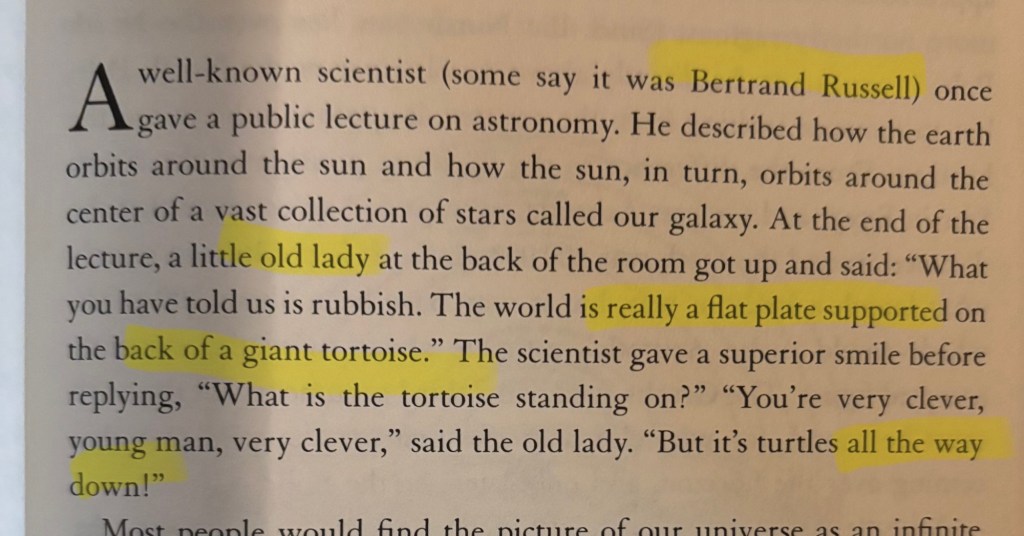
Those words were published by Stephen Hawking in 1988. (91 years after Russell was 25 years old and published his thesis; 91 years after James’ words were published.)
Sure. I grant you that it is possible that Russell gave lectures to little old ladies in 1897, despite his being 25 years old and having only published a thesis on geometry that no little old lady would ever be interested in (or aware of). But that only solves the lesser problem. How does “rock” become “turtle”?
Seriously.
Obviously the nature of the situation is Hawking placed the importance of “truth” well below standards when deciding how to open his best-ever-selling book (that is seriously flawed for more than this reason).
****
This is why you need to read, and read, and read, and read, and read. The solution is more reading.
Listing Benefits of Security Guarantees
The only question that we ought to ask ourselves is, “Why give Zelensky what he wants?”
For ease of thought, modify it slightly to, “Why allow Ukraine into NATO?”
- We believe Ukrainian lives are worth protecting at immense cost to our own lives.
- We believe there is some moral benefit, ie “the gods will be pleased” if we help those who cannot help themselves.
- We believe there is some practical long term benefit, such as “preventing future problems” as Zelensky seemed to have in mind when he uttered the “nice ocean” bit.
- We believe the wealth generated by the “get rich off minerals” idea actually does outweigh the cost of war or ongoing difficulties with Russia.
- We simply believe that we must not let the man Putin achieve his desires.
That’s what I can come up with. What about you?
****
To be clear, Ukraine does not satisfy the clearly established requirements for joining NATO. So no one needs to spend any brain cells on “Why not allow Ukraine into NATO?” Instead, the issue is literally, “What’s in it for me?”
I am very excited to see how this plays out. For time capsule purposes, my gut today says, “Zelensky is out. Trump gets deal done afterwards (no new security guarantees, definitely no NATO)—which amounts to ‘can kicked down the road’. And this is fine. No need to solve every problem immediately.”
Lastly, a longstanding talking point for my entire life (and yours) has been “Russia/communists educate/train/propagandize whatever group they are trying to defeat.” It’s generally been used as the explanation of the degradation of American universities. But today I heard the claim in reference to Ukrainian students.
Does anyone actually believe this is how life works? That you just kidnap/lure people and put them in classrooms and then in the long game you win? What a joke. It’s past time to stop indulging in that joke/conspiracy theory. People have minds and can reason for themselves. If they reason poorly, that is because they are poor reasoners, not because they are victims of some boogie man’s “long game.”
“…Hold Short of Runway Three One Center”
Way back in Iraq, our squadron commander told us (as crews of a helicopter that would nightly fly America’s special operations forces to their nighttime raids), “If any of you were to crash, it’d headline international news.”
I took his meaning to be, “I know this seems routine, and that routine can seem insignificant, but it’s not. You’re doing good work for America.” In short, he was keeping the troops motivated.
Naturally, it was also a true claim. If 30+ special operations troops crashed and died, that would be international news. This is true to this day.
But today, even aviation events where no one has died are making the news cycle.
For you, the non-pilot, I want to offer two pieces of perspective. Firstly, how would you like it if every single mistake you made on the job went viral? That’s right. And that’s why you’re not a pilot. And you shouldn’t be one.
Secondly, this near-miss at Midway has the same feature as the mid-air in DC. The pilot said he would do the right thing but he did not. How should this be accounted for?
For me it is simple. I have to maintain a hyper-sensitive honesty.
In the case of the DC mid-air, after I (in role of BH pilot) had said, “Traffic in Sight” the first time, if I found myself queried a second time (which is what happened), I’d have to trust that my well-honed honesty would have pricked my snowflakely-sensitive conscience as usual and then I would have said to tower, “Ahh, actually I am not sure what traffic you’re referring to. Can you point him out?” (I mean to bring to bear that I would intentionally use those non-standard phrases to call to Tower’s attention that the situation is abnormal and needing renewed attention, even as the words also suggest as much.)
In this case, at Midway, given the extreme situation of the news hyping every single aviation procedural aberration they catch wind of, the minute my clearance had changed (to be sure, there was some totally normal, but not strictly necessary, back-and-forth clarification between the pilot and Ground Control), I would have made the decision to stop prior to every runway and double-check if I was cleared across. This would be totally unnecessary and actually annoying and that is the point. The Ground guy would, then, display his hatred of me as he cleared me individually like I was a child (but apparently capable of being a pilot), but it would have pricked his conscience that I thought something was needing extra attention—the something being either 1. a weak pilot, 2. a weak controller, or 3. some as of yet uncommunicated circumstance.
Generally, aviation communication requires extreme eloquence and purpose—which amounts to an exceedingly small and standard vocabulary. Because of this fact, simply using plain language is a tool the pilot and ATC can employ without blatantly calling each other names when the situation arises. I’m not kidding. Believe you, me, when life and death are at stake, the desire to jump to full throttle on some moron, who is sitting in an air conditioned room totally free from danger, at the slightest unnecessary increase of risk with, “Go eff yourself!”, or conversely, the desire to put a supposed demi-god who believes himself to be the spiritual offspring of Maverick in place with, “I used English and you speak English!” or similar, is very real. (And I would argue appropriate and inescapable given the stakes.) The point here is demi-gods who are, in fact, the spiritual offspring of Maverick know how to use subtle and nuanced methods to get the attention they most assuredly deserve. And as you groundlings highlight to the world every day, we deserve a lot of your attention.
****
The last thing that you need to know is while parts of the media coverage emphasize the fact that the two planes were not on the same channel, this is fake news. Don’t be stupid people. Ground handles traffic on the ground, and Tower handles traffic in the air, and other channels handle other parts of the airspace system.
The problem of radio communication is it requires “one at a time”. To imply that everyone needs to be on one channel is completely without forethought.
Reading Log 2.21


Seems like I’ve been saying it for so long that everyone should know, but ICYMI, Last of the Mohicans is actually one of five (5) books Cooper wrote starring Natty Bumpoo/Hawkeye/Deerslayer/Pathfinder, or more commonly, Daniel Day-Lewis. The Pathfinder is 3 of 5, taking place after LOTM events—and without reference to them.
It is just great. I have read three now and plan to pace the remaining two Leatherstocking Tales so that I don’t peak too soon before death. Nothing makes me want to go camp and hike and scout and track like Cooper’s tales.
The Aliens epic collection was alright. Nothing great. But it did have some interesting storylines and the art was beautiful. One thing that that volume unexpectedly contained was a sort of short story, written in prose. And that story was graphic as anything I have come across. I have previously been made acquainted with the works of an author named Neil Gaiman and these cause one to blush. This story was along those lines. Most Alien stories have the lead as female, and this time she is only able to perform her heroine duties because of the abuse she suffered as a little girl. Bluntly, parallels are made in the story between her waiting on the monsters, and her waiting on the monster. Sick stuff.
Oh. And like the comment I made about how reading too many comics in a row kinda highlights the undeveloped-ness/infantile-ness of these stories, I now more clearly see that every Alien story ends with the main character learning that despite the recent total victory (extermination), one xenomorph embryo still exists and is poised to makes its way to another human settlement. I hadn’t really noticed that just from the movies. Oh well.
Relativity.
Here’s what I’ll do. These are the few summative statements Eddington offers. Comment below if you find them useful.
“A gravitational field of force is precisely equivalent to an artificial field of force, so that in any small region, it is impossible by any conceivable experiment to distinguish between them. In other words, force is relative.”
Actually, that is the only one that makes sense for a blog post. The big analogy that Einstein developed was the elevator (or “lift” if you’re reading in the mother country). Newton, you’ll recall, realized that if “bodies in motion tend to stay in motion unless acted upon etc”, then the Moon would have long ago kept going right past Earth, as Earth would have kept right on going past the Sun etc. The force that keeps the orbits is called gravity. Einstein, then, realized that artificial “gravity”, literally the kind you feel at the beginning of an elevator ride, is experimentally no different than “real” gravity.
Okay. Relativity is interesting but I prefer the universe stuff. (And am scheduled to read more on that next.)
Lastly, I want to conclude with probably the most fun takeaway from the book. It is from the chapter “Weighing Light”.
“It is legitimate to speak of a pound of light as we speak of a pound of any other substance. The mass of ordinary qualities of light is however extremely small, and I have calculated that at the low charge of 3d. a unit, an Electric Light Company would have to sell light at the rate of £140 million a pound. All the sunlight falling on the Earth amounts to 160 tons daily.”
It’s Like Movie Stars Complaining About Discrimination
As I keep reading essays and books essentially on “the definition of science”, I can’t help asking, “Where does the conflict with religion come in?” I can readily admit that I feel the conflict, but after spending any time in contemplation on the supposed conflict, I resolve everything to, “It’s comparing apples and oranges”. The only conflict is between bad religion and bad science. The real deal of either each stands alone and never the twain shall meet.
This new thought (in the post’s title ⤴️) about the conflict occurred to me just now.
So let me get this straight. The authors of all the mainstream science textbooks that are endlessly promoted and in use (or their conclusions are—which is the same) by all major educational institutions, these authors uniformly decry religion as, in general, something that holds humans back. Or that it stunts the development of knowledge and civilization etc.
Yeah. Okay. I believe you. Just like I believe the claims of millionaire celebrities that they’re victims of discrimination.
Gimme a break.
Just Finished a Book By Einstein; Christopher Nolan is Wrong
The title of the book is The Evolution of Physics.
Given there is still plenty of daylight, but my brain could use a break, I decided to revisit Nolan’s Oppenheimer. Why not, right?
In it, the woman asks, “Can you explain quantum mechanics to me? It seems baffling.”
Nolan has Oppie answer, “It is.”
He continues, “This glass— This drink— Our bodies— are mostly empty space, groupings of tiny energy waves bound together-”
She interrupts, attention laser focused, “By what?”
“Forces of attraction strong enough to convince us ‘matter is solid’.”
I do not know where Nolan got his material. I can imagine that he read Oppenheimer’s own writing and deduced this or—cringe—Oppenheimer even said this. I can imagine it, but I don’t believe it.
The problem with that definition is it neglectfully forgets a key point—or two, to be precise.
First, and this is directly from Einstein, it isn’t merely “tiny energy waves” but should say, “empty space, groupings of invisible energy waves.” And second, add “and energy particles”.
In full, and I hope to bring out for us lay folks the full sense of what I read in the clearest possible manner, if defined by Einstein, according the format Nolan introduced, the answer to “What is quantum mechanics?” when asked by a thin woman as a come-on (sapiosexual) at a bar is, “This glass, this drink, our bodies are mostly empty space—groupings of invisible energy waves and energy particles bound together by forces of attraction strong enough to convince us ‘matter is solid’.”
Put shorter—for illustrative purposes because I know this is uncommon—“Our bodies are invisible.”
Paraphrasing Einstein, for this claim to be true and/or accurate (the claim that “‘our bodies are invisible’ is quantum mechanics”) this claim must be tempered with, “when moving near the speed of light and observed indirectly.”
Now. You. Know.
Two Ideas For Books
Whether all experience it, or just certain personalities out of those who get the idea to write, I have learned that in the beginning of the career of unsuccessful writers there is a strong desire to not “let the cat out of the bag” too early. There is a belief that “I have a good idea and it is so good that someone else might profit if I share it before it’s for sale by me.”
But I have been blogging for over a decade now, and helped a few others with their books, and I am convinced that all that is hogwash. Life is just too complicated for a single idea, unaccompanied by the innumerable trappings of fate, to succeed.
To prove this, I share that recently I have had two ideas for books. These are prompted by a desire to somehow manifest that reading the classics has tangible results at a level somewhere below “advance of our civilization”. (Implied- civilization definitionally cannot advance if it is built on lies or ignorance of itself—so read the classics! It’s all at stake!)
Firstly, I want to write a book called “Union” that has a chapter for each, of what I have to believe would be at least twenty, type of artificial union between materials that man has developed. Knots, screws, nails, velcro, glue, epoxy etc. When I write it, the descriptions would be quick reads and informative. But the result would be the perfect contemplative admixture of “so what?” with “if we can figure out mating materials, why can’t we figure out relationships?” I have to believe—contrary to all evidence in my life—that we can figure out human relationship/union.
Secondly, I want to write a book—which may be uber short—which highlights a theme which I have seen in the bios of all the authors in my Great Books of the Western World and companion set Gateway to the Great Books. The theme being, the fact that the authors spent the entirety of their lives learning (as opposed to our deeply unreflective “go to college” mindset) coupled with often epic intellectually-based struggles well into old age. Each chapter may just be one page, often only one sentence. IE Hobbes – Forbid from publishing in his mother country from 70 yrs old to 91 yrs old when he died (don’t quote me, this is from memory and may be wrong on all points). The trick to this book is creating knockout punch sentences without getting repetitive.
****
“Go to college.” Ha. What a joke.
If you want to run with this, do it. I dare ya.
 Captain’s Log