Tagged: children
Report Cards in 2024: Grandparents Don’t Know—But Now You Do

I want to homeschool my step-son. His mother wants him to go to school. Naturally, she wins.
Here’s the rub. I actually do care about the boy. I actually do know that he has a bright future ahead of him—economically and in the ability to become fully man. I actually do want him to have a good life—something totally within his grasp as both an American and as my step-son. But especially as my step-son.
The image above is from his first report card (of course it not called that anymore—one up-vote for truth) at this new school.
I speak and read (and write) English very well. In fact, my communication abilities are excellent, as you can surely tell. Furthermore, I believe that I understand and can explain to you what this image states about my step-son.
Because of that, I know with certainty that it does not tell me anything about how my step-son is performing. According to this document, there is no standard. There is no benchmark. There is no measure.
This document is worse than a teacher grading on a curve to pass the class rather than admitting failure and reteaching the concept. It is also worse than just failing the students and dealing with whatever consequence is already designated in the rulebooks.
As an American, and former military officer, what really pisses me off though is how the document seems to indicate some amount of success to folks that cannot read English—vis-à-vis his mother.
The catalyst for this post is that the human bloggers who sometimes read my posts likely have not seen this type of performance document. They hear about climate change, CRT, book banning, soft standards, social justice, and all the other hot button cable news cycle topics which fall under the “education” umbrella. But they do not see or hear that the real problem is actually much worse. They do not see that there is actually no measure of performance anymore. None. Zero. Zilch. Nada.
Keep in mind, to be clear, I am not claiming that this is a case of “the blind leading the blind”. Or “stupid is as stupid does”. I am pointedly claiming that this is knowingly wrong. It would be better if the school did what “developing” countries (third world) do and just gives “A’s” to everyone, regardless of performance, with the reasoning that an A is the best grade, so it must be desirable.
The American Black Church has a proverb you can hear from the pulpit almost every Sunday: “People who know better, do better.”
The American Education system resoundingly proves that that proverb is merely trite, wishful thinking. In fact, the schools prove it is a stupid saying. The teachers’ proverb is, “People who know better, submit without resistance.”
She Wanted to Be Caught!
To the toddler, the crack of their door at night is more precious than all the gold and silver in the world. Shut the door and they cry and cry. But open it just a crack and they sleep restfully.
So what happened last night? I still don’t know. But I do know that the non-toddler family members were watching the latest Mission Impossible—the one, like all its predecessors, which always had the team simultaneously realizing and then stating aloud, “He wanted to be caught!”
The toddlers went down pretty easy—door was cracked. My hearing is the best out of the three of us, and so I was the first to hear some noises from their room and eventually paused the flick and rounded the corner to see that A- had climbed out of bed and turned on the hall light. Door was now wide open. J- was standing in his crib and now had Paddington—a gift from his older sister, I had to assume. As I laid him back down, he was in the mood to play, but I wasn’t, so I just covered him and turned my attention to A-.
“Gotta stay in bed, A-. It’s bed time.”
She put her arms out for a hug.
After the hug, I whispered to the dark room, “I love you. Goodnight.” Then I closed the door to just a crack and turned off the hall light as I went back to the movie.
A few minutes later, and I could hear more toddler shenanigans. Pretty much the same scene, but J- may have been closer to sleep than I would’ve guessed. Turning my attention to A-, I softly threatened, “It’s time for bed, A- If you get up again, I will shut the door.” She nodded like the perfect little angel that she is.
Back to the movie.
A few minutes later, back up stairs.
I left A-, saying, “I am closing the door. I told you this would happen.”
That was odd, I thought, as she didn’t make a peep of protest as I shut the door.
Back to the movie.
I just wanted to make it through the car chase scene, which I knew was about 10 minutes, and was sure to begin soon.
“Fart!” I suddenly had a sinking feeling. “She wants to be in the room with the door shut!”
Hitting pause once again, I went up the stairs to check on the two of them.
“No hall light on. Good,” I noticed as I turned the corner. Looking at the crack under the door, I saw the bedroom light was still off too. “That’s gotta be a good sign,” I thought. But in the movies the bad guys are always one step ahead of us good guys. So I did the unthinkable. I slowly turned the handle—so slowly. And then I opened the door a crack, and without the crack sound. As I continued in, I found little A- in some level of pre-sleep that was happy to be tucked in once again, but absolutely void of any contest. J- was out like a light.
Back downstairs we were able to finish the film without trouble. And I secretly acknowledged, with joy and anticipation, that the toddlers might actually allow me to sleep in a bit in the morning, given all these post-bedtime antics.
I was right.
Well, not about A- wanting to get shut in. But they did sleep in a bit.
So What That She Was Wrong?
So what that she was wrong? So what? She’s two and a half. How many times is little A- gonna be right at such a tender age?
Here’s how it started. A big winter storm was forecast to roll through over the night. (She couldn’t have known this, obviously.)
Then, this morning, as I surveyed the damage, I noticed it wasn’t quite as much snow as I feared, but I also knew more was on the way.
During breakfast, a certain sound, a bit like crackling, began as I monitored A-’s progress through her bowl of oatmeal and strawberries.
Focus in here: I wanted to test her meteorological knowledge. You see, she’s been the daughter of a pilot her entire life and school is always in session.
So I asked, casually, “What is that sound, A-?”
Simple enough question, right?
Apparently she hasn’t kept up her studies over winter break.
After turning towards the window, “Water?” was all that she could guess.
Much like you, when I heard this answer I naturally thought, “Wrong!”
To bring out the lesson, I got my phone, opened up ForeFlight, and read off the current METAR for the nearby airport, here redacted for national security purposes.
031415Z AUTO 01011G16KT 2 1/2SM UP OVC008 M03/M04 A2968 RMK A02
Obviously the only important part, the part she had neglected in her studies of late, was understanding just how broad a category “UP” was.
Sure, there is a certain sense in which precipitation of an unknown type and water are synonymous. But she was supposed to know the answer verbatim. Ver. Batim.
Maybe I’m being too hard on her. I don’t know.
So what that she was wrong? At least she heard the question. At least she considered it and gave an answer that reflected as much.
Hack Life Out of the Wilderness; In a Word—Work Hard
I married a woman from Ethiopia.
For the purposes of this post, the single cultural trait in focus is polygamy. Ethiopians are only generations away from the practice of polygamy. The mooslims still do practice it.
This manifests itself in the fact that they currently live in multi-family homes. I don’t mean apartments, I mean one larger home wherein many family members are supported by a few family members. My wife might tell me, “There aren’t enough jobs, so only my brother works,” to describe this particular living arrangement.
In our family, my wife and I’s current blended family here in the good ol’ US of A, it has become clear that she does not want to work hard. The way this has appeared is that she has chosen to take a minimal wage, part-time, night shift job rather than be a stay-at-home mom with her two babies.
Don’t mis-hear me. I’m admitting, confessing, and asserting that being a stay-at-home mom with two babies is hard work—far harder than any minimal wage part-time work. I’m knocking my own wife, to support the archetypical stay-at-home wife.
She hasn’t quite said the following, but indirectly she has indicated that if we lived in Ethiopia, then our two babies would be passed around all day, every day. “Okay, I need a break, you watch them. Okay, I need a break, you watch them. Okay, I need a break, you watch them.” Then rinse and repeat until they find themselves passing around their own babies.
As the dad, as the father, as the patriarch of my family, I want my children to be the strongest adults possible. Warrior poets. Scholar athletes. I want fearless giants. To be sure, I want pilots. (Forgive me, I couldn’t resist.)
I’m here to tell you that fearless giants are not possible if raised like an Ethiopian, fearless giants are not possible if raised by polygamists.
In the passing around of the children, something else gets passed around—responsibility. And accountability. The lack of responsibility and accountability is the direct manifestation of laziness.
“He did what?! That’s not how I taught him when I had him for two minutes of every morning,” the third cousin, twice removed on the mother’s side says, feigning to be indignant.
I didn’t see it coming when I proposed this marriage, but nearly every day of my life, I see more and more why American culture is the dominant one on Planet Earth. Today, I see it in terms of monogamy as the one and only producer of giants. Polygamy went away, not because of the New Testament or because of some other philosophy. Polygamy dropped off the earth because its offspring were weak and incapable of hard work. Polygamy is not practiced by Americans because the children raised by only two people, by only one man and one woman are more capable adults. Where did Americans learn to work hard? The wilderness. Americans hacked life out of the wilderness. And that took hard work. You should thank your national ancestors.
Children need to see—from their first breaths—that hard work is good, hard work is rewarding, and hard work is rewarded. And children cannot see that if they don’t see their fathers and mothers working hard to raise them—all day, every day.
As for this fearless giant, this pilot, as for this American? I’m a man who believes in hard work. So I married a woman from Ethiopia.
Written Record of One Conclusion after Observing One Illiterate Child in the 21st Century
This post is tricky for two reasons. Firstly, the child I’ve been observing could someday read it. Secondly, while it’s true that you’re reading this, I’m not sure you’re ‘literate’.
To cancel out any negative repercussions possible within the first reason, I want to clarify that my intentions are to simply record an observation that is interesting to me. There’s no judgement here. You didn’t cause yourself to be illiterate.
Regarding the second reason, I consider literacy to include the actual ability to imagine that you’re someone else. Literacy is not about lofting the sounds of symbols into the air. It is about understanding the author’s written ideas, their point-of-view, inasmuch as they can be understood by a reasonable person.
Quickly, then, the word of the day is “mimic”. That’s the best way I can think to capture the process. I have now watched for many months a unique-to-me case of an illiterate child growing up. They look just like us. Dress like us. Eat the same food. Drink the same beverages. But when it comes to talking, they exhibit a totally different pattern. Without having been read to in the womb, without having been read to as an infant, without having been read to as a toddler, without having begun to read in kindergarten, without having been reading on their own for the next three years, the illiterate child can only mimic sounds.
Think bird calls or mating calls–nature style.
I suppose in the pre-television/pre-entertainment-on-demand days this might have been an acceptable path to wisdom. But in our day, what this can mean is the child picks the reaction they like best–say laughter–and then begins to mimic or simply repeat the words which the characters uttered which preceded the laughter. Again, think about how a young animal might learn to imitate its parent’s audible warning or mating calls.
The important, and new-to-me, thing that I want to draw attention to is the lack of thinking. At the illiterate level, the child makes noises to obtain desired responses. Maybe crying for food, age-inappropriate jokes for laughter, coughing for a hug, gulping loudly for encouragement–all things that would be missed by a deaf parent.
Even more to the point, the illiterate child can start to use words instead of sounds, but–and don’t miss this–to the child the words are still merely sounds. They are empty words. If another set of words accomplished the desired goal, the illiterate child would use those. For the illiterate child, achieving the desired response is the only thing that matters.
Put inversely, coherence has no place. Truth has no place. Consistency has no place. Particulars have no place.
Again, for the illiterate child, achieving the desired response is the only thing that matters.
There is a flip-side, too. If I’m right, it means that for the literate there is something more in life.
Three More Days Until Home School
“No mistakes!” the boy beamed.
Scrunching up his forehead and sharpening his eyes, the man replied, “This one is wrong. And this one.” Then he turned the page over. “This is wrong. And this one isn’t exactly wrong, but it isn’t worded correctly enough to be right.”
Silence.
“Why did you say, ‘no mistakes’?”
“Because the teacher put a star right there.”
“Well, there are mistakes.”
“Well, the teacher doesn’t grade it. She just looks to see that we did it.”
I ask you, reader, do you know what it feels like to have Ignorance violently and maliciously knock you unconscious at breakfast?
“Well,” he began again, “Why did you tell me that there were no mistakes if you didn’t know?”
Crickets.
“Okay. How about, ‘What does mistake mean?'”
“Like when you accidentally make a mistake.”
“Well, you can’t use the word in the defin-”
“-something wrong!”
“Right. But it’s not really limited to ‘accidents’.” A pause. “So why did you say, ‘no mistakes?'”
“I was guessing?”
“Why guess?”
Silence.
“Never mind. How about, ‘If the teacher says, “No mistakes,” when they haven’t looked at the work, then what is that called?'”
A searching pause. This, reader, was then followed by a nine year old’s terrifying, confusing, distasteful, and yet somehow innocent identification of everything wrong with public schools.
“A lie?”
(In case you missed it, the beginning of my tale found a child–Hero? Villain? We do not know–in Fantasy Land, and he felt like a million bucks. Then the end of my tale landed our hero in the real world, where A- was repulsed by the thought of moral responsibility–not just moral responsibility but mere moral reality–and longed for that Fantasy Land of yester-minute filled with lies and no responsibility.)
Because We Were The Nazis
This one is long overdue–not for the reading, but for the writing of it.
I have a step-son now. He was not born in America. He does not know much about the West.
A few days ago he asked me, “Why does everyone talk about World War Two so much?”
I said, “Huh?”
“You just said, ‘World War Two.’ The other day at school my teacher said, ‘World War Two.’ Why is everyone saying ‘World War Two’ so much?”
Yesterday we were in the car for long enough that I finally took the time to answer him.
“Well, what do you know about how many people are in our town?” I began. I quickly and subsequently learned that the boy is not quite a census expert. So I remedied this as best I could. Then I let Siri do the persuading.
“Hey Siri!” I began, to his delight. “How many people died in World War II?”
“Do you see now?” I asked the boy.
He says he does, but he probably doesn’t. That’s the way these things go.
But there’s something I haven’t taught this young man. Well, it’s more accurate to say that there’s something that I haven’t spoken aloud to this young man. In truth, I’ve been teaching him this thing, and nothing but this thing, since he moved in. I breathe this thing. I eat and drink this thing.
This thing: there’s a deeper, more hidden reason everyone talks about World War II. The reason is because we were the Nazis. Humans were the Nazis. Not corporations. Not aliens. Not AI. Not the poor. Not the rich. Not those with guns. Not those without guns. Not the Muslims. Not the Christians. Not the Blacks. Not the Whites. Not the immigrants. Not the healthy. Not the sick. Not Trump. Not Obama. Not the LGBTQ+. Not the Non-Binary. Not Antifa. Not #IMWITHKAP. Not Greta. Not Climate Deniers. Humans were the Nazis.
The reason everyone talks about World War II is because we were the Nazis. And we cannot forgive ourselves.
But worse, we believe that if we teach what happened, if we just talk about what happened, then we believe it will not happen again.
That, of course, is simply not true. To be crystal clear here, George Santayana’s eloquent sounding sentiment, “Those who cannot remember the past are condemned to repeat it,” is dead wrong. He was perniciously wrong.
So I’m raising my step-son (and H-) with this in mind–constantly. I do nearly everything with one singular goal in mind: teach him to be a man. That is, I teach him to think for himself.
We were the Nazis. But I was not a Nazi. And LORD help me, I will never be a Nazi. Instead, I am a man.
Moreover, I will not let the voices of doubt win when it comes to raising a boy to become a man.
I’m talking now to all of you who think it is cruel to make a child work on handwriting. Cruel to make a child read aloud until they get it right. Cruel to punish a child for disobedience. Cruel to create a standard and hold a child to it. Cruel to keep a child from TV and YouTube. Cruel to teach a child that children do not boss adults. Cruel to have a bedtime schedule. Cruel to make them eat the same meal everyone else at the table is eating. Cruel to make them finish their food entirely–and their milk. Cruel to make them do chores. Cruel to say “no” to a child–every single time they ask for something stupid like more dessert, more time, or any and everything they ever see at the store.
I’m raising a man. I’m not trying to have a friend. And I’m not trying to please you and your gay sensibilities. We were the Nazis! Do you get it? “We” were the Nazis. The only thing that can defeat “We” is “Me.” I won’t join you. And I promise you that my adult children will surely feel a shame second only to the one which comes from awareness of having sinned against their maker, if they find themselves joining the “we” on some distant day.
Enough about me. What about you? What about your sons and daughters? Are they going to come after my children some day?
The Black Mask and The Executioner
“I am innocent!” the noble, righteous, and beautiful hero protested, unable to rain down his fist for emphasis. The blood dripped from where his finger nail used to be.
His hands were taped down to the kitchen table of his youth. He couldn’t get up. He couldn’t move. A whimper escaped his lips. The Black Mask did not notice.
He muffled an indignant and a righteous howl as the Black Mask unexpectedly reached across the table with both hands and tore the tape away with a speed that rivaled lightning.
Maybe it’s over.
The hero prayed, thanking his god for rescue. Almost imperceptibly, he lifted his head to get a better look at the masked man and the torture room, once his safe space.
The walls were charred black. The place where the stove used to be–the stove which received his mother’s love, meal after meal of his distant childhood–was now as empty as a reluctant warrior’s gaping chest cavity after receiving an RPG round on a foreign battlefield, in a forgotten war. Breakfast, lunch, and dinner, she stood, stable as an oak tree, beautiful as a sunset–and apparently as fleeting–never so much as hinting that the effort she spent preparing his food should cost her more than the mere hours it took.
Before his hands had moved even an inch, an agonizing pain began at his left wrist and tore through his left arm like a tornado through a Texas trailer park.
Then he felt something moist smear across his face.
Then he heard the sound.
Then he saw the instrument.
The head of the ax was buried into the kitchen table. The handle stood cocked like the minute hand of his parents old wall clock, except that this cursed chronometer just announced Pain’s time of birth. And like a watch, it divided his wrist from his hand as cleanly as up from down, as permanently as left from right.
“Where do you think you’re going?!” barked the hot voice, smoke bellowing from beneath the Black Mask.
Time was running short. One hand already lost, coupled with the fact that the Black Mask was running out of torturous tools, the hero decided to sing out one final protest. His voice, his majestic, his chivalrous, his heavenly voice–the voice that had drowned forest fires as it chased them down mountains, the voice that had serenaded thunder back into the puffy clouds from where it came–his only weapon.
Attempting to use his body to help elevate his noble cause to the gates of heaven, he began to stand as he proclaimed, “I’m sorry!” He drew his next breath as if it might be his last. “But I am innocent! And I demand you cease these proceedings at once.”
Uninterrupted, he boldly continued his pathetic, and now somewhat benevolent, plea, “And what have you done with my moth-”
But before he could finish a button had been pressed. Straps of scalding, sinewy snakeskin sprung out from the floor beside his chair and wrapped painfully across his thighs. The wooden chair legs groaned under the new, nearly unbearable load.
The hero heard what he supposed was a laugh–but sounded more like enemy tank tracks grinding toddlers’ teething smiles into the wood-chips which fill schoolyard playgrounds–flap out from the bottom of the Black Mask as the eye holes sparked flame-red with delight.
The realization that there was no point in protesting hit him like thirteen jackhammers during a construction sign-studded summer drive at five.
Seeking, but seeing no disagreement, he stretched his right fingers out and felt for the brier-barbed pencil.
“Did the Black Mask leak a solitary beam of light?” the hero wondered confusedly, his left stub likewise pulling the loose-leaf paper close.
The outside world could have fallen away, burned away, dried away, or shaken away and the Black Mask would not have noticed as he watched the boy sigh and write out for the sixtieth time, “I am responsible for my gloves. If I lose my gloves, it is my fault. I will not lose my gloves again.”
I Didn’t Care That It Was Raining
This post is singular in its purpose. Yes, I’m still more than a little upset at Greta. And my “more-than-a-little-upset” becomes “furious” when people assert that she isn’t to be criticized because she’s a child. Given the power of social stigmas, I cannot talk about this at work, so I’m back in the Captain’s chair.
Let me repeat: this post is singular in its purpose. My goal is to persuade you–Greta, and you–Greta’s friends, and you–Greta’s parents, and you–Greta’s teachers, and you–Greta’s supporters including you–former President Obama. My goal is to persuade apparently ev-e-ry-one of you that there is another way when it comes to climate change.
Where to begin? Oh, I know. The weather. I’ve recently been elbow deep in meteorology books. I began with the FAA’s Aviation Weather advisory circular. I found a soaring pilot’s weather primer. More FAA publications followed. The USA Today Weather Book made it to my home.

Eventually I even tracked down a proper Meteorology 101 textbook that universities employ. Finally, I found a rather entertaining book on Cloud Spotting. Oh, and lastly, I picked up a book on Tides. But the book on Cloud Spotting is where I want to start my argument.
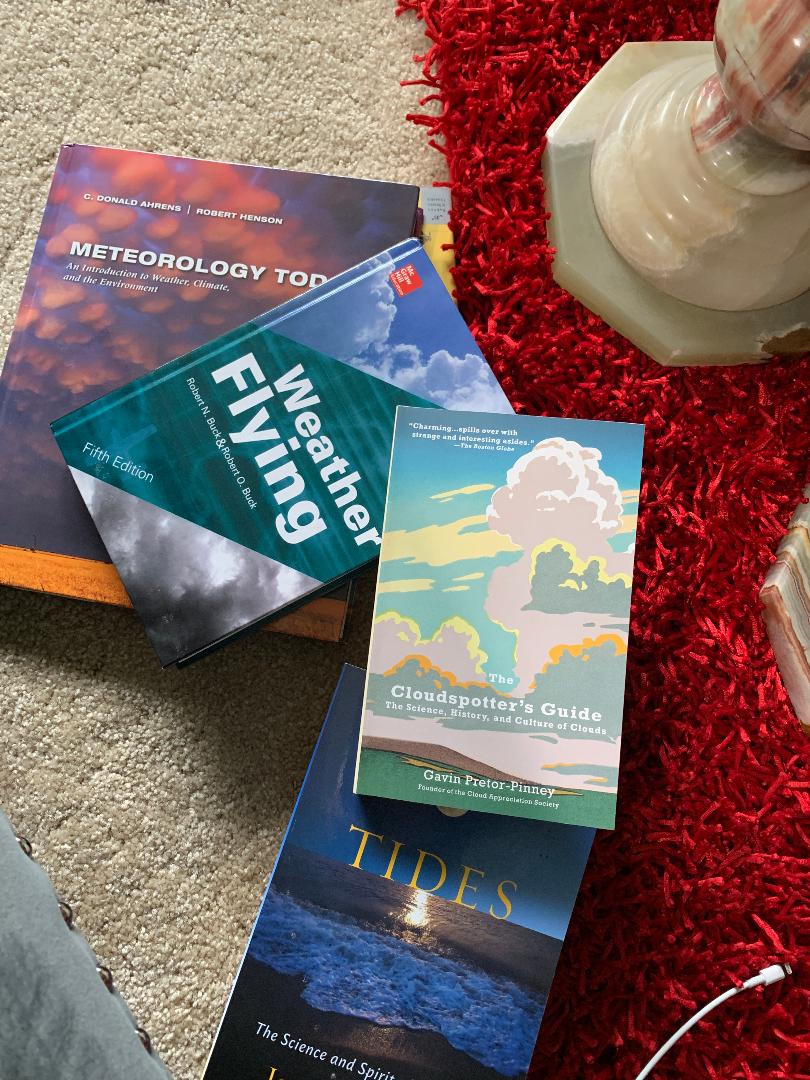
Convention has it that we call clouds by their Latin names. But, I wondered, why did the Latin-speakers use the words they used? What do these Latin names mean?
It turns out that they mean what we mean if we were to just describe the cloud. Without any meteorological training we might see a big puffy cloud and say, “There’s a big puffy cloud.” Well, that’s just what our many cloud-spotting ancestors did in their language. If that big puffy cloud is making rain, then a prefix or suffix meaning “rain” is appended. In other words, “cumulo-nimbus” are just big puffy clouds which are producing rain, whereas “cumulus” are merely big puffy clouds.
Put another way: there is no magic.
Trackin’? First question for you: What is the difference between showers and thundershowers? Ding, ding, ding! You got it! The sound of “thunder” which accompanies the shower.
Next question, new angle: What is the difference between snow-showers and rain-showers? Ding, ding, ding! That’s two in a row! Nice work. The difference is in the type of “precipitation” falling. (BTW, quick note, “meteorology” is so-named because Aristotle and friends called anything falling from the sky “meteors”. Rain. Snow. Rocks from space. You know, all things similar.)
One more softball: What is the difference between an isolated thunderstorm and a super-cell of thunderstorms? Good job. The size and probably the longevity of the storm.
Harder question: What is the difference between the high winds of a thunderstorm, the high winds of a tornado, and the high winds of a hurricane? It’s no trick question. I’m looking for “scale”. These three types of high winds are different in scale. The wind is strong in all three, but the amount of wind and the duration of the wind are the distinguishing characteristics–no different than the falling rain being both the actual and linguistic factor which distinguishes cumulus clouds from cumulonimbus clouds. But this time, it’s a total name change, not just a prefix or suffix.
Current Event question: How long were the Bahamas hit by Hurricane Dorian? Couple of days, right? How long was Hurricane Dorian called Hurricane Dorian? Maybe a couple of weeks?
What’s bigger than a hurricane? That’s a tough question, no? I’m thinking “droughts.” In the past there were “famines” that lasted years. Surely we all know and hear–a totally disproportionate amount of talk–about past “ice ages.” Is that it? Is there anything else that’s bigger than a hurricane in size and duration? Well, there is now. There is something of which I’m aware. It’s called Climate Change.
And I say we call this first one, “Climate Change Greta”, in honor of–well, you know. Climate Change Greta will be a larger scale than Hurricane Dorian, than hurricanes as a category of weather, in fact. (This, just as hurricanes are a larger scale than tornados and tornados are a larger scale than summer breezes).
While Climate Change Greta will affect the same area as an ice age (everywhere), Climate Change Greta’s duration and intensity won’t be scaled quite as grandly as the last ice age, the late Paleozoic.
Climate Change Greta will affect the planet as a whole. But it won’t end life, anymore than the late Paleozoic stopped me from typing this.
Here’s the thing: Anyone who’s stood under a tree, anyone who’s been in a cave, anyone who’s worn a hat, anyone who’s stood in a man-made shelter has had the experience of discovering that rain was falling all around them, after rain had started falling all around them. Every single one of us has said, “Huh. I didn’t know it was raining.”
Not everyone has worked outside, though. But some of us have worked outside. That is, some of us have labored under the sky, in the sky, on the earth, in the earth, on the seas, or in the seas. Often, that work doesn’t stop for rain. I once climbed to the top of our oil rig while it was raining and with lightning nearby–merely to get that stuff that makes your indoor job possible out of the ground. I once raced a thunderstorm–and won–to help just one of you get to a hospital. I once landed in a field which kicked up so much fine dust that after we landed it took minutes for the ground team to be able to see where their ride was so they could get on and we could go home.
And I’m arguing to you that my more adrenaline fueled experiences are no different than how you don’t stop your car and wait for the rain to end before you proceed on your merry way, no different than how you wear a raincoat, no different than how you don’t let your dog have free reign in the house after he’s been doing his business in the rain-soaked backyard until after you dry him off.
In short, then, for the same reason I didn’t care that it was raining, I don’t care about Climate Change Greta. And you shouldn’t either.
I Accept Greta’s Dare
It isn’t polite to speak aloud what we privately think. So we write.
Greta Thunberg accused, “How dare you!” in her latest tantrum. For what else can her speeches be called? I can think of many places passion is welcome. The bedroom, the sports field, the battlefield, the Russian novel, the frontier, the pulpit, the wave, and the peak–just to name a few.
But the World Stage? Nope. It’s not appropriate. It’s uncivil. It’s disrespectful. It’s childish. Instead, simply deliver your message and sit down. If I adduce that your words have merit, I’ll take my time to consider your opinion. But when you bring passion to scientific discourse it makes me doubt that you have taken the appropriate amount of time to gather the data. Abstract truths are awful boring.
Greta then said, “We will never forgive you.”
Here Greta reveals her only disability. She is nearsighted. Normally this imperfection is not fatal, but considered in the light of that old sinner, Cain, and his near-sightedness, the problem is fatal indeed.
Greta’s disability would be ironic if she spoke only one time and only to her peers in speech class. But she’s on the world stage advocating the most hateful philosophy mankind has yet developed. And to applause. Have we no shame?
One thing Greta said that shows hints of her available redemption is that “humans” may not be able to fix the problem. Amen, Sister. Humans? No. Jesus? The risen lord? Yes. It’s going to be okay, child.
We able-bodied folks need to decide how to handle the Greta’s of the world. I see two ends to the continuum of response. We can debate what “1.5 degrees” means. Or we can win the long game by forgiving each other as Jesus commanded.
What Greta is doing is forgivable. She’s just a child after all. But, like Cain pleading with the LORD after blood-soaked dirt found its voice, she probably won’t feel the need for forgiveness until after blood has been shed. Until then, we wait.
 Captain’s Log