Tagged: politics
Reading Log 7.11.2026
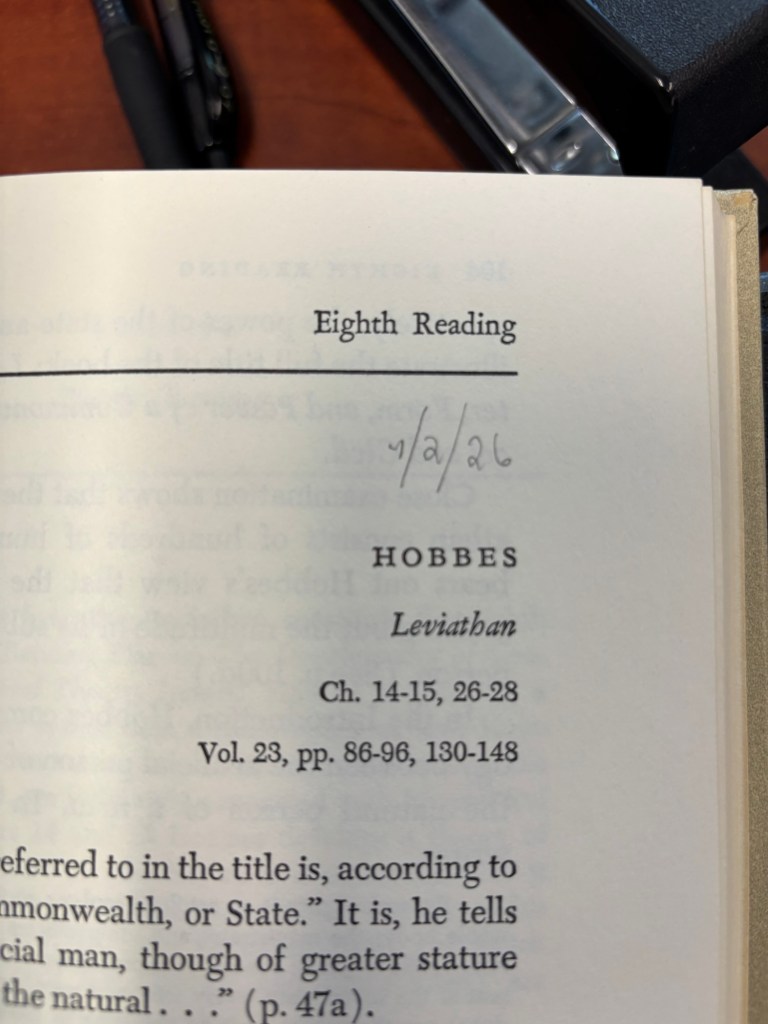


I have said it before and will say it again and again and again. Hobbes’ Leviathan is absolute must-read material. I am rarely more invigorated while reading than when reading Hobbes. I exhort you, brethren, find a copy and make time for it. You will not be disappointed.
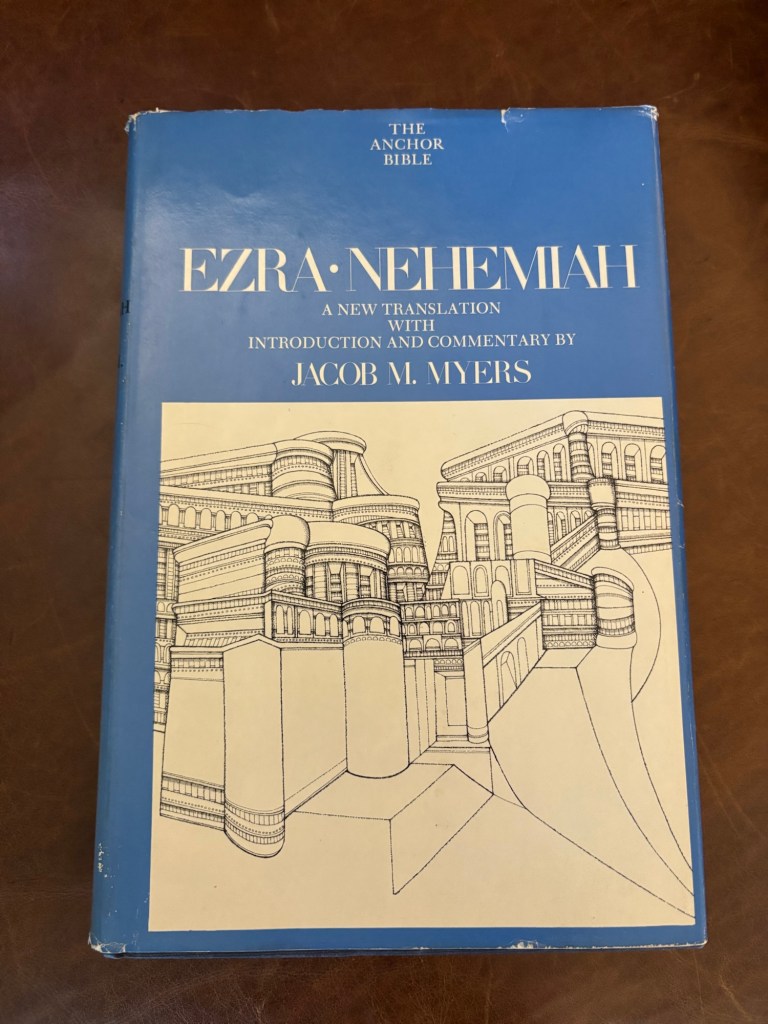
A former professor from the seminary reminded me recently that as an alumni, I had access to an online theological library. So I tracked it down and joined, $10 a month. Around the same time as joining, the same professor told me his recommendation for a commentary set for a church—meaning lay people. I had asked his opinion because I wanted to start a library at the church I joined. His recommendation was the NIV Application Commentary, which uses three approaches to each passage and never or rarely mentions any original language issues in a manner that requires training to understand. The three approaches are, “Original Meaning”, “Bridging Contexts”, and “Contemporary Significance”. Anyhow, I do have training in the original languages and I hate reading anything about the Bible in which the author has made the decision for me, preferring instead to read authors who lay out the evidence from which to choose what to think for myself. That’s where the Anchor Bible Commentary set comes in to play. I am certain there are other solid academic commentaries, but Anchor is kind of the gold standard. By way of example, the NIVAC’s 1 Peter volume might include, “Peter wrote…” and the Anchor Bible might write, “The author of 1 Peter wrote…” I prefer to approach the Bible Indiana Jones-style. (Recall—there are no priests!)
Boring details of my life, I know, but while all this was happening, I had started to get anxious about the issue of accuracy in the digital realm. Specifically, I had seen a few examples of how streaming services are latently airing edited versions of beloved entertainment. Long story short, I determined that I did not want to ever be distracted by worry about whether the content I was reading on a screen was original or edited, so I started tracking down a used set of the Anchor Bible commentary volumes. And I found and bought one (not quite complete). Then, lo and behold, I got an email announcing that the online theological library was ending its availability to alumni—at least as accessed outside of a proper library. No real reasons were given, but I was very thankful and felt very wise in my decision to begin to purchase the actual books for my home library.
All that to say this: I have for many years struggled in my attempt to a good habit of daily Bible study. As I have mentioned, I always start with the Bible if I have time to read. But I never loved my plan of just reading it and I also have never enjoyed using a devotional which were always so clearly superficial and kitsch so as to distract me from the intent of Bible study. Around the time of all this purchasing and subscription-cancelling etc. I had been in Ezra and Nehemiah, so I, one day, decided to see what ol’ Anchor said about them. And, boy, was I ignorant. It’s actually fascinating to me how much I had never known. This was part of the reason I began to read them recently anyhow. (Yay me.) Anyhow, the main thing to share here is that 1 and 2 Chronicles and Ezra and Nehemiah are all contemporary to each other. And the date of writing may be as late 150BC (don’t quote me on the date). Also, Haggai and Zechariah are the prophets of that same time. So what’s that? Like 6 books, spread from after 2 Kings to the end of the OT, in the Christian canon’s arrangement. I had known the Jewish canon concluded with (1&) 2 Chronicles, but I hadn’t ever studied the other four books, or committed to memory anything about their dates at the least. I did know that Nehemiah is where the tradition of standing during scripture reading gets it start.
All that said, I am happy to report that I have my new way of daily Bible study. I just read a passage and its “comment”. I have even been able to interest my wife in listening to it as I try to rid believers, one at a time, of the notion that one can gain understanding of the Bible by praying. It just doesn’t work like that.
Onward.
Netflix made a Frankenstein movie. I couldn’t finish it. But then I watched Bride!, as you know. I mentioned this at work to a reader and she asked me if I had read the book. I had not. So here we are. I haven’t researched it entirely, but I get the sense that Shelley (married to the famous writer Percy Bysshe Shelley, and daughter herself to very famous writers) really did invent the “monster” story, which pervades all manner of entertainment to this day. Quickly, I do want to note here that Frankenstein is the name of the creator, not the monster. And, imho, the book itself isn’t that good. But the idea is—obviously. The idea being, what if the creature you bring to life is a devil, not an angel?
Farmer Boy was fun. My main criticism is that a city kid of today really and truly cannot use much of the information which is transmitted and which was conceivably useful to farmers back in the day.
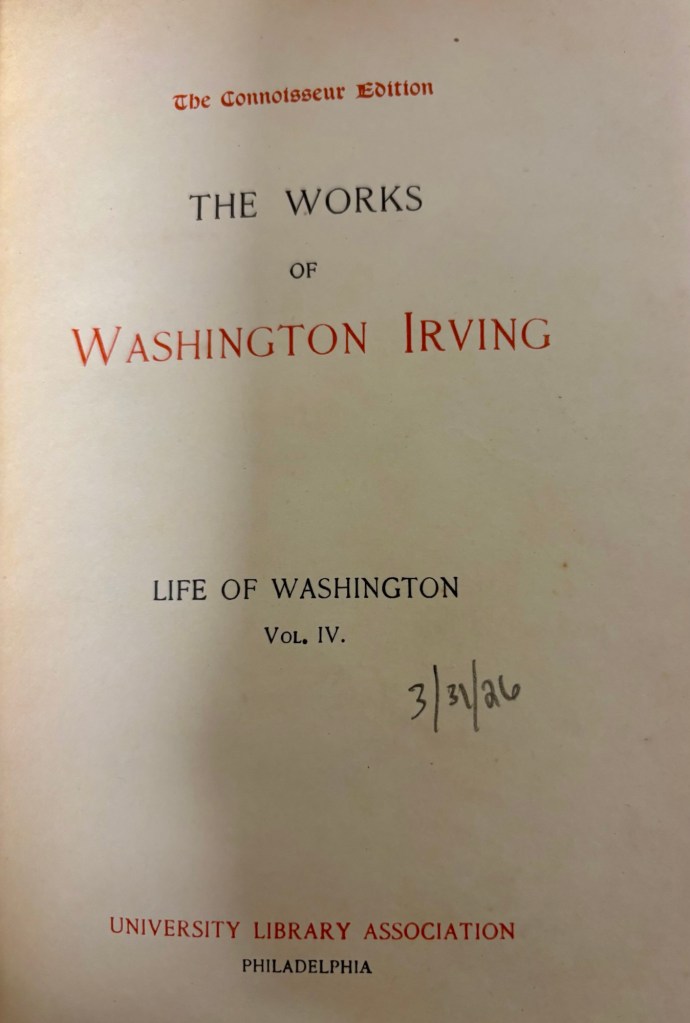
GW continues to be great. He is now President, not exactly by choice. Also interestingly, the state of politics in America back then was so startlingly similar to today, that a new idea has formed in me. This idea being that while everyone who wishes America well can appreciate the “fighter” in Trump, the truth is that we really need a leader who knows how to gain respect of everyone. That is who George Washington was. People were as vehemently opposed in their desires, motivations, and methods as we are today. But when a decision was needed, they all agreed GW was the man for the job. How did he do it? Moral living and pure motivations. How can such a man be formed and found? Imho, by studying GW. And by providence’s intervention.
I can’t explain it, but any time I spend away from Shakespeare causes me to forget how great he is. Luckily, he is so abundantly great that merely reading a line or two is all that I need to fall back in love with him. What a writer. What stories.
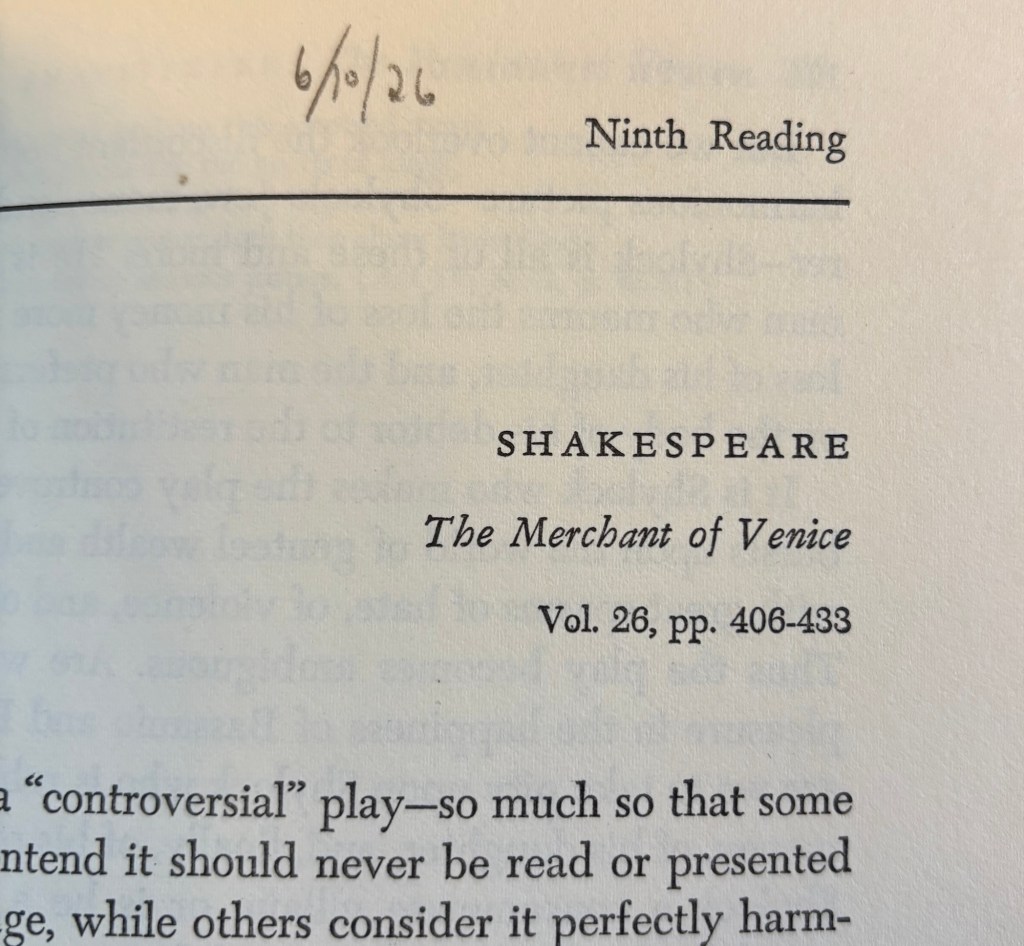
Merchant of Venice is in the Great Books of the Western World’s Great Ideas Program guided reading on the topic of “Philosophy of Law and Jurisprudence.” This is because the character agrees to forfeit “a pound of flesh” if he can’t pay back his debt. To generalize this contract, the question Shakespeare raises is, “Can a person use the law to bind himself to commit an unlawful act?” The largest perspective being, “What is the name of the thing which prevents a person from freely entering into a lawful contract which has as one result unlawfulness? If the thing is ‘law’ itself, then where does it get its power, since a man freely made the contract? Doesn’t law come from man?”
In any case, Shakespeare toys with the language and big ideas as if they were nothing. And it is a whole lot of fun to read.
That’s all for today.
For Next Year’s ARC Conference: No More Hedging If You’re a Christian Speaker
I have been listening to a few of the 13-min talks from this year’s Alliance for Responsible Citizenship conference and, as with the past two years’, they are tier one models of conservative perspectives. And yet I cannot deny that when the speakers use the language “America’s past is not perfect” or similar, I shake my head. I hadn’t been able to pinpoint exactly why this phrase, and the concept behind it, bothers me so until just yesterday.
For context, please call to mind that I am reading volume 5 of Washington Irving’s Life of George Washington. Specifically, I am up to his decision to run for reelection. Let’s just say that since his birth and the legendary tree incident, a lot has happened. And after everything I have read, I conclude, “And all of it was the best thing for the future occupants of planet Earth,” full stop.
I know, I know. I can hear you. What about slavery? What about women’s rights? What about civil rights? What about ‘Nam?
Allow me to break some news to you. I am a Christian. Inherent to Christianity is the belief that all men are sinners (“They have all turned aside, altogether they have become worthless; There is no one who does good, not even one.”
Psalm 14:3 LSB) and that no earthly government—though instituted by the Living Triune God himself—is perfect (“Then Yahweh said to Samuel, “Listen to the voice of the people in regard to all that they say to you, for they have not rejected you, but they have rejected Me from being king over them.”
1 Samuel 8:7 LSB and “Be subject for the sake of the Lord to every human institution, whether to a king as the one in authority, or to governors as sent by him for the punishment of evildoers and the praise of those who do good.” 1 Peter 2:13-14 LSB). For me, a Christian, then, to hedge the character or accomplishments of people or governments with some seeming politically correct admission of unpleasant facts, is to betray my beliefs, exchange them, as it were, for someone else’s beliefs—and for what? For likes? For views?
No. That is not right. We can all just speak truth for truth’s sake. Speaking isn’t violence. Everyone knows, by virtue of the content, what we believe anyway as we talk. And the import of the speaker’s content is directly related to the integrity of the message. In short, it is weak when a Christian hedges their claims about men and government. It is weak because the Bible has, amongst many mysteries, essential and clear statements about the nature of man and government. Man is sinful. Government is inadequate.
Conversely, it is the game of the Woke, the Left, and the Commies, among others (hard to leave out the DNC) to believe man is perfect (without evidence) and government is adequate (without evidence). Christian doctrine does not support either.
So, ARC presenters, next year, as you continue to bravely, and at some risk to yourselves and your families, model for us plebes how to live, please step up your integrity on this topic. America wasn’t doing “the best it could while having some original sin”, instead America “is and has always been the beacon of freedom for the entire world”. George Washington didn’t “have faults”, instead GW “played the almost superhuman role of founder of America, played it well, and deserves our continued gratitude and attention”.
The events of the present and future are not improved or sustained by “bending the knee” to those who seek destruction. Time is limited. So use it all to accomplish any speaker’s goal: nourish and flourish.
(Let us pray.)
The Value of Communicating Waters Cannot Be Understated
In reading Vol 4 of Washington Irving’s Life of George Washington (taken together with my memories of Africa’s chapter in Conquests and Cultures by Thomas Sowell) I cannot help but walk away with the thought that it cannot be overstated how valuable waterways which can be navigated by large ships are.
If you need an easy to remember, due to superlatives, summary of the history of life on planet Earth (how has it unfolded), as told by winners, it is this: victory has come to those people who were interested in communicating aloud with the most people, the most frequently, and who were able to command the waters which communicated the heaviest amounts of goods, the farthest distances, at the fastest speeds.
In short, open-minded, talkative, and good-listening entrepreneurs on the banks of waterways of significant depth and breadth hold the keys to the Kingdom of Earth.
Maybe My First Podcast Recommendation Ever
I can’t recall ever using this blog to recommend a podcast episode before. In any case, I haven’t done it often. But I just listened to one that is a “must listen”, if such a thing exists.
It is Peter Robinson’s latest. He interviews a historian on the topic of The History of Communist China. (It is just over an hour.)
Do you know any communists? If so, listen.
Have you somehow marooned yourself and your WordPress Reader alone on an island? If so, listen.
Let’s just say, upon completing the episode, I have begun teaching A- and J- (5 and 4 respectively) two general and absolute truths. (I do it catechism-style, Q&A.)
Firstly, What is the first defense against communists? The first defense against communists is books—communists hate books.
Secondly, Who do guns protect us from? Guns protect us from communists.
In the same vein, it seems now is as good of time as ever to share another national security proverb my young progeny get to repeat, “The Democrats are not the fifth column.”
Dovetail Wisdom for Memorial Day ‘26
On “Cultural Appropriation”: You can’t steal what you can’t own.
On “Conquest and Integration”: You can’t stop what you didn’t start.
(This formulation of these twin truths, same as all truth, should add joy to your life.)
Thuck-Y-Dideez
I first heard of Thucydides in college. This would have been 2001-ish. We weren’t studying him, but the professor needed to make a point and used the classic “Athens-open, Sparta-closed” historian to do so. Along the way, the professor interlaced a story about how a student came to him complaining about the reading and pronounced thoo-sih-di-deez: Thuck-Y-Dideez.
Funny stuff.
I do not know what the Thucydides Trap is, but I want to post an informed guess before I google it. What did Xi mean when he used the phrase?
Before I reveal my surmise, I want to add here that a chinaman using a western anecdote is real evidence that America and the West are already winning the war with China. And rightly so, since we’re obviously the more relevant civilization.
Okay. That said. What is the “Thucydides Trap” that we hope to avoid?
War.
(Wish me luck in my AI-ing for confirmation/information.)
Did You Know the Victorian Era had a Fad Called “Table Turning”?
It’s true. I first read about it in the Gateway to the Great Books volume on Natural Science.
The renowned physicists of the era actually referenced, with tremendous disdain, the nonsense on their way to explaining how the physical world follows seemingly iron law.
But don’t take my word for it. Just search it up. Victorian era table-turning.
(You’re tired. It’s late. What does this have to do with anything, you ask? Well, it just should be counted as proof positive that there are no bounds to our ability to try to fool each other and to be fooled by each other. There are no extraterrestrial life forms, folks—only terrestrial suckers.)
On Complicity
I’m still stuck on this notion of “complicity” included in the crazy man’s manifesto.
For today, I want to use a phrase from Ezra 7:25 to focus the discussion. We read, “‘And you, Ezra, according to the wisdom of your God which is in your hand,..’” (Italics mine.)
This is a phrase from a decree by a ruler. We would be right to call it a form of delegation. “The ruler is delegating his power to Ezra,” we might say. But there is a limit to the power. Ezra doesn’t receive all power from the ruler. What is the limit? The limit is apparently whatever is meant by “the wisdom of your god”, but not just some ethereal or spiritual or emotional (and therefore hopey-changey concept) but a concept that is contained by something that can be placed in Ezra’s hand.
I don’t mean to play read my mind; we’re talking about some concrete way of describing “the written law”. You can hold it in your hand. The ruler has delegated his power to Ezra, but limited Ezra to a written record of the “wisdom of [Ezra’s] your god”.
Back to complicity.
Do our laws suggest that watching a crime is the same as committing the crime?
Surely not.
I can imagine that there may be a law on the books (in our hands) which a bystander can be found guilty of breaking by not helping a victim, but even that law (if in existence) will not mean that the bystander committed the same crime as the attacker.
In short, the crazy man (and I want to be clear: ALL crazy men) are fundamentally unlawful in their thinking and understanding of the law, life, and the passing scene.
You are not complicit in another’s crimes, not according to the law of the land, not according to your standing before the God and Father of our Lord Jesus Christ—as limited by the Wisdom of Him found in the Bible.
Because Every Christian Should Be Able to Do Likewise Without Blinking
The crazy man said, “Turning the other cheek when *someone else* is oppressed… is complicity in the oppressor’s crimes.”
Biblical Christianity says: Nope. You answer to your creator for you and no one else.
The crazy man said, “Yield unto Caesar what is Caesar’s” and then discussed rule of law vs rule of personality, and concluded that the Law should always be followed.
Biblical Christianity says: Yup. The Law should always be followed. I’m not sure where he thinks his reasoning is different. (This is sarcasm as we all know he actually meant to argue that the Law enforced by men who don’t follow the law themselves does not count.) To be sure, Biblical Christianity has always believed that murder is wrong.
Can We Be Serious About the AI Pic Trump Posted?
If we’re serious and methodically particular in this ridiculous much-ado-about-nothing, faux outrage, the following is the claim:
“I think the POTUS is crazy because, for unnamed reasons, he posted a picture which was a montage of cultural (as opposed to Biblical) Christianity imagery, to include a figure in a white robe with a red sash that, for some reason, for many people calls to mind the son of God—Jesus of Nazareth, post-resurrection—but instead of the usual artistic rendering of what famed boxer Muhammed Ali called “blonde-haired, blue-eyed” Jesus’s face, the image Trump posted had Trump’s face.”
Shorter: “I think the POTUS is crazy because he posted a political cartoon where he is depicted as the hero.”
In other words, the entire idea that “Trump posted a picture of himself as Jesus” is absolutely non-sensical.
There are no pictures of Jesus!!

