Tagged: jesus christ
Reading Log 9.20.2025






The Aliens vs Avengers are better than Alien: Paradiso, but both are tremendously better than this random Batman comic.
Not sure what to say about Musk. Fascinating on every level. I guess main takeaways are he has a habit (from the beginning) of using all his money always—ie re-investing profits into new ideas/products. That appeals to me. And it is eye-opening to read about so many individuals who seek out money. I have never really thought about life like that. But Musk has money and is willing to use it to pay for what he wants to build.
Oh, and the part about flying home from Russia without a rocket and his data-based decision to build it himself for cheaper anyhow is the stuff of legends. Archimedes, you wild man of naked street running, watch out!
Plato is always a treat. Apology and Crito are a delight to read, at times laugh out loud funny, and also terrifically on point. For example, Socrates is on trial for his life. The charge: corrupting the youth. (Sound familiar yet?) His defense: the god (not biblical Yahweh, just some general concept) told him (Socrates, not Kirk) he was the wisest man—which he couldn’t believe. So he then decided to roam the country trying to find someone wiser. (Note: Plato wrote this about Socrates over two thousand years ago. Do not think about Charlie Kirk!) But no matter to whom he inquired, he always left disappointed because while they, in fact, weren’t wiser than him (Socrates), they thought they were wise. Socrates considered this as a worse state than his own, because where he wasn’t wise, he knew he wasn’t wise. Anyhow, in the end, he loses the case and was essentially forced to commit suicide. What can you do? It begs the question: What is an uncorrupted youth?
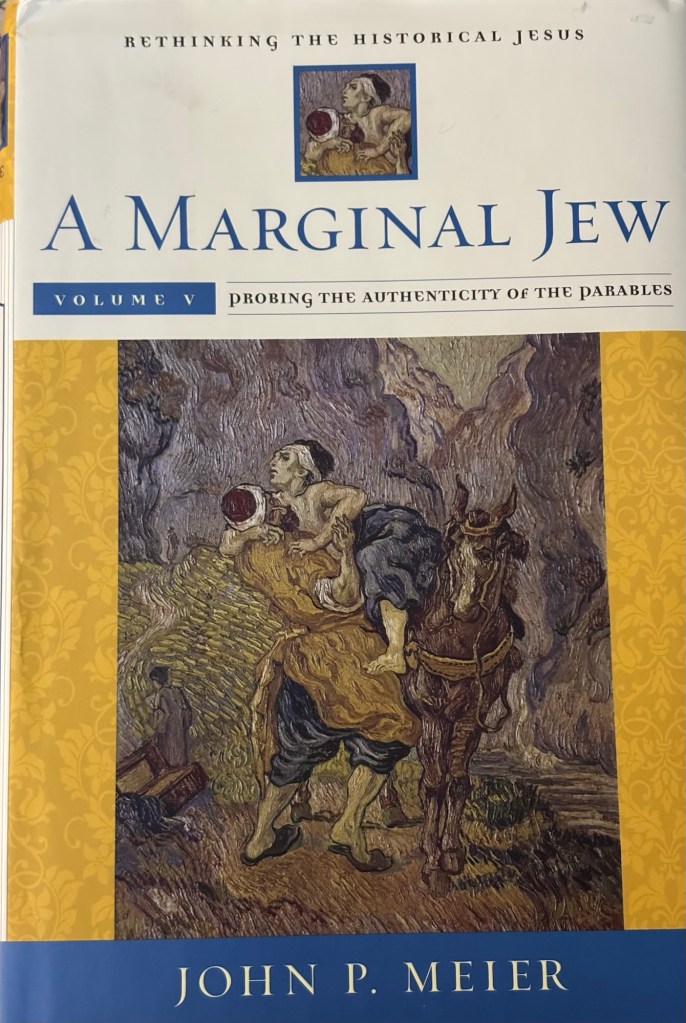
This final volume from Father Meier is excellent for the same reason the previous four are excellent. Meier states his destination and the rules of the road, and then works steadily towards it. This strategy allows the reader to do something even the Bible itself doesn’t: we get to assess his work. Put another way, Meier gives you everything you need to disagree with him. The only real criticism, then, is to discount his destination (an acceptable-to-all historical Jesus) or his rules of the road. (And feel free to do so.) But I love his destination and even if I didn’t agree with his road rules, I agree with the concept and so his portrait of the historical Jesus is fine by me.
To be sure: upon completion of these five volumes, you will never again believe Jesus was hippie-like. You will never again believe Jesus was some wise sage, like Confucius etc. But more importantly, for every stupid thing that you hear non-believers say about Jesus, you will have excellent evidence of where they are wrong. Never forget, the goal with these folks is not some stunning delivery of “you are wrong”, but “I bet you’d reconsider if you had better information. Do you have a second to chat?”
I threw in Metallica’s Load Album book for kicks because (1) I did read it. And (2) it has some pictures that were tremendously nostalgic. (Metallica re-released Load remastered recently.) “Hero of the Day” is far richer, more “Simple Man”, than I ever remember noticing. You will not be disappointed to reinvestigate both.
Attention Black Faith Leaders: We Need Black Preachers
I just read about how you’re trying to boycott Target.
In the comments, I read, “…Thank you.” As a white man, I take this to mean, “Thank you because, as you know, I would prefer to shop with Whites only anyhow.”
So let’s get this straight.
Segregation was real. And you (Black Preachers) got it to end.
Now you (Black Faith Leaders) advocate for segregation?
Seriously, you need to become Preachers again (Gospel Preachers, if you want my honest opinion). Something was lost in the generalization.
Another Example of the Rewards of Reading in General, and Reading the Great Books of the Western World in Specific.
I have written or implied here that it is my belief that the Great Books of the Western World set is nearly as inspired as the books of the Holy Bible. No one cares.
But I care. And so I persist. Here, then, is another example of the rewards of reading them. I am currently in Vol 4 “Religion and Theology” of the companion guided reader set “Great Ideas Program”. After Aeschylus’ Prometheus Bound, there was some Old and New Testament passages and now St. Augustine’s (aw-GUSS-tinz) Confessions.
Some backstory (“Learning is a change in behavior based on experience”) is relevant.
While at Seminary, studying the Bible in its original languages (which truly means being told aloud in English that translators fear “Yahweh was hot” will sound too human ((ergo, not separate—or the Holy in “Holy Bible” (((The “separate book(s)”))))) and so they have opted for the supposedly more esoteric and divine sounding “Yahweh was angry”), I persuaded myself that these early humans were exceedingly (and uniquely) concrete in their writing. And I still believe this to be true, the following reward notwithstanding.
For example of what I mean by this unique “concreteness”, I believe when Moses would tell the Genesis account, he would sweep his arm over his head, from horizon to horizon, as he said, “In the beginning God created the heavens” and then sweep his arm under his feet, from horizon to horizon, as he concluded, “and the earth.” Get it? In other words, I believe that he pointed at the night sky (in my mind I can never shake that all the Old Testament stories were told only after darkness near a pleasant campfire) as he said “heavens” and then the ground as he said “earth”. In short, I believe that Moses did not try to trick anyone or talk about anything unseen in order to talk about the unseen Yahweh. Put one other way, I don’t believe there are two steps of belief. It’s not “Let me explain one unseen. Got it? And then, stick with me, you’ll get God!”
No. For me, my theology—based on content of Bible, to include when it was written—all that the Bible authors ever did was use material world to explain spiritual world.
That backstory complete, let’s get to the heart of the post.
Augustine has a book (chapter) which translators subtitle, “Augustine proceeds to comment on Genesis 1:1, and explains the “heaven” to mean that spiritual and incorporeal creation which cleaves to God unintermittingly, always beholding his countenance; “earth,” the formless matter whereof the corporeal creation was afterwards formed…”
Like you’re undoubtedly thinking, I also thought, “That is an intense sentence. I had to read and re-read it too much to want more.” But I pressed on.
And as I read, with my gesturing Moses in mind, I couldn’t help but notice something. Augustine was spending a lot of time defining formlessness or describing how he couldn’t wrap his mind around it—despite wanting to understand it and then explain it to others.
Then it hit me.
My gesture theory is flawed, in one sense. At the stage of creation in verse 1 of Genesis, a careful reading reveals that this “earth” that Moses points to CANNOT be Planet Earth (however little Moses and mankind knew of it at the time) because the next part of the story is, “formless and void”. Planet Earth is not, formless and void, so something else MUST BE meant. But what?
I still say Moses gestured (and meant it) while he spoke. But I am now forced to clarify that he definitely added a clarification that means he does not believe he is talking about Planet Earth and the rest of the material universe when he gestures.
The new question on this Sunday of Sundays: According to the text, what did God create, by creating “the heavens and the earth”, because it certainly can’t mean material/corporeal/measurable bodies beloved by physicists?
Augustine wrote down his ideas. I have some reactions to those. Others have recorded their ideas. The idea here is not to suggest we can know what Moses meant. The idea is that we can live richer lives knowing that we don’t know what he meant.
“Learning is a change in behavior based on experience.”
In short: the reward for my reading from the Great Books of the Western World is that I learned, that despite my previous intentions and best efforts, that I was wrong. And the “right”, oddly enough, was plainly written and right in front of me for all this time, too. Fascinating.
Fellow Christians: NewsFlash—He Wasn’t in the Tomb for 3 Nights
Any mind reads the passages foreshadowing the length of Jesus’ stay in the tomb and thinks, “Umm, that doesn’t match.”
Any modern mind is correct. It doesn’t “match”. The math doesn’t add up.
Additionally, there is a concept I see floating around as I peruse “reasonable” or “rational” Christianity defense websites which compares the calendar of Bible cultures with our calendar. This comparison is literally an exercise in futility. Don’t be duped, Believers. (Pro Tip: If a Christian pulls out a dry erase marker, white board, easel, or pad of paper and pen to explain their point, stop listening. Diagrams and visual aides are not necessary to understand Christian truths. Back to the timeline claim.)
Jesus compares the event to Jonah’s “three days and three nights”. And then every record of the resurrection (“Early! Early Sunday morning—He got up!!) has words which describe that he was only in the tomb for what may be best called two periods of night/dark. Not even the original Jonah account in the OT records the start and stop time of Jonah’s stay in the whale.
This is not a theological problem and I’ll prove it to you. The proof is contained in this tip when discussing with skeptics.
Next time the issue comes up, try this.
“Let me ask you this. Let’s skip to the end and pretend you’re satisfied with the answer to the ‘3 days’ problem. With me? Just imagine I said words and you found them sufficient. After this, how do you propose to handle the ‘heart of the earth’ problem?”
I’m serious. We have all these Christians and non-christians walking around debating how to count, and there is a mutual claim that the individual/being in question will be in the “heart of the earth” for the time period in question.
A practically uniform tenet of the faith is the explicit claim that a borrowed, above-ground tomb was used. Jesus definitely did not have any earth thrown atop his body.
Moreover, even if he would’ve been buried “six feet under”, and even with the analogical heart being located slightly to one side of the top half of the body, the “heart” of planet Earth is proportionally far deeper into the dirt more than a mere six feet.
In the end, the “solution” to both is the same.
And the LORD God Almighty owes you nothing more, by way of explanation, than you’ve had all along. Use your brain, Christians. Getting these moments with skeptics right is serious.
(Also, never forget that no skeptic has a problem with a Christian who honestly says, “Good question. I haven’t thought about that before. I don’t know.” Skeptics have a problem with BS and stupidity.)
“One Pastor Candidate for Every Five Pastor Openings”
Have you heard this one? I just heard it the other day.
I’ve been generally aware of the “pastor shortage” or, put differently, the “need for pastors,” but the other day after a men’s Bible study, a church member shared this doozy with me.
You see, the local church my family will probably join is between pastors at the moment and it’s been seven months. They have stalled in the search, basically taking the past seven months to write a church profile with only two salient facts in my view: low attendance (50-60 a Sunday) and minimal budget (somewhere around $150k a year).
But now, with only depressing effect, there’s this fact in the mix. Only one pastor is available for every five congregations looking for a pastor, or in need of a pastor.
I say, let’s honor the rumor and explore what it may mean. Like from a God’s eye view. For example, are we saying that God isn’t providing shepherds for His flocks? Seems unlikely. What are some other options?
One other option, possibly the only other option, is that the pastor-less churches aren’t churches.
Boom.
Consider that.
What would that mean? What would we be saying if we concluded that four of five pastor-less churches aren’t “churches”?
I’ve been thinking about this question all week. And the answer, as I see it, is not as surprising as you might guess.
What does it mean that four of five pastor-less churches aren’t actually “churches”?
It means people aren’t religious anymore.
And that fact is not surprising at all. It’s quite mundane really. It’s not even embarrassing. It’s “just the way it is”.
Specifically though, or more acutely, it means that these pastor-less groups, are viewed by men like me (or men I went to seminary with) as uninterested in religion. Instead they’re interested in having their way all the time, and won’t be moved from their opinions.
In the particular church I have been attending, the head deacon was curious about my opinion on whether the flag could be placed back behind the pulpit in the sanctuary. It seems the previous pastor took it down as an early order of business during his tenure.
The point here is not, “What did you tell him, Pete? We are having the same debate.”
The point is, “What man on earth, let alone man of the cloth, man called by Almighty God to preach the Word, wants to debate sanctuary decorations?” That’s not a Christian church problem, that is a personality problem. Too many cooks in the kitchen.
Step 1 of problem solving, Air Force Officer Training School style: Recognize The Problem. The problem here is not a pastor shortage, the problem here is a truth shortage.
The God of the Bible, the Creator and Sustainer of the Universe is not afraid to use unpleasant truths to accomplish His will.
The truth is these groups of people long ago stopped being Christian churches. Everyone with children left—that’s the first sign. But more than that, churches grow. They also convert people. If so-called “churches” aren’t growing and aren’t gaining new converts for years, they’re not churches. This isn’t the end of the world. It’s the truth.
In conclusion, don’t put out a “Pastor Wanted” sign if you’re not a church.
And if you’re not a church, then the only public action for your group is prayer. If the “church” won’t pray together, then you’ve learned all you need to know. 1. It’s definitely not a church and 2. your two options then are evangelize or leave.
I say, why not evangelize? Most people are horrible at it and you’ve at least got a ready audience.
As for me and my particular situation, I’m attempting to practice what I preach here. I’m sticking with these folks, who otherwise are not a church, because they’re a ready audience and they need Gospel as much as the next man.
They Will Know
Hardly a day has gone by while I have been a professing, confessing Christian that I don’t think about the vast increase of nearly irrefutable knowledge since Bible times—and its seeming ability to dethrone gods.
This new Jurassic Park movie is one more stumbling block for Christianity. It’s not just, “There are no dinosaurs in the Bible.” It’s not just, “Using the Bible timelines, there’s no accounting for dinosaurs.” It’s not even merely, “Christians go to unappealing lengths to rationalize away everything that dinosaurs mean to timelines of the universe.” It’s that dinosaurs are certainly not gods and yet they have seemingly trounced the god of the Bible—and effortlessly at that.
As I mentioned last post, I’m currently reading selections of the greatest math and science books, and that means Euclid. When it comes to science, you start with math. When it comes to math, you start with Euclid. (Wait for it…) It’s elementary.
I have mentioned Euclid in past posts, and I have mentioned that I think comparing what Euclid was doing circa Bible times with what Biblical authors and God Himself was doing circa Bible times is endlessly fruitful.
This time around, the guided reading book put special emphasis on the fact that Euclid was concerned with ideal figures, not with drawn figures. Put differently, his definitions, postulates, common notions, and eventually propositions were not about, “Can you draw an equilateral triangle or circle etc.?” No, they were about, “Can you build a mental construction (field of study we call geometry) which supports itself against all attack?”
Student: “Why is a point that which has no parts?”
Teacher: “Because that’s what Definition 1 says.”
Smart Student: “Okay, I get it.”
It’s not far removed from fiction.
Reader: “Why is Batman not able to fly?”
Author: “Because he’s just the man Bruce Wayne.”
Smart Reader: “Okay, I get it.”
Unlike fiction (you’re telling me no one ever notices Bruce Wayne is not present when Batman is??), however, Euclid holds up tolerably well.
And my point, regrouping, is to highlight that Euclid was intentionally teaching things he knew were only in his mind.
Dinosaurs—only dead objects.
Triangles—at their purest, only in our minds.
Religion—inadequate written and spoken term for core reasons for actions and ideas among living people.
****
Next, a lady at work yesterday rolled up her sleeve to reveal a new-ish tat of a scene of the “North Woods” on her forearm, from what I could tell without staring.
At the gentlemen’s clubs, I saw many women with bodies all tatted up. I learned that some men found it ugly, and others liked it. I found it kinda sexy when the tattoos were thought through. But no matter my opinions today, I can remember initially being repulsed by what I thought the ink did to an otherwise beautiful figure.
Yesterday, I felt that revulsion again. This was a pretty darn normal looking lady—definitely not a lady of the night choosing fast living at every turn. I then felt, “She’s searching for meaning. That’s the only explanation. She’s feeling like a cog in a machine and needs to individualize and ground herself. That’s why she took the counter-culture path.”
I know, I know. Seems like a lot of thought for something trivial. But my religion compels me to see it’s not trivial. Everything matters. And most of all, losing matters. It’s clear that religion has been losing. At every turn this is true. Why is religion losing?
This brings me to my title.
I’ve been studying Ezekiel for some time now. And many times the LORD gives, “And they will know that I am the LORD,” as the reason for his actions. Most often, his actions were lethal judgement of the members of a prideful tribe.
I’m not gonna ask the corresponding question about dinosaurs. But I do want to ask it about the math and science geniuses. What power did ideal figures have in staving off death? What power does a jurassic period in history have in clinging to life?
How about the tattoo? Did my co-worker’s tattoo satisfy?
****
Clear, consistent thought is a must. It doesn’t obtain eternal life, mind you, but it sure is essential while on Earth.
Dinosaurs are fascinating to contemplate—especially when they are destroying national monuments.
It feels wonderful to make long-lasting decisions (permanent tattoos). I can speak as an expert on this one. Being able to act decisively with an aircraft which does not forgive poor judgment is half the reason to become a pilot. My thoughts and actions matter. I’m important.
But even I can report that making many vital decisions still doesn’t satisfy.
Religion satisfies.
At the end of the day, I see American history recording our current age as “one in which we discovered the reason religion didn’t die.”
“And they will know that I am the LORD.”
Almost A Decade In, And I Still Love Blogging
The first post on this blog was in 2013. As most bloggers can surely relate, that post felt very exciting. It felt like I was about to contribute. And not just in a small way either—this was the big time. My words were going to give other people meaning.
The excitement that I felt that day nearly nine years ago wore off pretty quick. But I still love blogging. Here’s why.
Yesterday, after reading some of the book of Genesis, the book of Beginnings, from the Bible, I was frustrated that I knew hardly anyone who could keep up in a conversation about the actual words of the text. Plenty of people like to talk about what they believe and what their church believes, etc. But it’s a different thing to find someone who can remain centered on the text itself.
So I posted a fantasy conversation. I just took a minute to befriend myself and imagine what I thought a good conversation would be like.
The conversation ultimately centers on the Bible’s very own version “Which came first, chicken or egg?”
And here’s the point. Because I blog, because I took the time to flesh out my little fantasy, I came to a pretty cool little realization. While I was wrapping my mind about how someone could know he’s been fathered by one particular father, how could that person not know his father’s name, I now see that I had set the stage for me seeing that this conundrum is one of the primary claims of Christianity.
Regarding Moses, Yahweh was always there. But Moses hadn’t met Yahweh, or put differently, there was a time in Moses’ life before Yahweh had introduced himself to Moses. This introduction is the precise moment where words in the atmosphere, ink on a page, crossover into reality.
The question about how Moses could know he was an Israelite, but not know his own god’s name, is not more than chicken and the egg.
But this simple way of analyzing the problem doesn’t resolve anything, mind you. Yet it does bring things to a clean head. Christians often say they have met their maker. “That’s when I met Jesus”, or something similar. They claim they know—with certainty—the chicken came first. But for you, o undecided one, or egg-firster, the problem remains. Is your maker out there, trying to get your attention? I don’t mean your natural father, I mean the one that gave us “life”. I don’t mean animation, I mean, joy, sorrow, passion, desire, personality, you know, our life. Could you imagine that he is out there, this maker? And his interest is to make his introduction, with a follow-on goal of giving you eternal life?
This introduction and this eternal life are certainties that do not necessitate the end of uncertainties. My own ability to know the chicken came first and yet still ask, “But how did the chicken get there?” is proof enough of these unending uncertainties.
In the end, I just wanted to share that after nearly a decade, I still love blogging. More than that I love life. And I am glad to believe that I have received the promise of eternal life from Jesus. Let’s keep the good time’s rolling.
Friday Post-Bible Reading Fantasy Debate
“So it’s campfire story until after Moses dies?”
“That’s right.”
“So Moses is telling the story of Adam and Eve, Cain and Abel, and then Noah, and then Abraham, and eventually Jacob and Joseph?”
“You got it.”
“So is Moses somehow ‘read into’ a version of scripture as a young boy, like an already begun tale, or is he passing down something later related to him, perhaps by Yahweh Himself?”
“Interesting question. What brings it to mind, if I may ask?”
“Well, in early books of the Bible, books authored by Moses, books written before Moses learns God’s name on Sinai, characters use that name in speech. For example, Abraham talks to the king of Sodom and says, ‘I have raised my hand to Yahweh God Most High…’”
“So?”
“So, my real question is, ‘Is Moses telling us the truth that Abraham actually uttered the name “Yahweh”—which would mean it was then lost by the time Moses had to ask—or, is Moses helping the story along, and keeping it particular because he, Moses, knows that Abraham meant the god “Yahweh” whatever he, Abraham, actually uttered in that moment?’”
“Ah. I think I see your point. Quick clarifying question. What difference would it make if Abraham uttered ‘Yahweh’ vs. Moses only saying that Abraham uttered it?”
“Well, doesn’t that make Moses a liar? I mean, how can he say something happened that he knows did not happen?”
“What do you think? Is there any way that scripture holds integrity here? You’ve painted a pretty stark picture.”
“I guess I could zoom out a bit and say the point of scripture is not to get Abraham’s exact words correct, but to reveal who Yahweh is.”
“Seems a bit too loose.”
“Maybe I could say that it must be that the name Yahweh was lost by the time Moses was on Sinai?”
“Seems like you don’t actually believe that.”
“Maybe Moses didn’t really write it as tradition holds?”
“Jesus seemed to think he did.”
“Good point. Hmm. So Moses knows he’s a member of Israel, and knows this before the burning bush, because that’s the whole point. His people were already a “people” in their own eyes, that’s how they were enslaved. Then it’s got to be some kind of more immediate need on Sinai when he asked, than Moses inserting it into Abraham’s speech falsely. And that would, or but that would also mean that Moses is passing on an inherited tradition—which is now not that unlikely because the story is definitely that they were enslaved according to their tribe.”
“But this still leaves what problem?”
“It leaves the problem of ‘If Moses is passing on inherited stories, why did Moses have to ask Yahweh what his name was? Shouldn’t he and all the people fresh off the Exodus have known?’”
“Precisely. But let’s ask it this way, ‘Would the people who were already creating an idol while Moses was up on Sinai have known Yahweh?’”
“Good point. And yet someone had to have told Moses.”
“Had to have. Or else Moses, as author of Genesis, must be lying.”
“But he can’t be lying.”
“But he can’t be lying, that’s right.”
“What do you think?”
“I think what I normally think.”
“‘More reading.’”
“More reading.”
God Did Not Write the Bible
This post is driven by that same Wednesday night church experience last week behind that other post about choosing a home church. As a refresher, the Baptists had a new children’s winter Bible Study and through it, on day one, lesson one were teaching the kids that, “God wrote the Bible.” In fairness, the pastor quickly clarified or tempered this claim with something like, “…using men…” But my point remains. God did not write the Bible. Moreover and more to the point, no Baptist, alive, dead, or yet-to-be even believes that God wrote the Bible. So why teach a child that?
I’m actually a little at a loss on the topic overall, these days. Why even say, “The Bible is inspired by God?” Or, “The Bible is God-breathed?” I’m totally fine with quoting scripture as in, “In Peter’s second letter he (Peter) says the writings we consider as the Bible are…” But, if we’re talking amongst ourselves (Christians to Christians), the thing being communicated is known and part of the “Christian-ness”. It’s like two basketball players describing that there is air inside a basketball.
And if we’re not talking to Christians, then we’re telling a person who doesn’t believe in an admittedly invisible being that that self-same unseen being wrote a very visible book which is most evidently written by humans.
What, then, shall we say? Start with, “The Bible is coherent.” We Christians believe that both the Christian and the non-Christian/pagan/heathen can all understand the contents. No different than Romeo and Juliet or the Constitution of the United States of America. So start there.
Scrap all the virtue-signaling and holier-than-thou talk and just tell the truth. Say true sentences that are defensible to their core. Was the Bible written by God? I answer as a Holy Spirit filled follower of Jesus Christ and a literate human, “No.”
A Baptist, a Charismatic, and a Baby Walk Into a Bar…
…actually it was just a walk around the neighborhood. But picture it with me, because the setting is important. It’s a small town, about an hour from the major metropolitan city center. It could be any number of these type of towns. Mostly rural, but that doesn’t mean folks don’t have all the markings of city life, from fancy cars to fancy ideas.
My wife likes the local charismatic church, as does my step-son. (I choose the word “like” over others intentionally, as any Baptist should. So mark that.) It’s hard not to like the church. On Wednesday nights the foyer is lit like a nightclub, and the parking is full like a bowling alley’s on league play.
I had just arrived after ducking out of the Baptist church’s Wednesday night programming early, that is, when the games started. Baptists have recently switched from AWANA to “Kid’s For Truth” and this particular Baptist church was on its first effort with the new program. Suffice it to say, the night did not go well. Lots of scrambling, lots of evidence of lack of preparation. Lots of scapegoating that it was the “new programs” fault that things were not running smoothly.
This morning then—starting last night really—my wife and I chatted about the different experiences I had as we continue to seek out a church home. I love these types of conversations and discussions, and my wife enjoys them enough to indulge me.
Without walking you through the hour long chat moment-by-moment, though that was an eye-opening experience itself, I want to give you an analogy which captures the result, or where we landed.
The mystery of the modern protestant church is best likened to two engineering schools that teach from one specific written curriculum how to build one specific item—boats.
Now imagine that one of the schools is packed with students and that the professors all believe they are teaching how to build boats. Moreover, all the students really feel like they are learning how to build boats—the professor’s all agree—and they talk all the time about boats and their design and construction.
But they never build boats.
Mind you, no one needs any boats. It’s not like there are customers calling to ask, “Where’s my boat?” That’s just not happening. What is happening, to repeat, is there is a school which uses one specific written curriculum to teach how to build boats, there are professors teaching how to build boats, and there are paying students believing that they know how to build boats. All this, but no actual boats.
This is the first school.
The second school, using the exact same curriculum, has trouble finding professors—often resorting to retired professors and temporary professors—but they teach the curriculum to the letter. A person could build a very good boat based on their teaching. Regarding students, there are only non-traditional (25+ year olds) who actually are just auditing the course. Every once in a while, a real student shows up and pays to learn, but they often quit attending and ultimately (and quietly) stop submitting assignments. The older auditing students happily provide the materials for the boats—often one-upping each other in quality of supplies—but the students just seem to need other students around and so they keep quitting when they realize that they are the only one in the school.
So again, like the first school, there are no boats being built.
And like the other school, the written curriculum is there. There are capable, if not likeable and consistent, professors. Different than the first school, at this school there are even all the necessary supplies and tools, to build the boats, but the trouble is there are no students—and so no boats.
Now enters the problem. In what everyone sees retrospectively as a “should’ve known” moment, a bizarrely miraculous but terrible event occurs. Everybody, all people—not just students of those two aforementioned schools—fall into their own personal sink hole of varying sizes that contains themself and everything they have ever built. If one man built a lego set, it’s in their sink hole. If another built a paper airplane, it’s there. Many individuals have many items. Some have none. If someone built their house, the house is in the sink-hole. If a person built a boat, they have their boat. If a baby built nothing, there is a rather small hole with just a baby (probably crying). You get the picture.
There is no way out of these sink holes. No ladder can reach the top. No one is above who can throw down a rope. No flying machine has fuel. Everyone is stuck by themselves with whatever they built.
Then it starts to rain with no sign of stopping.
As this rather precarious and new, if not oddly predictable, situation continues to unfold, suddenly, the entire planet, and all its occupants, all its plants, everything instantly burns up. Nothing is left.
Finally, everyone gains awareness that they are still alive. Some are amongst a trash fire, unaware, and never becoming aware, that any change to their misery is possible. Others find themselves in what words cannot quite describe, but when pressed maybe something like blissful communion with what feels like an old friend and mentor, communion that has an odd mixture of familiarity and constant newness and overall is simply awe-inspiring.
That’s it. That’s the analogy.
****
In short, for my dad and readers like him who feel they want to understand but aren’t there yet, I’m saying the problem with church-shopping is that the church doesn’t direct where we end up after the fire.
 Captain’s Log