Tagged: AI
Why Is AI So Slow?
Anyone else having this problem?
I’m sitting here, trying to illustrate Genesis, chapter 37, exactly as my well-informed mind’s eye sees the scenes, and after I finally input the prompt, it’s like the time-space universe reverts back to 1996 and dial-up.
What gives?
Seriously, when I want 18th century BC grain sheaves to bow, and in the style of Gustave Doré, I want it now! And I don’t have time to waste.
What gives?
How can AI be sped up?
Anyone know?
Is anyone working on the problem?
Anyone?
Bueller?
The Less Committed Noah, A Review of “The Coming Wave” by Mustafa Suleyman
To recap, I admitted to myself some months ago that I knew nothing about AI. I also doubted that anyone uttering the sounds, “A-I” (“It’s an acronym”, taught Kamala), knew much more than me. This belief was bolstered and informed by my nearly-techie brother’s share that his bosses advocated the use of the phrase wherever possible during meetings with clients as it perked people up. In other words, AI is trending. (There is nothing new in this confession of mine.)
The first book I decided to read was Melanie Mitchell’s Artificial Intelligence: A Guide for Thinking Humans.
I then asked a friend for any recommendation he might have, and that is how I ended up reading Suleyman’s book.
To be clear: there is no need to read this book. It is not earth shattering. It will not change your life. It truly does not have much by way of content. A Toastmaster friend once told excitable me, in an effort to dissuade me from buying his book, that these days books are little different than business cards. That is about right for Coming Wave.
But I did read it and consider it and this is my blog so I am going to share my thoughts.
Maybe because I have been reading a bunch of ‘evolution of physics’ books, I read “wave” in the title and pictured (and was intrigued by) the wave in lightwave. Maybe it was because I have already asserted that AI is merely man’s newfound ability to sense electricity with greater refinement than ever before that I didn’t see “water” wave. Whatever the reason, I was totally taken aback by Suleyman’s opening alignment with Noah. It’s actually shocking. Seriously, consider it. There is a man, who by all accounts is ‘successful’, and he chose to warn the world of cataclysmic disaster.
What?
Perhaps it was my background in Biblical Studies that clouded my thinking. But the end of the Deluge account in Genesis includes the Rainbow and the promise to never flood “the world” again. This leaves two choices available to authors. First, believe the Bible story and live a peace-filled life. Second, totally miss the conclusion of the Bible story and with astounding boldness, still identify yourself with the main character in some bastardized version of the story.
But what do I know? I’m often told it is better to not throw the baby out with the bathwater.
So I read on.
Suleyman opens the book with a Glossary, much like post-graduate work requires. But unlike post-graduate work, no editors or friends told him that his definitions are nebulous. Take “Waves” for example.
“The global diffusion or proliferation of a generation of technology anchored in a new general-purpose technology.”
Global, generation of technology, anchored, and general-purpose technology all need to now be defined.
Another term (pessimism aversion) includes the word elites. What exactly is an elite? My best guess is the intro-extro couple from Susan Cain’s Quiet who can’t decide on how to seat guests at their parties. (Throw pillows and a bar with top chairs was the solution, if I recall.)
All this might seem too detailed and in the weeds, but I assure you of my earnestness. What exactly is the threat? Why don’t I feel it? How come when I hear “pessimism aversion” I think, “Does he mean hope?”
I’ve talked about how unappealing it is for politicians to constantly hedge their positions elsewhere on this blog. Well, Suleyman cannot but hedge. His warning, so laughable, is always immediately followed by, “But it is also possible that it only rains the exactly perfect amount.”
Fourteen chapters, two hundred eighty-eight pages worth of Noahic warning, immediately hedged.
Again, Noah didn’t hedge. This commitment is one major reason Noah is timeless. Suleyman, on the other hand, will not be remembered. His wave will not form—regardless of his book’s grand clarion call for containment (and central planning at a level red blooded Americans will never tolerate).
Moving on to “new to me”.
I have to admit that Suleyman did introduce a few topics that Mitchell left out of her more focused general audience primer. Synthetic Biology, according to Suleyman, is a hand-in-hand technological advancement. Think Arnold building Arnold.
Suleyman also introduces the concept that, running with the Terminator theme, Arnold won’t care about nation-state boundaries (which Suleyman defines, abhorrently, as “collective fiction resting on the belief of everyone concerned”). The example of this coming hellscape (the “warning” before the hedge) being, ta da, Hamas. Or, maybe a good analogy are the fringe groups in the NW part of America which seem to always be trying to separate statutorily from anyone who can say “sanctuary city” with a straight face.
Then again, it is possible that AI actually ushers in more rainbows and the first ever unicorns. You just never know.
To be honest, and this is the end, Suleyman’s main problem is he cannot (nor can anyone it seems) meaningfully define AI. Melanie Mitchell essentially teaches us how AI works, but Suleyman doesn’t mean that AI. His warning is about the coming AI. You know, the one that really is going to put an end to the Anthropocene and all the blood-pumping bipedal organisms with opposable thumbs and large frontal cortexes.
My final takeaway, the one I sent to the recommending friend, is: Either (A) AI programmers like Suleyman are trying to suggest the coming AI is concretely analogous to handing nuclear bombs to the homeless or (B) they don’t mean that.
If (A), then right now we must immediately issue a call to arms and begin a first of its kind unceasing kinetic war against them. If (B), then there is no coming wave.
Reading Log 6.9.2025



Heart of Darkness was a spur of the moment addition to what I had lined up. I stepped out of my car in my sister’s neighborhood and the neighbor whose yard I was parking in front of, and of whom I inquired if the parking spot was okay, became chatty and mentioned he’d read the book 10 times. He mentioned many other things about it too. I hadn’t read it in years (there’s a review on here from a decade or so ago). So I figured I’d give it a re-read. It is scary. Definitely not for kids. And yet it is a must read. Also, the film adaptation Apocalypse Now is probably the best adaptation of any book/story ever.
****
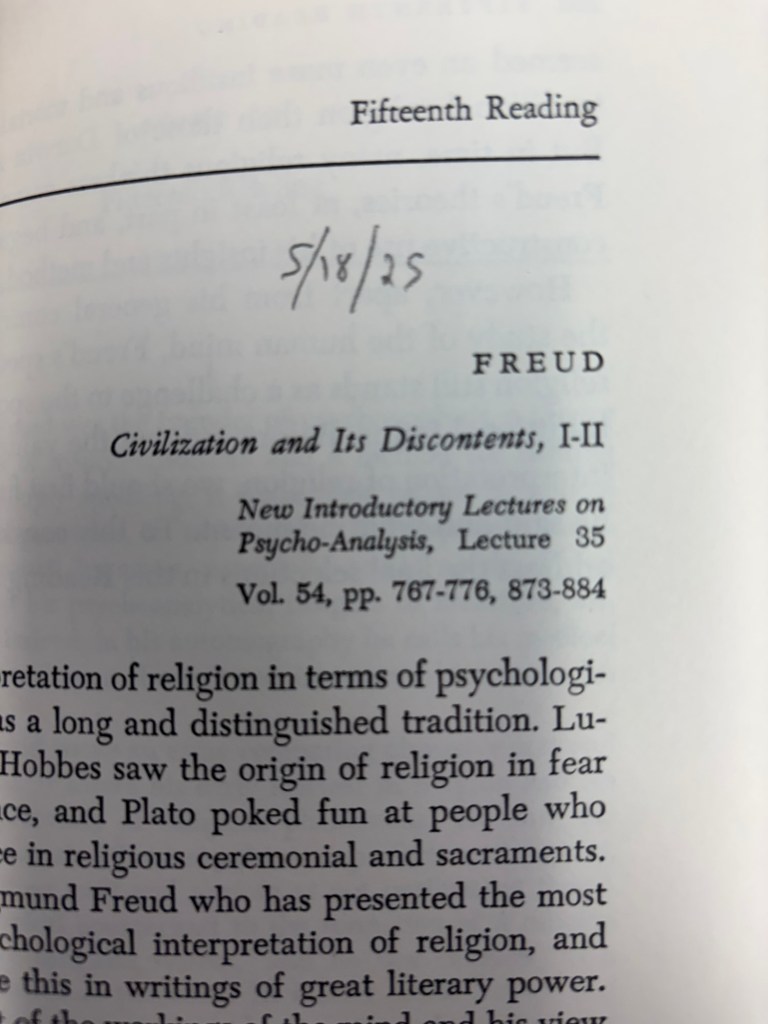
Freud is someone I kinda disdain with all my heart. What a waste.
So everyone is living on the planet, all hunky-dory, and then one man says, “You know that feeling in your belly, the one you get when you haven’t filled your belly in a while? Well, we get hungry and have needs in our minds too, don’t ya know? Oh, and this means we invented religion.”
I enjoy reading people who I disagree with—I like trying to imagine arguing with them. So there’s that. But Freud is someone whose influence I could live without. I will say this, though. Rather, I’ll let him say it.
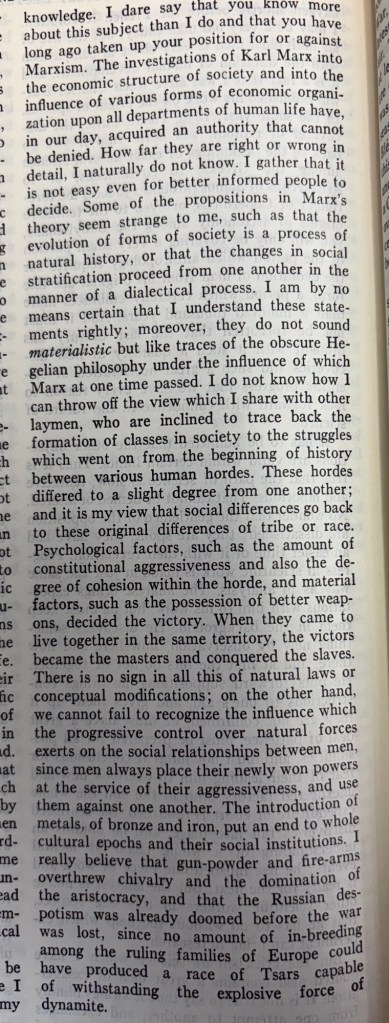
Freud went on to declare that Marxism and its “suffer now, be rewarded later” propaganda was, to him, no different than religion—and needs to go, too. So with that I say, Freud, ol’ buddy ol’ pal, pull up a chair. Let’s get you another round.
****
I had been reading that Eddington for far too long. I am happy to be finished with it. He is exactly my style and we see the same world. The main takeaway that an honest man like Sir Eddington gives is the truth about the speed of light. He very clearly explains that the speed of light is, in fact, not unsurpassable. Instead, what the physicists mean is the speed of light is universal. His analogy is that it is the “wood grain” of the (wood)universe. Even while he was alive they had experimentally collided electrons or whatever together and gone “faster” than the speed of light. But that doesn’t affect the fact that nothing is faster than the speed of light. This is because the speed of light is the separation of time from space. So if you were to go “faster”, you’d be combining time and space, which is clearly unimaginable.
****
I picked up this book on AI for obvious reasons. And guess what? My instincts were right again. There is nothing to fear. AI does not learn. It does not read. It does not understand.
In short, the computer nerds learned from the brain nerds that between 1. a conscious decision to move the body, and 3. the brain-activity that moves the body are 2. many other brain-activities whose purpose is unknown. So the computer nerds built (2.-like) delays between “do this” commands and “do this NOW” action. And then, the computer nerds programmed the “do this NOW” action to respond to “you failed” responses with (actual jargon alert) back-propagation. It is this back-propagation that is “mysterious” and where the nerds say the AI is “learning”. But again, the AI is not learning, it is following commands and making exceedingly subtle adjustments. The trouble for the nerds is the time it would take to map out all the exceedingly subtle adjustments of back propagation is considerable—and even if they took the time, they’d simply have a ton of data points and not really any necessary reason to draw one conclusion from another as to why the program executed either 1. that many actions or 2. those actions in particular in order to not “fail” again.
Talk about navel-gazing.
Regarding handling and “seeing” images, the computer nerds, this time, learned from the eyeball-nerds. In short, the eyeball nerds have learned that there is a distinct method to how we see, which essentially goes from big to small. Like, outside, blue sky, green earth, forest, tree, tree branch, tree leaf, leaf veins etc.
So on an image, the computer nerds tell a program to find edges first, and then go from there. Again, AI does not see anything. It just is really good at the game of “memory” (unless humans screw with images in certain, invisible to naked eye, ways.)
One final comment of recommendation for this book. (You really should admit ignorance and read it.) The author describes the phrases “AI Spring” and “AI Winter”. And she proceeds to use them throughout her description of AI’s history. In short, AI “astounds” someone (Computer beats Chess Champion), and money shows up in large amounts. The computer nerds take the money and promise everlasting life. This is AI Spring. Then the computer nerds fail to deliver. The money dries up. This is AI Winter. The cycle repeats. ICYMI, we are currently in AI Spring, more like AI Monsoon. But winter is coming. It always does and always will. Withstand the hype! You can do it!
The REAL Truth About AI
AI is mankind’s ability to sense electricity—and nothing more.
To repeat, AI cannot read. It definitely cannot read English. But it also cannot read any other language.
Also, AI cannot see the road.
Furthermore, AI cannot think up answers.
To be fair, to describe these and other negative facts about what AI cannot do is easy when compared to accurately describing the relationship between one of us “using” AI and persuading themselves (or being persuaded) that AI is reading, that AI is aware of the road, that AI is “thinking”. It’s not impossible though. In the most important sense, that relationship does not meaningfully differ from when a person feels the handle of a hammer in one hand and a nail in the other hand—and is persuaded that the nail will be driven into the board without a doubt.
No inanimate machine “hears” the sound (or any one of the many sounds) the letter “a” makes when it senses the electrical representation someone has coded for “a”. (It’s not like the electricity buzzes itself into an “ahhh” sound.) Instead AI senses some distinct electrical value which corresponds to what some person had decided should consistently and uniquely (though not exclusively) correspond to the English letter “a”. This is no different from how your hands consistently sense hammers and nails which correspond to what we have come to call hammers and nails when it holds them.
AI as a name is likely here to stay, unfortunately. But this is no more difficult a situation than, say, the QWERTY keyboard sticking around.
But AI is not artificial, it is not intelligent, and it is certainly not artificial intelligence. That is, unless you mean to convey that AI is mankind’s ability to sense electricity—and nothing more.
The Special Psychosis Behind AI Fear Mongering
The “threat” of AI is no more and no less than the threat within the act of “texting while driving”.
I mean to apply this analogy in both the case of you texting while you’re driving—a risky endeavor which can end in tragedy for you and a few others if you cause a wreck—and also in the case of you (not texting and driving) being struck by someone else who was texting and driving.
That’s the “threat”—no more, no less.
Everyone calling for concern at the level of atom bombs and armageddon is suffering from a special psychosis.
In other words, ignore them.
Better yet, put down the phone. Focus on the road.
 Captain’s Log