Tagged: faith
Knowledge Is Irresistible; It Defies Rebellion
Come close, ya stiff-necked supercargo. This one is important. This is a story about laundry. It is a story about power. It is the story of knowledge.
It may come as a surprise that pilots, especially military pilots or their veteran counterparts like me, spend many nights of each year in sleeping bags. As an Eagle Scout who knows the true value of a quality sleeping bag, I remember being very proud when I heard that our deployed commander used one instead of sheets while in Iraq. You see, I was no longer alone. To this day, I spend about 1/4 of the year’s nights in a sleeping bag—not including camping trips.
Naturally, this level of commitment leads to the need to wash a sleeping bag, and wash it with more regularity than your own sleeping bag laundering habits have ever included. In fact, you’re likely thinking this very moment, “Where is my sleeping bag?”
Washing a sleeping bag is an adventure of its own. Not just the washing, but the drying as well. For any ground-pounding, civilian pukes who never have spent a night under the stars (let’s not forget the boldly illiterate hippie camping community), there is a tag right on the bag that says, “Only dry in commercial dryers” or some similar wording that forbids the pilot from his perfect dream of living as an island.
(I have laundered my sleeping bag(s) many times at home and never had a problem. This post is not about rule-following.)
So the other day, despite both cars revealing mechanical issues almost simultaneously, I learned at night that the dryer stopped heating. (LORD? You watchin’?) It made the same noises and tumbled as surely as any other day—even longer when on the “automatic” setting; but the clothes wouldn’t dry. I tracked down that they weren’t getting warm either.
Enter YouTube.
There were two probable issues. One was that a thermal fuse on the heating element had tripped/blown. The other was the heating element itself had broken.
I tracked down an appliance parts guru in town who loved to chat on the phone and he assured me it was the fuse. But I forced him to concede it was worth ordering both just in case his foresight proved dim. During this back-and-forth, he said something like, “It’s all about airflow. The air has to blow the heat from the heating element into the dryer and then that air has to find its way past the clothes, past the lint trap, and through the vent all the way to the outside world. If any part of that path is blocked, the heat will remain and eventually blow the fuse. You may never know why the path got blocked. Could be stray article of clothes got caught in the wrong spot or maybe someone washed too big a comforter. But it’s all about the air.”
Fasten your seatbelts.
“Only dry in a commercial dryer,” the tag reads. Any warm-blooded human says, “Huh?” And we proceed to rebel and possibly damage the dryer.
But…
“It’s all about airflow. If the sleeping bag blocks the incoming heat, the fuse will blow—which is annoying. If the fuse doesn’t blow, the heating element could potentially overheat and cause a fire—lots of variables in that one,” the facts are. And any warm-blooded human says, “Okay.” And then assesses the risks and gets on with their decision.
The passive, uninformed warning fosters rebellion, and well it should. Instinct informs us to demand respect! “Don’t boss me! You have my attention. Now treat me like a man!”
But the knowledge is irresistible and fosters sound judgment and good decision making. “Hmm. Good to know. I’ve dried many things of similar size in this machine and so I’ll risk it.” Or whatever.
What is knowledge? Knowledge is irresistible. It defies rebellion.
Go get some.
PS – It was the heating element. And Speed Queen dryers are super easy to work on—should they not live up to their name.
PPS – Yes, I have gone back to the original name of my blog. I do want to use the fact that I stare down death for a living to get your attention. Whether I can keep it is the thrill.
New Conversational Vocabulary for Resisting the Next Vaccine (Approved and Inspired by Claude Bernard)
While the RFK Jr. news is provocative, I am not persuaded that the lessons the Left learned from COVID and power available during pandemics will ever be forgotten.
I got vaccinated, but not for medical reasons. Like many, I had it at least once.
I am not an “anti-vaxxer”.
Yet, it should not surprise anyone that my sympathies will always lie with people who resist acts of compulsion—notably by the government. Additionally, my own instinct instructs me to recognize that my fellow humans’ instinct which tells them to resist vaccines should be allowed to prevail. In short, “you do you”. But I can’t help but notice the resistance lacked rhetorical skill.
Given my status as exceedingly well-read and becoming more-so daily, I want to lend a hand. I wouldn’t spend so much time in the books if I didn’t believe there is practical value inherent.
In this post, then, I want to give any “instinctive” anti-vaxxer the language, the vocabulary as it were, to successfully repel any future mandates, and their inherent conversational societal pressures. In other words, I encourage you to adopt the following as your script when your own family members make outrageous claims to “trust the science”.
****
Smug Relative: “Just trust the science! It’s harmless.”
You: “First, ‘No, thank you.’ First Part B, what you mean by science, and what we both agree is its prime definition, is ‘same conditions, same result—every time’. In short, science is certainty. Anything less than certainty is not science. If I may, you don’t trust the science, because one cannot trust the science, because the vaccine—unless you claim it is certain—is not science.
“To conclude, say what you mean. You’re trusting something—but it ain’t the science.”
“Second, harmless? What is the difference between harmless and failed? Because when you say harmless, you seem to be implying that no one put any effort or investment into the attempt to develop a compound that will teach my body to defend itself from the virus. But I believe people most definitely put effort and investment into developing a material that will teach my body to defend itself from the virus. (And I believe you, here again, actually agree with me.)
“Therefore until they are certain, harmless must mean “they failed.” And I am not interested in putting failure into my body from the outside; I have enough trouble keeping it from being generated in the inside.”
Smug Relative: “There is never going to be certainty in medicine.”
You: “Again, we find ourselves in agreement.”
Smug Relative: “I see. So what? You need me to explain the statistics?”
You: “Nope. I don’t require anything more of you. Thanks for hearing me out. I’m glad we chatted.”
Time To Turn Off the TV
I know you don’t agree. I know you don’t. That is the point of this post. There is no topic more detestable to humanity of all stripes than the notion of turning off the TV—and any meaningfully similar source of information.
Yes, I’m happy Trump won. But not for anything to do with politics. I’m happy because while all the republicans and conservatives were wringing their hands, I said over and over that he had it in the bag. And so when I was proved correct, I was happy.
But every moment since then, I have been questioned by friends and family and had my good name challenged because I am not happy that Trump won for the same reason as they are.
I do not believe he is some sort of savior. I do not believe we’ll see a reversion to some past life when groceries were cheap and rule of law was respected and understood. I just don’t see national politics from that kind of perspective.
But the point of this post, again, is to explore that when I share my perspective, which boils down to, “You’re all Henny Penny and if you would just turn off the TV, you’d have profound improvement in your ‘flourishing’,” folks lose their shyat on me. It’s like I’m asking them to give up—not just food but—breathing.
I actually resorted to telling my Ethiopian/African wife (you’ll-understand-this-if-viewed-from-well-known-they’re-more-spiritual-vantage-point), “You love to talk about demons as if it’s still Biblical times—well when it comes to our attachment to TV, I agree. This situation seems at the level that an exorcism may be necessary.” Perhaps unbelievably, this did get through—in its moment.
So I think I’m done. I already do not have a TV at the house. I have cut movie watching drastically back (difficult to cut completely because night work leaves a lot of zombie time during the day). But I’ve been checking news like a junkie of late. It’s time to stop that now. And why? Because, as an human without TV, I can happily report, “The sky is not a-falling.”
Watch and Wait
The only thing left to do before the results are declared is watch and wait.
Specifically, we’re watching for the dems to start crafting the inevitable “why we lost” narrative. This is no different than when watching a sports championship and the time is ticking down and the announcers become more cognizant that it is not time to keep saying, “There’s a chance!”, but instead time to say, “It’s looks like it’s gonna take more than…”
Everyone is too self-aware that the internet is forever to keep up the charade until the very end. The end was a long time back. Now we watch and wait.
“So You Wasted Your Vote”
I didn’t get to conclude my, “I wrote in a candidate, which by the way is not as simple as you may think-” before my acquaintance dismally uttered, “So you wasted your vote.”
Just like that, I found myself neutered. The man behind the knife was Puerto Rican, incidentally, and didn’t seem to be in the mood to let the joke pass without consequence (which I have to say the joke has gotten funnier with age—go watch it again if you need a pick-me-up). This means he isn’t voting for Trump either.
But I didn’t take away his manhood when I learned his position. So I count that as indicative of my winning the moral moment.
This post is ultimately about the meaninglessness of all our ballots and the meaningfulness of right action. But first I want to record, for posterity, how a write-in vote works.
- There are only specific candidates who can be inked in. These folks had to essentially apply for the opportunity and you can google your state to see the options. (I may actually run one year. Seems like a bucket list thing to me.)
- In Colorado, the law says you have to write in the last name of both the president and vice-president for the vote to count. (I believe the full names would be fine, too. But the space is limited, and since this is mostly an exercise in futility, let’s not draw it out.) So be sure to read the instructions on write-in voting in full.
- Here’s my ballot.
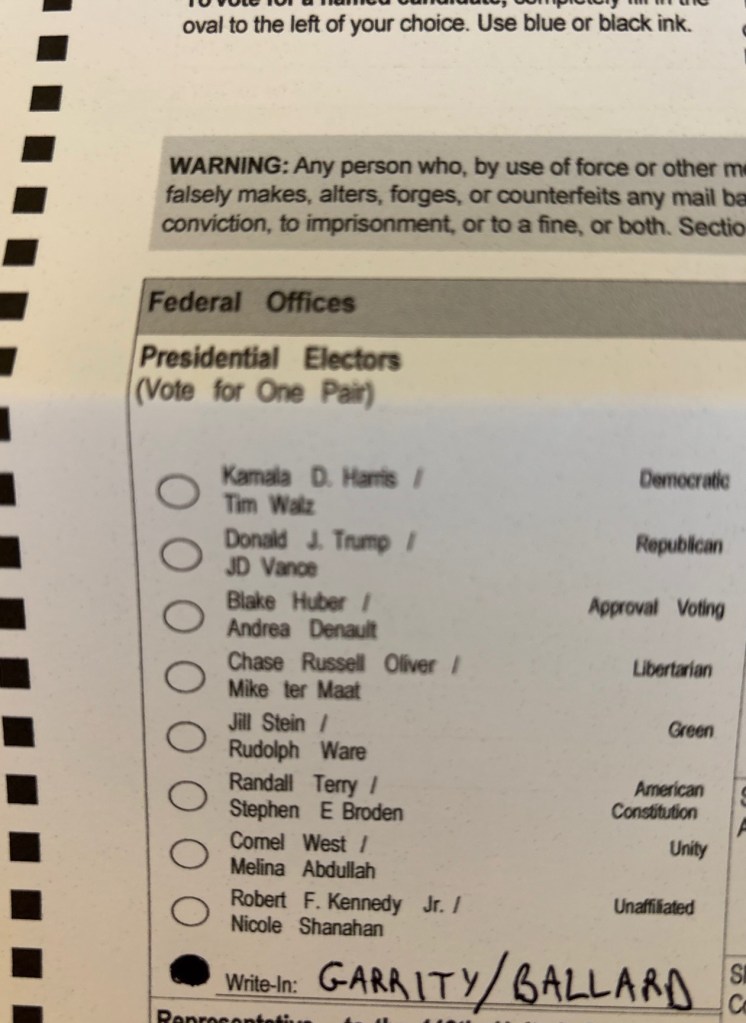
Okay. Back to the debate. Just about everyone on the continent tells me that I wasted my vote. I contend that I did not waste my vote in any sense different than you “wasted” yours. And I counter that it is foolish to believe that if you vote for Trump or Harris you have somehow not wasted your vote, somehow spoken in a more effective language. Or contributed to democracy or the country more than me. Or you have accomplished some civic duty, which I have not.
No, no, no. That’s wrong.
Don’t hear me suggest “fatalism”. I do not dryly believe “what’s going to happen is going to happen.” Please do hear me when I say your actions during this one, seemingly absolutely critical moment in time do not weigh more than your actions during all the other moments. I think I mean this in the biblical sense, introduced by the psalmist and highlighted by my namesake, “one day is like a thousand years, a thousand years like one day.” In short, all our votes are wasted because the notion of voting necessarily implies an incorrect perspective on life—even the life of a country.
Another way to talk about this point of mine that I here offer is to reminisce about the “How did we get here?” question that is terribly fun to debate.
I have yet to hear anyone suggest we got here because of folks’ past voting records (here being these two candidates, after the last two, after the last two, ad infinitum). Instead, the answers given are more provocative. “Education” (or lack thereof). “Immigration.” “Wars.” “Immorality.” “Russia” (meaning anywhere from the theory they have intentionally and strategically taken over the universities to the direct influence on elections). And many, many others. “Welfare.” “Military Industrial Complex.” “End times.” “Democracies only last 250 years, give or take.” Bluntly, then, I mean that if we do not cite our past votes in our answers to “how we got here?”, how could our votes ever be “how we achieve” whatever goal (political or otherwise) towards which we aim?
In the end, no, by writing in, I did not waste my vote any more than you did, you who chose one of the two candidates who possess a proper chance at winning. (Trump has it in the bag, never forget that.) So dismount your high horse, Citizen, and rest assured that in the not too distant future I will be lounging like a tree near streams of water with the knowledge that I didn’t let myself get caught up in the hype anymore than I did for Black Jesus (or Bush or Biden…).
This election is another referendum on how you (we) live your life. It should be interpreted as yet another instance of divine compassion. We’re mucking things up for sure down here. But Voting for Trump or Harris (or anyone) does not change your character. And believing that it does betrays a fundamental flaw in your understanding of life.
Vote or don’t vote, I don’t care. But I do care that you shape up. Turn off the TV. Use the newfound free time to exercise your mind, body, and spirit. The battle rages.
A Little Time Means A Lot Of Focus and Politics is Personal
As election day draws near, I cannot deny that my resolve not to vote for Trump began to waiver. Colorado is solidly blue, so a Trump vote would certainly be a wasted vote. Still, I was starting to feel like it would be fun to tell the grandkids that I was part of the unforeseen popular majority.
As I voted today, I just couldn’t do it. And with time running out, the underlying reason finally surfaced. (I don’t know why I didn’t see this happening; it always does. We veterans prefer working under pressure for the clarity it brings.)
The reason I can’t vote for Trump is because I can’t vote for Republicans. The Republicans were in power during 9/11. They had a chance to accomplish what no humans have yet accomplished, and they blew it—including wasting my time and energy by sending me to Iraq in response.
9/11 should have been used to relegate the false god Allah to the myths and legends section of libraries and bookstores. And the only way to do that is make supporting him deadly—which can be done directly or indirectly, but with intention, nonetheless. So many gods have perished. This shouldn’t be controversial. Instead, and unconscionably, the supposedly great Republican party* decided to lie and wage irrelevant (and illegal) wars under the guise of satisfying all interested players and offending no one.
So, no, I won’t buy into the same system that made that category mistake. Nations are okay, but gods are where the action is at.
Anyhow, I know my opinion is unpopular. So it’s not like I expected to find some candidate who wanted to lead and win the coming Holy War. But I also can’t vote for people who have had the opportunity to do so and dropped the ball. So I found the rules for write-in votes (you can’t just vote for anyone) and there is some random unaffiliated and normal looking citizen that satisfied the requirements for Colorado’s ballot and I voted for him. In other words, literally any average citizen is better than Trump/Harris and the major (and minor) parties. His name is Chris Garrity. Best of luck, man.
In short, with time drawing to a close, I have just now realized that, for me, politics is personal.
*To be clear, the Dems would have done no different.
The Preacher Said, “Joy Cometh in the Morning” in Today’s Service. Was It Code Today?
This morning was my last morning with the Black Baptists before the election. (I work next Sunday.) Going in, I was curious what kind of political talk we’d hear. For the past several Sundays, the gist was always “Trump bad,” but never quite “Kamala good.” And Baptist preachers wouldn’t be Baptist preachers if they didn’t say, “Vote!”
Today’s service had two political moments. The first occurred way before the sermon, during a fairly random reading of a Black History Experience. I don’t recall the exact words, but I remember smiling as the lady said something about how important this election was.
I thought, “Hype!! It’s all hype. She’s a sucker. No different than at this Super Bowl or during these playoffs ‘we are witnessing something never before seen!’ It’s all hype. Don’t fall for it.”
The second moment requires a brief reminder. There are many sayings or scriptures or proverbs which the Black Baptists all around the country utter at least once during each Sunday service. “But early, EARLY Sunday morning…” is one. Another is, “God loves…a cheerful giver.” A third is, “You can’t out-give God.” Another is, “He woke you up this morning!” Another is, “As the old saints used to say…”
The one in question, and behind this post is, “Weeping may endure for a night, but joy cometh in the morning.”
Seriously. If a woman who has seen five or more decades and survived at least one round of cancer doesn’t say this into a microphone, with perfect timing and emphasis on “But Joy!!…comes in the morning,” then you weren’t at a Baptist church.
Today, however, the sermon was essentially a Stephen-esque recounting of all it took for Moses to strike the rock rather than speak to it. Then, as the capstone, she delivered the somehow never-tired, “Remember, weeping may endure for a night,” (wait for it) “But JOY comes in the morning.”
It was code. It was so clearly code. “Vote Kamala—the candidate of JOY. And stop worrying. The LORD won’t let him win.” Had she said it at any other time in the story, I wouldn’t have even noticed it. But it was delivered with an ever-so-slightly-out-of-place force, an ever-so-slight amount of “indulge me, Saints” that I am certain it was meant as a Gilead-made balm to the community.
My aforementioned Ethiopian wife didn’t see it that way.
What do you think?
The Spark
I’m not saying it will ignite what seems inconceivable—a full and prolonged civil war—but I am saying it will light a proper insurrection.
The spark is going to be a widely attended and publicized funeral.
When the time comes, the funeral, and its attendant crowds, will be the event and day and time that ordinary citizens, and not-so-ordinary citizens, will violently enflame the tinderbox of MAGA vs. DNC incivility. Stay home.
Yes, I have been reading Les Misérables. Yes, I got the idea directly from it. No, I do not think the situation in America is anything like 1832 Paris. But we all can feel that more escalation and more outrageous events await.
It’s my blog. There is a thrill to making measurable predictions. Don’t steal my joy! And before you get your panties in a bunch, just admit that, sadly, you know I am right on this one.
Another Example of the Rewards of Reading in General, and Reading the Great Books of the Western World in Specific.
I have written or implied here that it is my belief that the Great Books of the Western World set is nearly as inspired as the books of the Holy Bible. No one cares.
But I care. And so I persist. Here, then, is another example of the rewards of reading them. I am currently in Vol 4 “Religion and Theology” of the companion guided reader set “Great Ideas Program”. After Aeschylus’ Prometheus Bound, there was some Old and New Testament passages and now St. Augustine’s (aw-GUSS-tinz) Confessions.
Some backstory (“Learning is a change in behavior based on experience”) is relevant.
While at Seminary, studying the Bible in its original languages (which truly means being told aloud in English that translators fear “Yahweh was hot” will sound too human ((ergo, not separate—or the Holy in “Holy Bible” (((The “separate book(s)”))))) and so they have opted for the supposedly more esoteric and divine sounding “Yahweh was angry”), I persuaded myself that these early humans were exceedingly (and uniquely) concrete in their writing. And I still believe this to be true, the following reward notwithstanding.
For example of what I mean by this unique “concreteness”, I believe when Moses would tell the Genesis account, he would sweep his arm over his head, from horizon to horizon, as he said, “In the beginning God created the heavens” and then sweep his arm under his feet, from horizon to horizon, as he concluded, “and the earth.” Get it? In other words, I believe that he pointed at the night sky (in my mind I can never shake that all the Old Testament stories were told only after darkness near a pleasant campfire) as he said “heavens” and then the ground as he said “earth”. In short, I believe that Moses did not try to trick anyone or talk about anything unseen in order to talk about the unseen Yahweh. Put one other way, I don’t believe there are two steps of belief. It’s not “Let me explain one unseen. Got it? And then, stick with me, you’ll get God!”
No. For me, my theology—based on content of Bible, to include when it was written—all that the Bible authors ever did was use material world to explain spiritual world.
That backstory complete, let’s get to the heart of the post.
Augustine has a book (chapter) which translators subtitle, “Augustine proceeds to comment on Genesis 1:1, and explains the “heaven” to mean that spiritual and incorporeal creation which cleaves to God unintermittingly, always beholding his countenance; “earth,” the formless matter whereof the corporeal creation was afterwards formed…”
Like you’re undoubtedly thinking, I also thought, “That is an intense sentence. I had to read and re-read it too much to want more.” But I pressed on.
And as I read, with my gesturing Moses in mind, I couldn’t help but notice something. Augustine was spending a lot of time defining formlessness or describing how he couldn’t wrap his mind around it—despite wanting to understand it and then explain it to others.
Then it hit me.
My gesture theory is flawed, in one sense. At the stage of creation in verse 1 of Genesis, a careful reading reveals that this “earth” that Moses points to CANNOT be Planet Earth (however little Moses and mankind knew of it at the time) because the next part of the story is, “formless and void”. Planet Earth is not, formless and void, so something else MUST BE meant. But what?
I still say Moses gestured (and meant it) while he spoke. But I am now forced to clarify that he definitely added a clarification that means he does not believe he is talking about Planet Earth and the rest of the material universe when he gestures.
The new question on this Sunday of Sundays: According to the text, what did God create, by creating “the heavens and the earth”, because it certainly can’t mean material/corporeal/measurable bodies beloved by physicists?
Augustine wrote down his ideas. I have some reactions to those. Others have recorded their ideas. The idea here is not to suggest we can know what Moses meant. The idea is that we can live richer lives knowing that we don’t know what he meant.
“Learning is a change in behavior based on experience.”
In short: the reward for my reading from the Great Books of the Western World is that I learned, that despite my previous intentions and best efforts, that I was wrong. And the “right”, oddly enough, was plainly written and right in front of me for all this time, too. Fascinating.
The Image of a Microscope which Accompanied the Science Article—That’s What Bothered Me Today
The Sunday paper had an interesting article about the current war with China. Interesting as it was, there was no call to action. Or at least not a memorable one. There certainly was nothing for citizens to do. I think what I’m suggesting about the op/ed was that the scale wasn’t appropriate.
On the other hand, there was an article suggesting two “Life Science” bills be voted down. One of the two stock “science-y” images the paper used was of a microscope. Of all the articles and opinions in today’s paper, this irked me the most. Why? Because unlike the other author’s claim that China is an existential threat to America (the sky is a-falling!), this image is one which an individual—likely an editor—can do something about.
“Science” is not merely tool use. If anything, science is to tool (science:tool) as man is to wheel (science:tool::man:wheel). Science invents tools; science is never the process of using tools.
And an editor should know this—could know this. And that editor would be doing a service to truth, and his bottom line, if they put a bit more reason into their product.
What image should the editor use to capture science?
There are many that would work. But an easy one would be of someone writing an excellently organized paper, with a title which sufficiently describes the paper’s purpose.

