Tagged: faith
Not On Star Wars
Vanity Fair‘s current over-Thor-in-a-flattering-red-t-shirt’s-right-shoulder headline, “Can a man of God end a 21st-century SLAVE TRADE?”* caught my attention while checking out of the grocery store today. I haven’t bought a magazine in forever, and yet after just putzing around watching a bit of Butch Cassidy and the Sundance Kid last night, I confess that I do not have the fortitude to quit reading cold turkey. (Sidebar: I’d never seen that movie, but it seems to me that besides J.K. Rowling owing her success to her J.R.R. Tolkien ripoff name, she also wasn’t very creative after all with Lord Voldemort. Lord Baltimore. Lord Voldemort. Just sayin’. End Sidebar.)
When I was in the Air Force, because of both the protect-the-weak aspect of the work and the worldwide deployment, in my last few years there was recurring training on human trafficking. We were to be vigilant on duty and off duty–if you get my drift. Aren’t euphemisms great? Instead of sex-slave, we say human trafficking. Wouldn’t want to offend the P.C. gods. Anyhow, sex-slaves are one thing, but two years into my re-indoctrination into the civilian world, I found myself teaching remedial math at a local inner-city (read: black and Hispanic) high school. Out of the blue I gathered that something fishy is going on. On the bulletin board outside my classroom hung all these student projects that were calling for the end of slavery. “WTF?!” was all I could not say out loud. Thirteen year old kids who couldn’t fill out a multiplication table were being encouraged to affirm that not enough was being done to end slavery? I was speechless. Add to this that students wrote sentences that were allowed to make it to the wall like, “This took me back 150 years.”
In any case, I just finished up learning about the origins of Friars and Monks and the like, so when I opened up the magazine and saw that the “man of God” was a Friar who photographed well, I began to read. Then the it was my turn, so I let my training take over and made the command decision to add the magazine to my cart. My question, “What the hell is going on with slavery? I thought that that abomination was eradicated once and for all from the planet. Am I really that out of touch?”
I think I mentioned previously that one concept that we discussed last semester was formal curriculum versus hidden curriculum. Churches are notorious for lacking due diligence to match these two up, and if Friar Xavier Plassat can be trusted, Brazil is guilty of the same charge. Slavery (formal) is illegal, yes. But “conditions analogous to slavery” (hidden) are still present.
Mom, Dad: don’t worry. I haven’t purchased a plane ticket.
Here’s my problem with the word slavery being thrown around today. It’s sensational nature precedes and overpowers it’s descriptive nature. That’s my judgement. America is so sensitive and guilty over its unconscionable past that, me as evidence, using the word slavery sells magazines (and online ads…). And social programs. And makes young white teachers sleep easy at night because they find themselves standing nobly amidst an atrocity, much like Lincoln and the Blue. I shamefully admit that “slavery” interests me more than “human trafficking.” But it’s an abuse of a journalist’s responsibility just the same.
For any cranky readers, please calm down and realize that I haven’t opined one way or another on the reported situation in Brazil. I will now. It’s horrific. The horror is not the conditions (though they are horrible) but that money has such an effect on people that impoverished, uneducated men and women hop on buses that are taking them who knows where, for who knows how long, and that other calculating men and women send out those buses to be able to “improve” their standard of living.
My take? I work in the heart of downtown Denver. The homeless are unmissable. One day I got a call that video security noticed a person laying outside the back door and he/she looked unresponsive. I made my way to the back door and opened it, hoping for the best. I saw matted grey hair and a lot of layers of black clothing. I said, “Excuse me, sir. But I think you are going to have to move from this spot.” His head turned, and she said, barked rather, “Of course, I have to fucking move.” (For a more accurate account of her demeanor, think back to the Princess Bride “Booooooo” scene.)
I do not possess the mental capacity to discern all the nuances of that exchange. What does it matter what I think about slavery in Brazil? I think Brazilians need to stop slavery. I’m not the one turning a blind eye to it. Are you? How about you? Are you turning a blind eye to slavery?
That homeless woman though? Some dad, some mom, some brother, some sister, some child, someone was the first to turn a blind eye on her. It surely wasn’t me. And least that’s what I tell myself so I can sleep at night.
*Langewiesche, William. “Slaves Without Chains.” Vanity Fair Holiday 2015/2016: 94+.
Made It
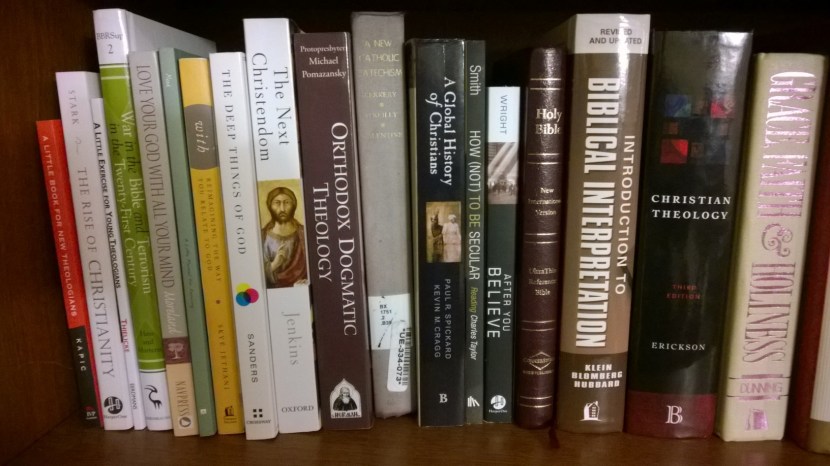
Barely. I’m tired. (Keep in mind, there was much more reading from PDF’s, and all the paper writing. Oh, and the Koine Greek–not to mention full time work.)
I tell you what. I’m still running on the inside. Hopefully I’ll find the peace that passes understanding tomorrow. I only have until the end of January before it begins again. Here’s a photo of the books I read this semester. On the left of The Holy Bible are books I read cover-to-cover, on the right, are books that I read half-or-more. Within the aforementioned Bible, Genesis, Exodus, Leviticus, Numbers, Deuteronomy, Joshua, Judges, Ruth, Job, Psalms, Proverbs, Ecclesiastes, and Song of Songs. Though those last three were more skimmed than read (forgive me).
If I was you, I’d be dying to know what I think my chances are of getting into heaven (naturally being the ultimate goal, right?) after one semester of a seminary. Well, as always, I’ll offer you a reference point from a movie. Remember Johnny Depp’s Benny and Joon? There’s a scene where the all-to-ready-to-play-Buster-Keaton Depp wants to see his girlfriend who’s locked up in a group home. He employs some of his talent for good, tossing his hat toward the closing door and it slides perfectly between the door and the door frame, thus propping the door open. Overlay the pearly gates onto that scene, and you get the idea.
The thing that bothers me most about tonight is that I am alone. That’s no good and about as anti-Christian as it comes if any of my reading has paid off. Oh well. I’ve made my choices and have few regrets. Someday I’ll stop pushing people away and together we’ll fulfill Augustine of Hippo’s City of God.
I hope to write some more flash fiction over the break. But first, like the rest of you, I have to figure out my Obamacare situation before the 15th. And then I have to renew my pilot’s licenses before the spring semester begins.
I’d like to leave you with this quote by an ol’ timey preacher from the early 20th century named Billy Sunday. (To be clear, if you’re not wearing a silly grin after you read the following, dial 9-1-1.) Apparently he’s famous for proclaiming,
“I don’t know any more about theology than a jack-rabbit does about ping-pong, but I’m on the way to glory!”
As the Boondock Saints would say, “I do believe the Monsignor has finally got the point.”
Amen.
On Joy
With little H- as conclusive evidence, yes, it is true, I have had sex. It can feel good.
The fantasy or foreplay of sex, most of us would probably admit, can feel good–even better than sex itself sometimes.
Eating amazing food is pretty great. (Here I’m thinking the choicest cut steaks cooked rare, beet red tuna sashimi, fresh croutons, cheese cubes, hard-boiled eggs–heck, anything in a monster salad that isn’t a vegetable–and, of course, cheesy, bready, pepperoni-ee, sausage-ee pizza.)
Sneezing has always had a unique feeling of pleasure to me, too. Especially solo sneezing when I am able to liberate my body from any social concerns and just let it get those dust particles OUT!!
Laughing. I love laughing. Ask anyone who knows me and they’ll tell you that I will sacrifice nearly anything (friends, family, jobs) to help someone laugh–even if that someone is only me.
Thinking about a blissful, eternal afterlife. That can bring me joy sometimes. The dream of a problem-free existence.
But none of those things, not one of those instances of life can compete with right now. Right now, at this very moment, I am living within the sure knowledge that at this time, one week from today, I will have completed a semester of school. No matter how little sleep I get, no matter how poor my grades turn out to be (I’m doing fine…just trying to stay humble), no matter what else happens, next Friday, December 11th, 2015, my brother’s one-hundred-and-elevenenenth birthday, I will have officially completed something.
Boy! I wish I could stay in this moment forever. Talk about joy. If only I could bottle this feeling. This is it.
Day After A Solo Thanksgiving + Creed = Blog Post
At the end of the film Seven, Morgan Freeman’s character opens a box and declares, “John Doe has the upper hand.” That admission characterizes my experiences at the seminary thus far. I thought I knew.
****
When learning about God, there are apparently many, though not infinite, key terms. Many of you know these. Omniscient, omnipresent, omnipotent, benevolent. Some people have thought they were really witty and thought they really proved something by asking if because of these attributes God can make an rock that is so heavy he cannot move it. H. Ray Dunning writes, “Both [Martin] Luther and [John] Calvin vigorously resist all speculation about God beyond what is revealed. Each, with a great deal of seriousness, tells the same anecdote about anyone who would raise a question about what God was doing before He created the world. The answer: He was making hell for curious people.”* Ell-Oh-Ell.
If I may indulge in my own assessment of the passing scene, it is that the Adversary, the great Satan himself, had a hand in creating Microsoft Powerpoint and the idea that preachers should use it. If there is one thing God, in the person of the Holy Ghost, cannot do, it is overcome the trappings of Microsoft Powerpoint presentations. Perhaps my belief stems from my indoctrination at the hands of the US Air Force which had me reciting “death by power-point” when describing what a Training Day would entail to new officers. Or perhaps it is historical reality. In either case, I have yet to see this supposed communication tool be employed without embarrassment in any situation, let alone one as dynamic as a sermon. To be clear, MS Powerpoint is simply a better way to pass around a picture. Put the image on the screen. Tell us to look at it. Then take the image down and move on. Publicly tying yourself to an outline is a sure way to detract from any possible benefits unseen forces–whether holy or unholy–can add to your presentation.
****
I saw Creed on Thanksgiving. It was simply fantastic. My brother mentioned that he was going to show his wife the first six movies before taking her to see this, the seventh. I told him that just wouldn’t work. Rocky can’t be “got” in 12 hours. The critics seem to agree. What is so special about Rocky? For me, Rocky is the ultimate example of man who lives without a hidden curriculum. My attempt to do the same is to share that I am taking the courses I’m taking at an Evangelical Christian Seminary because I can’t tell if I like Christianity because I was taught it at a young age or because it is historical reality in this time-space universe. What is odd, to me, is that while these days I definitely credit Jesus et al. with keeping me alive, I have no problem ceding that Stallone’s Rocky has had more immediate impacts on my everyday life. “Like” this post if you would have never attempted a one-armed push-up if it wasn’t for Rocky.
****
If you’re looking for a Christmas gift for anyone who you think resembles me regarding their pursuit of self, get them James K. A. Smith’s How (Not) To Be Secular. Charles Taylor wrote a very long book that Smith summarizes succinctly. Taylor’s longer book is, Smith says, a map of our history and attempts to account for how in the year 1500 atheism didn’t exist and in the year 2000 theism is probably more difficult to maintain (yet people do). Taylor’s book is apparently 900+ pages. Smith’s is 139. One sentence is not going to do justice to Taylor’s ideas, but, again, it is a solid attempt to explain how the Protestant Reformation (a re-forming of worldviews), despite Christian designs, led to what Taylor calls “exclusive humanism” and atheism.
One of the main “hidden curriculums” that Taylor’s long tome exposes (according to Smith) is that it isn’t cold, hard scientific realities that have replaced the Christian story, but the appeal of being able to tell the story of how little ol’ me has now, through maturation and age, gained the courage to stare down the fact that life is without meaning.** And it’s a great story. But is it true? I don’t know.
****
One thing that has my interest today is the idea of the inerrant nature of scripture. We’re learning Koine Greek and no one has any problem saying that the New Testament’s grammar isn’t inerrant. I can’t explain why, but upon hearing this my mind immediately went to the fact that grammar is itself only a convention. It’s not like God cares about whether sentences end in prepositions. So then I think about what written language is anyhow. Obviously it is communication. But this whole inerrancy thing seems to rapidly become merely a fight picked by *some* Christians. It causes lines to be drawn in the sand that perhaps allow for rightful displacing of heresies, but it also seems to fulfill prideful desires to be “right”. Do I believe the Bible is without error or contradiction? I certainly believe that many aged and mature Christians make that argument. And I trust their judgement. But, for me, inerrancy means that I believe the Bible, Old and New Testaments, is the final authoritative revelation of God’s word. I love Leo Tolstoy and Mark Twain–love them, probably idolize them. But where they disagree with the writer or Matthew or Luke or Paul or Moses, I concede that the canon of scripture wins.
And, yet, before any bible verses, some of the first quotes I have taught H- to recite are (relating to piano) Immortal Beloved’s, “A mistake is nothing. A lack of passion is unforgivable,” and relating to life, Tolstoy’s, “Happiness is not the realization of desire.” Then again, perhaps I’m not the most orthodox of Christians. Who knows?
*Dunning, H. Ray. Grace, Faith, and Holiness: A Wesleyan Systematic Theology. Kansas City: Beacon, 1988, 113.
**Smith, James K. A. How (Not) To Be Secular: Reading Charles Taylor. Grand Rapids: WM. B. Eerdmans, 2014, 77.
For Christians. (Pagans: Move along, nothing to see here.)
Religious indoctrination in a seminary has been very trying. There is an enormous love of the word “tension”–enormous. Tension between this and that. Tension everyday. Oh. And “unpack”. I have never heard the word “unpack” so many times before. “We’ll unpack this in a bit.” Okay then.
Here’s some unpacking from a Captain. (Former Captain–for those of you who were not privileged enough to make my group text, I am officially in every sense of the words “Honorably Discharged” from the Air Force as of last month.) Back to the unpacking. Here’s the greatest tension as I see it. The church fathers that history presents to us were avid writers. It seems at times that when they heard the bible verses which recommended unceasing prayer, they heard unceasing writing. We’re talking volumes upon volumes, confessions upon confessions. I love it. But I also want to do it myself. And I feel like there’s a unspoken belief that we (humanity) are beyond it. Well I’m not beyond it. I have my doubts and I want to explore them via the written word. This anonymous blog will have to suffice as I’m not entirely convinced I’ll be accepted into the group at school if I share everything with them. Let’s get started then.
****
One aspect of the seminary I am at, an aspect that distinguishes it from other seminaries, is that there is a character development class. You read that right. I started this adventure with the idea of it being purely academic, and now face the fact that if I want a degree, I have to undergo two and a half years of character development. I’m kind of in love with the idea, while I simultaneously dread undergoing any changes. Because, you know, I’m perfect today.
****
A part of this character development is the notion that my job has something to do with my religion. As I’ve recorded on this blog already, I kind of disagree with this idea wholeheartedly. The course presents the concept that, generally speaking, church-goers view a missionary as more important to the Kingdom than a plumber. Obviously this presents a huge problem since there are only so many missionaries, and yet my toilet runs right now. I believe that what follows are my most wise and encouraging to plumbers conclusions about life from one semester of introspection thus far. When talking about earning money, and whether or not there is a value in God’s eyes to the type of work you do, there are two questions that must be answered by Christians and whose answering will illustrate the ridiculousness of valuing one form of work over another.
“Should anyone be paid money to have a relationship with God?”
“What portion of your paycheck should be funded by sinners?”
****
This brings me to another major tension. I confessed with the intent of gaining laughter and respect that I see the world through movies, and the professor responded with a, “Really?” She wasn’t entirely judging me, but her tone suggested some shock. Yet, every single class has referenced a major Hollywood production–every single class. The film Gladiator has made numerous appearances, and regarding a person’s professional endeavors, I have always identified Maximus’ servant Cicero’s line, “Sometimes I do what I want to do. The rest of the time I do what I have to do.”
Denver loves the idea of monetizing your passion. It’s horseshit to me. Just pay your bills. What you do when you’re not working is the real test. (In my humble opinion.)
****
When dealing with God’s providence, by which I mean the notion of to what level God dictates your actions, I find strength in the non-canonical film The Last Samurai when Tom Cruise says about changing his destiny, “I think a man does what he can, until his destiny is revealed.”
Then again, I view all of life through movies.
****
The other day H- learned how to play We Wish You A Merry Christmas during her piano lesson. The Muppets perform a hilarious version of the song and I had her listen to it. Randomly (and awesomely) H- responded by declaring that she has a new name. She says, “My first name is ‘Won’t Go’ and my last name is ‘Kindergarten’.” Then she looks up and says, “And my middle name is, ‘Light bulb.’ ‘Won’t Go Light bulb Kindergarten.'” I love the Freudian slip nature of that, and also the native american roots.
****
Lastly, H-, who is 5 1/2 these days, always asks me to open her door when I finally decide to go to bed myself. I have often asked her why she wants the door open, because to me it seems like letting in any light at all would have the opposite effect on my own desire to sleep. In the past when she simply answered, “Because”, I let it go. For some reason tonight I didn’t let it go. I asked three times, “Why do you want the door open?” She finally confessed, “Because I don’t like turning the door handle.”
Boom.
Honesty on that level is so refreshing. “I don’t like turning the door handle.” So little H- is afraid she might not make it out of her room when she wakes up. I feel like there is a sermon in that admission. Something along the lines of how, metaphorically, the non-Christian, atheistic belief system alternatives give me no way to open the door whereas, on the other hand, Jesus provides the strength to open the door. I don’t know. Maybe I’m just addicted to the opiate of the masses.
****
Oh, and lastly, if I may indulge myself, I am rapidly coming to the conclusion that American Christians must use the word “unfortunate” infinitely more often than they currently do. It is only in asserting how many people on this planet are unfortunate that American Christians will actually begin to recognize the possibly atheistic reasons behind their own good fortunes.
By way of example, I am incredibly fortunate. I come from a culture which values honesty and straight teeth. I have three years of experiential evidence that I will never have a difficult time finding a job that supports my lifestyle. And I can admit that that has nothing to do with Christianity. In fact, I view it as a hindrance to my Christian character.
****
Actually I can keep going. In the character development course, the professor identified the idea of formal versus hidden curriculum. For example, formal curriculum is that all ages are welcome in a worship service. Hidden curriculum is that crying babies are not welcome (as disapproving glares from old people are gathered).
This is the big point of life, isn’t it? Announcing the hidden curriculum. What are we really saying to each other? From where I sit, humanity just hears the loudest claims. COCA-COLA IS THE GREATEST SOFT DRINK! BUDWEISER IS THE KING OF BEERS! LOUIS VUITTON IS THE BEST PURSE MAKER! WAL-MART IS THE ONLY STORE YOU NEED! HAPPINESS IS THE REALIZATION OF DESIRE!
Of course none of those are true, no matter how many beverages we buy or desires we realize, are they?
****
Are they?
Theological Observations After Midnight In November
Christianity’s greatest asset and greatest hurdle is humanity’s desire for God. For a long time, nearly a decade, I thought I was really something special. I thought I was the result of a long line of human achievement. I was the result of thousands of years of contemplation and experience which resulted in the superior conclusion that God did not exist. For various reasons and with various degrees of arrogance Christians have pointed to Psalm 14:1’s “The fool says in his heart, ‘There is no God,'” as evidence that it is foolish to be an atheist. Condemn me now, but I don’t need bible verses to admit that God exists. How many churches exist? How many temples? How many religious sites? How many places are there on this planet in which people gather to worship or discuss or contemplate God? Denying God’s existence would be like denying McDonalds. And yet many of you are going to tell me that God is a fiction and a human weakness, a figment of our imagination, a fairy tale created by Iraqis and former Egyptians bent on collecting ten percent of your hard-earned income so they don’t have to work. Yeah. Okay. You’re right.
****
“The problem of evil” finds itself among the great controversies of Christian theology. If God is good, how is it possible that evil exists, the question goes. I know I’m only a first semester B-averaging seminary student, but for me the problem of evil is one of the main reasons I find Christianity appealing. God purposefully creates man with free will. Man uses the freedom to disobey. Dunsky. Next, man murders. The rest is history.
Whatdya got as another option? Man just decides to one day kill for pleasure? And did it give him pleasure? Do you actually derive pleasure from hurting people? From lying? From stealing? Is anyone reporting that they are happier because they acted unethically or immorally? Give me a break. Daily I behave in ways which I know aren’t right and I am not happier for it. I am confounded by it. I shared my insistence on not being bullied on the road the other day, and like most of you pointed out, I knew at the time that it was not the right thing to do (hopefully you don’t think I was bragging about my actions.) I know the better option was to not aggravate the asshole. But why was he being an asshole in the first place? Seriously, what am I missing? How do you account for evil or asshole-ery?
****
Here’s a new one. Want to know why you aren’t satisfied with your job? Because as part of God’s redemptive plan after the Fall, He cursed work. He modified existence in a way which directed humans back to Him. All He wants is a relationship with you. Or so the argument goes. What do you think? I say we’re all meant to produce and consume. Name brands. And apps. And pills. And tablets. That’s it. That’s life. Oh. And try to be nice along the way. I almost forgot. We’re here to talk about food ingredients. Yes. If you can explain to me what you’re eating within the time it takes to share a meal with you, then you’ve figured out life. Hooray!
All I’m asking for is a softening. My heart is hard. Feels like it always has been.
I blame my mom. Whoops. Classic Freudian slip–when you say one thing and mean your mother.
But as I’m grown now, it feels like way too much energy is expended to keep it hard. Maybe you know what I’m talking about. Or not. I’ll say this. I am not yet convinced that urgency does Christianity any good. But I am convinced that Christianity is worth exploring at your own pace.
Big Bird On Mormonism
I need to write a paper for class, but motivation wanes. Instead, I’d like to share one rather intriguing factoid about Deuteronomy and how it helps us understand what we all know: The Book of Mormon is not God’s word.
In brief, the Hittites were a culture whom archaeologists and historians claim wrote treaties according to a specific format. As the name ‘treaty’ implies, these were usually documents (we might expand the term to literature) which were developed after a fight of some sort. In any case, what we now call Deuteronomy is written in the form of one of these Hittite Vassal treaties. Besides helping us date the book of Deuteronomy, this similarity also speaks to the way Christians believe God reveals himself. Don’t miss this point. Folks long ago were milling around and if they were going to write things down (create literature) one of their options was a Hittite Vassal treaty. They didn’t have blogs, or tweets, or fb posts; novels weren’t around, nor were comic books. So when Moses (likely) wrote Deuteronomy he wrote it in the style he would have known–a treaty.
Later, when the Gospels and Paul’s letters were being written, they too were written in the forms their authors would have known. Keeping in mind that none of the Bible’s authors knew that what they were writing was going to be compiled as part of “The Bible”, in a roundabout way, this strengthens the argument that the Bible deserves some time and attention before discarding it.
Then there’s the Book of Mormon. Sesame Street has the familiar, “One of these things” segment and the lesson applies here. Unlike Mr. Joseph Smith, none of the Bible’s author’s claimed to find the Bible. Sure, we can debate whether or not Moses made up the Noah’s Ark story, but it’s Moses’ story. If God wanted an American to add to the Bible’s 66 books in the 1800s, then the writings would been similar in form to, say, the U.S. Constitution, or a dime novel, or more letters, or anything else that Joseph Smith’s contemporary’s would have recognized as “normal”.
Did I just imply that I posses the power to discern how God talks? Yes. Don’t be alarmed. You do too. Who’s up for a little game?
Humility
We’re studying source and form criticism of the Pentateuch. Orthodox Christianity has it that Moses is the author, and it was written around 1300 BC. Super smart Germans in the late 1800s AD developed a hypothesis that super smart westerners continue to support that these first five books of the Bible are comprised of material from several sources and authors and with nefarious, political agendas anywhere from 1100 BC to 500 BC.
First question: Does it really matter? Yes. One illustration of why it matters–Jesus of Nazareth is recorded as saying “As Moses wrote…” Things start crumbling if Jesus Christ lied.
Second question: Is humility a virtue (and therefore worth aspiring toward)? Much of the doctrine of this school revolves around orienting the student’s focus during our lifetimes. Are we to be centered on the human or God? Boldly claiming that despite the fact that there is no empirical evidence confirming the “documentary hypothesis” and millenia of tradition rejecting it that you are confident that Moses did not write the Pentateuch is a “human” or a “self-centered” perspective. On the other hand, concluding that while it’s important to account for the Pentateuch’s claims against the archaeological record, a spirit of humility in the concession that thousands of years of tradition probably counts as passing the test of time is “God” centered.
There seems to be a undertone that only academically incapable minds would reasonably conclude humility is the best course. But I’ve been going to school with you, living with you, and listening to you for a total of thirty-four years now. And I’ve out-performed all but the brightest of you–when I’ve cared to–according to the ways we sinners have developed to measure such things. And yet I hear most of you questioning my academic prowess in my confession of humility and vote for “God” centered-ness.
Just a passing thought that intrigued me during class today. On to the opening pages of A New Catholic Catechism and not enough sleep. Wish me luck.
Thank You
Great comments. Thank you for taking the time to share.
Koine Greek is apparently a language where word order doesn’t matter as much as it does in English. A bad illustration of this is in Greek you could say, “Is green the house” or “the house is green” or “Green is the house” and other features of the language render each of those orders equivalent to “the house is green”. I mention this because I attempted to use a tactic of Greek to open yesterday’s post. Since word order is variable within a sentence, writer’s are in a sense more free to make their points via word order. Scholars, then, have concluded that the first word of a Koine Greek sentence contains the emphasis of the thought. And that’s why I began by saying “allegedly”. I wanted to succinctly indicate that I wasn’t beating a drum or jumping to conclusions etc.
Given the all-to-familiar reports of the Columbine murderers’ asking “Are you a Christian?”, and given Evangelical Christianity’s (the brand I’m participating in) tendency to believe the “end times” are near and therefore view any attack on Christians as proof, I too was skeptical of this claim when it was presented. We all have our opinions about the integrity and motives of newspapers, but when the New York Times and Wall Street Journal both include the claim, I would like to believe we can all agree that there is at least a strength to it. Maybe not. In any case, only time will tell if the claim is verifiable and true.
So what was the seminary’s response? Prayer.
Your Turn
Allegedly, the shooter singled out Christians.
Because my ego knows no bounds, after first hearing about this shooting this morning whilst in Greek class at seminary, I immediately thought of you and how surely you’re curious to know how a school bent on training Christian leaders would respond/feel/think/report this shooting. And I’ll tell you–after you tell me what you guess the scene was like. Because I’m desperate to hear reactions from the people on the streets. One rule. Be honest. What was your first reaction to first hearing that Christians were singled out? And what was your first reaction to my question, “I wonder how Pete’s seminary presented/responded to the reports that Christians were singled out?”
Thanks.
 Captain’s Log