Tagged: Church
Brave Post On Personal Responsibility
Jewishworldreview.com is a news site I started perusing for headlines years ago when Thomas Sowell still wrote. It’s nothing great, but the format is simple, the site loads quickly, and the viewpoints can be provocative. Last week, there was a piece by Larry Elder on the Ahmaud Arbery murder case. The editor of the site called Elder’s article “Gutsy”. This is because Elder writes that the single greatest threat to young black men is young black men. (He wrote this in response to King Lebron’s tweet.)
That’s not a gutsy move at all. I mean I guess if Elder loses something because folks find out that he is not “progressive” or “woke” then it was gutsy. But on the whole, it was more of the same. Boring.
I can do better. And I’ve been on the road all day yesterday and today and need a break, so I will take a moment and prove it.
Firstly, LeBron surely is not to be discarded because of figurative language. He felt hurt and expressed the pain. I do this all the time. Who would I be to hint that LeBron shouldn’t tweet away? (To be clear, my ex is a whore though. The two most dangerous things I’ve ever done are solo flight in an airplane only 20 hours into learning how to fly and sleeping with my ex. Let’s put it this way: If evil was an STD, the pandemic started at her home. However, if stupid was an STD, it must pass from mother to child during pregnancy, because I clearly was infected before meeting my ex.)
More importantly, however, it’s not gutsy to write something, which is perhaps a painful truth, to someone who cannot read. The Black Community cannot read. We all know this. Mr. Elder knows this. And yet Mr. Elder went off in written language, adding a statistical defense, and we’re to congratulate him for being brave? His target audience can’t read! Drop the stats and give a speech at a Baptist church on the topic and I’ll give him props. But until then, or until I hear that he does that regularly, I’m withholding my applause.
I know this because I went to a Baptist church, was married in a Baptist church, and tried to make Baptist friends for over three years. Most of my readers are friends. Want to know how many of those recently befriended Blacks read my blog? Zero. That’s why I’m not afraid to write this. They will never read it.
But whites? We read voraciously at times. We read to the point of stupidity. For example, I just found out that my ex’s dad reads this blog. I had no idea. I knew my ex-sister-in-law did, but I never would’ve guessed my ex father-in-law was a fan. It’s been nearly eight years since the end of the marriage and he still reads it! It’s stupid. Why torture himself? Because he’s white.
To be clear, you are stupid for continuing to read my blog. Just like I am stupid for believing “mother believes that parenting time is appropriate and necessary to maintain (and develop) father/daughter relationship” when I read that. Just like Blacks are stupid for not taking advantage of the chance to change their social status by simply learning how to read English. Oh well. We’re all stupid.
But I’ll tell you something. I’m never going to stop writing and I am never going to limit the topics or content. That’d be missing the point entirely. And H- deserves a fighting chance at learning the truth of why her childhood was the way it was, learning how your daughter is trading a few short years for eternal darkness, which is where she’ll be before Hell, after my daughter figures out there’s a written record.
More than that, you need to just stop reading. You’re stupid for continuing to read. This is the first and last post with you in mind. Why do this to yourself? Block the emails. Or unsubscribe.
Actually, who are we fooling? We know it’s not even you. You’d like to get on with your day, but the matriarch calls you in when it’s a juicy post. Fine. Just like how us two stupid guys were able to de-escalate things earlier, I don’t blame you. You’re not directing this madness. Tell her to stop reading. Just like she had to be told to stop bathing a nine year old. It’s disgusting.
We Are Past the Time of Prophets
The prophetic book of Ezekiel is widely known for one small and relatively (or arguably) minor passage about “dry bones”. Christians (myself included) love the imagery. YouTube has clips upon clips of sermon upon sermon on the passage. The trouble is that the dry bones section is ultimately a very brief part of a larger writing that is of a decidedly less hopeful tone.
The question for today, and I mean the question for April 21, 2020 during the pandemic, is, “Are we past the time of prophets?”
The question came to my mind because I watched a pair of rants by Bill Maher, and was encouraged to do so by a super-conservative blogger on a near-scary news website. Both rants by Mr. Maher were engaging, coherent, and, most importantly, timely. But I felt like a fool afterwards. Bill Maher is a joke. The words in and of Ezekiel have made it nearly 3000 years. Bill’s tone of voice will keep him going for 50+ years, but his words are ultimately empty. Take this assessment of mine together with the fact that I cannot find one commentator who I agree with, and the question came to mind, “Are we past the time of prophets?”
Ezekiel 2:7 has the LORD saying to the prophet, “But you shall speak my words to them whether they listen or not, for they are rebellious.”
Naturally, there have been prophets before Ezekiel got his call. Again, that is not the question. Obviously, and despite the at times anachronistic ordering of the books of the Old Testament, there were prophets after Ezekiel died. That is not the question either. My question is, “Are we past the time of prophets?”
During the #Metoo movement of a bygone era, comedians found themselves defending their barbaric craft. I wonder if during this pandemic prophets should be defending theirs?
The LORD told Ezekiel, “…speak my words…whether they listen or not…” In so doing, one might say, the LORD gave a definition of a prophet. The prophet is going to speak. They don’t care what happens next. They may desire one outcome or another upon hearing, but they, the prophets, believe they are called to speak. The listeners’ response is always contingent on the LORD’s will. And my question is, “Are we past the time of prophets?”
Put another way, “It’s been 2000 years since the resurrection. Are we bound to support a segment of society who simply criticize, people who simply lament, people who simply know better, people who are smug, people who saw COVID coming, people who think the Bible saw COVID coming, people who think the situation is obvious? Are we bound to listen to people who would choose to hold the microphone over all other professions and at all cost? Are we bound to these people?”
I say, “No.”
I say, “Shut up.”
I say, “You’re no journalist. You’re no newsman. You’re no investigative reporter. You’re a prophet. And we are past the time of prophets.”
Renaming the Bible
As I mentioned, I was recently in Judges. Then the last few days, I have been studying Thessalonians 1&2.
I don’t want to rename the Bible. Moreover, I wouldn’t be able to. The idea is ridiculous. But I would like to share what I would call it, that is, in an imaginary world.
I’d call it… Actually I can’t put it into words.
It’s something like a self-help book that teaches you how to accept happiness in your life.
“Accept Blessings”. That’s about as close as I can get. But that sounds like an military order, not a book title.
“How to Accept Blessings” might be more accurate, but now I don’t know if I would have ever picked up a book with that title.
All I’m really trying to say is that the more I read the Bible, the more I see that people around me do not know how to be happy, how to make two good decisions in a row (let alone how to add a third), and the more I see that even when life doesn’t appear to be unfolding in our favor, it is.
Put another way, the starring character, Jesus, is supposed to have said, “I came that they may have life, and have it abundantly.” And you won’t find that information anywhere else but in “Accept Blessings.”
See? That’s just not powerful.
Trying again.
And you won’t find that information anywhere else but in “How to Accept Blessings.”
Hmm. That’s definitely worse.
I guess we’re stuck with: And you won’t find that information anywhere else but in the Bible.
Then Pete and H- Sang On That Day
In three years of Seminary coursework, I never did find myself tasked with the Old Testament book of Judges much. Helping edit a friend’s chapter-a-day devotional emails, I recently have been prompted to read it. And I’ve not been disappointed. It’s like Braveheart, Gladiator, and 300 all rolled into one.
This post is my volley into the C-O-V-I-D-1-9 written commentary foray. Setting the scene a bit, I’d say it’s probably best to picture a large post-NFL game parking lot brawl (or better yet maybe COSTCO at the toilet paper aisle) and some mesomorph man annoyingly jumping in only for cheap shots and then hopping right back out again before some seasoned ignoramus can counter-attack.
Early in the book of Judges, an account begins which involves the rare-to-scripture female protagonist. This Deborah is a prophetess who encourages the military leader, Barak, to fight a war. She then warns him, or advises him, however, that the honor (consequent to winning) will be given to a woman. Skipping ahead in the story, we learn that the defeated, fleeing king, Sisera, thinks he has found safe keeping in the house of a friend–having accepted the invitation of the friend’s wife. Picking up the story there, the Bible records, “But Jael, Heber’s wife, took a tent peg and seized a hammer in her hand, and went secretly to him and drove the peg into his temple, and it went through into the ground; for he was sound asleep and exhausted. So he died. And behold, as Barak pursued Sisera, Jael came out to meet him and said to him, ‘Come, and I will show you the man whom you are seeking.’ And he entered with her, and behold Sisera was lying dead with the tent peg in his temple.”
That’s all interesting, fine, and dandy (reminded me of the antler-to-the-neck in Braveheart). But it’s just the setup. What I want us to focus on is Deborah’s (and Barak’s) celebratory song–or the last part at least. It goes:
Out of the window she looked and lamented,
The mother of Sisera through the lattice,
‘Why does his chariot delay in coming?
Why do the hoofbeats of his chariots tarry?’
Her wise princesses would answer her,
Indeed she repeats her words to herself,
‘Are they not finding, are they not dividing the spoil?
A maiden, two maidens for every warrior;
To Sisera a spoil of dyed work,
A spoil of dyed work embroidered,
Dyed work of double embroidery on the neck of the spoiler?’
Mockery. Blatant, pure, and chilling mockery. Deborah goes two levels deep in her scoff. She doesn’t just mock the dead Sisera’s mother, but adds the consolation that she can imagine the “wise princesses” offering. Cold-blooded stuff.
Which brings us full-circle to the hysteria. Here’s our victory song:
You thought government was god of the universe–God in the flesh.
You thought the government could solve all problems.
You bet hearth and home on the government.
And now you’re buying *extra* toilet paper.
Hahahahahaha.
You don’t even know why!
Hahahahahaha.
And you have to explain it to your kids.
Hahahahahaha.
The look on your kids’ faces is judgement from your maker. They know you’re unhinged. They can’t do math. They can’t read. They wouldn’t know what critical thinking was if it hit them square in the jaw. But they know what too much toilet paper looks like.
Hahahahahaha.
H- said, wide-eyed and earnest, “I hope they buy some plungers too–if they’re going to be flushing all that down the pipes.”
Hahahahahaha.
Seeker Friendly vs. Denominations–A False Dichotomy
This is more for so-called Church leaders than lay-folk, but feel free to engage it in either case.
At the seminary, I learned about high-brow, denominational Christianity’s generally negative view of “seeker friendly” churches. (For the uninitiated, this “seeker friendly” designation means “churches folks enjoy going to”.)
There was a feeling of, “‘seeker friendly’ is fine, and it has a place. But after conversion, the new believer will find themselves desiring something more than easy-to-repeat and easy-to-digest platitudes, encouragements, and affirmations.” Then, the thinking continues, at that moment, the mainstream denominations (the “churches folks attend begrudgingly Sunday after Sunday, Wednesday after Wednesday, painfully bad sermon after painfully bad sermon, while always stubbornly ignoring all signs that something is amiss if everyone keeps leaving”) will step in and save the day.
Subsequently, curiosity grew and I began going to “seeker friendly” churches, too. I have been back and forth between the two ever since.
Here’s an observation that I didn’t expect. Week after week, the “seeker friendly” churches say something like, “I grew up, like you, at a (insert mainstream denomination) church.” The leader will then add some personal anecdote about how “…only later did I realize the full freedom allowed by the Holy Spirit to break from tradition, conservatism, etc.” And in so doing, the “seeker friendly” leader, will have made his or her appeal to those who are seeking to go “deeper” or seeking greater “meaning.”
In other words, no different than the stoic, wise, and time-tested denominations, the “seeker friendly” churches were hocking that they are the place to find real, deep meaning. “The denomination gets you started, but ultimately fails to satisfy,” they say.
For this reason, because you’re both suggesting you’re the place to “go deep,” I confidently say, “You’re both wrong.”
I’ll add this. Two thousand years ago Paul wrote, in a letter to one particular church of his day, “I gave you milk to drink, not solid food; for you were not yet able to receive it. Indeed, even now you are not yet able, for you are still fleshly.”
Here, we have some options.
We can say, A: “Paul was talking only to that particular body of believers alive some two thousand years ago which was manifesting itself as ‘fleshly’ as opposed to ‘spiritual’ and his words have nothing to do with me.”
Or we can say, B: “Paul was talking only to believers who manifest themselves as ‘fleshly’ as opposed to ‘spiritual’, no matter what era they live in, including contemporary believers,”
Or we can say, C: “Paul’s admonishment, unbeknownst to him, was to all believers. (Period).”
(There might be other options too.)
I choose C.
I choose C for the following reasons.
1. It’s not A, because I wouldn’t have heard of the Gospel, Paul’s letter, or the Bible if Paul was only talking to his immediate audience. (There should be no surprise here. This is kinda inherent to a Bible-believing Christian’s view of Scripture.)
2. It’s not B, because there exists in all of us a shameful little thing called “pride”. The moment I believe that “I made it” (in this case, ‘I’m spiritual’), I, again, lost the battle.
3. It’s far more exciting and interesting to live a life which never summits. And, it’s a nearly impossible mental gymnastic to defend spiritual maturity, and simultaneously maintain that the Christian’s satisfaction and fulfillment is only found in actual (neoconcrete?) life with Jesus–after whichever happens first, the Second Coming or death.
In short, if you’re a Christian leader, please return the “I’ve got a secret” tactic to the get-rich-quick, make-friends-easily, persuade-people-now motivational guru’s you stole it from and pass the milk.
One Interesting and Singularly-Themed Divination of Two Uncertain and Possibly Meaningless Instances which Occurred on the Road in Iowa
First up was the oddity that as I looked to see if there was anything to note about the passengers or vehicle passing me, I was surprised to be the recipient of a smile and thumbs up.
For an unknown reason, anytime I suspect that an occupant of another car is communicating to me, my heart skips a beat. I must be on fire, I think.
But, no. That’s not what was happening here. This was some sort of encouragement. But for what?
Was this Iowan so sheltered that my Colorado plates being in Iowa were simply exciting? As in, “Good for you! You got out!!”??
No. That just didn’t make sense. Plenty of people pass through this state.
Hmm. Not on fire. (Confirmed by the fact that another car has passed me–sans attempt to warn me of fire.) Not my foreignness. What could he have seen?
I know.
A- was in the backseat reading.
No tablet. No phone. No movie. No video game. Just a boy and a book. Yup. That’s it.
A smile and thumbs up from a stranger passing me on the highway. Why? Because I’m raising a boy right.
Secondly, I saw a bald eagle. It was just lazily riding the waves of the wind. At first I couldn’t be sure that it really was a bald eagle. But as I returned my eyes to the road, I saw a new scene. A blanket of red, white, and blue–47, 48, 49, and, yes, 50 bright stars to boot–warmed the wintry landscape. And I could tell that, even when I wasn’t looking, men and women were constantly sewing and mending this mantle by dim, fading candlelight in one great period of darkness.
Then I was sure of it. It was a bald eagle if ever there was one.
Dear Evangelicals, Now You Wan’ Ta’ Get Nuts?!
Dear Evangelicals,
“Now you wan’ ta’ get nuts?! Come on, let’s get nuts!”
You probably missed it, because the speaker was *shh* a Catholic, but the Pope just said, “We are no longer under a Christian regime because faith – especially in Europe, but also in large parts of the West – is no longer an obvious prerequisite of common life, and on the contrary, often it is even rejected, mocked, marginalized and ridiculed.”
As you know, the Bible writer’s believed you’d be persecuted for your faith in Jesus. But that’s not what the Pope was talking about here. No, he was talking about the world-over response of folks to people who say something that means nothing. Most recently, one example I believe he is talking about is Evangelicals’ political pronouncement: “God uses imperfect people.”
Evangelicals love to hide behind this statement. You seem to believe it is meaningfully a “mic drop of mic drops” with which to naturally conclude your squirming, vacillating defense of your loyalty to the idea that President Trump was a good choice.
But all the world over, if it has the time to spend on your ideas, only laughs at you. They reject you. They mock you. They marginalize you. And they ridicule you. And, in this case (among others), they are absolutely right to do so.
Saying, “God uses imperfect people” is the same as saying, “legless reptiles are snakes” or “large bodies of water are oceans” in response to, “I think it’s poisonous,” and, “Looks wet to me.”
You haven’t defended anything. That’s why so many folks think you’re irrelevant.
Defend Trump, I say. Defend him. Defend your choice. Defend your savior. Defend your vote. Defend your mind. Defend, defend, defend. That’s where you make your money. So do it.
Or maybe you don’t know how.
Pete
Mayor Pete is Woke; This Pete is Awake
There is “NSFW” (that means “not safe for work”, Grandma and Grandpa–thanks for always reading btw), and then there is please never ever try to talk about what you are about to read. (PNETTTAWYAATR.) I’m serious. The following is a no win conversation. You just have to trust me. (It’s all true. But measuring by the “shame” I feel writing it, I wouldn’t say this out loud if my life depended on it. Ergo, we write.)
Disclaimer: this post is going to sound like it is written to “whites”. I’m going to act like I’m revealing a secret that I learned over the past four years while a member of a black church, attempting to socialize with the Black Community. But this post is not for the “whites”. It is for the “blacks”.
Let’s begin.
With the election cycle approaching full-swing, I finally feel like I have something to contribute. Perhaps it is because I have a namesake running. Speaking of, the big headlines about Mayor Pete right now contain the basic idea that the “blacks” (of the African-American type–not the new immigrants who playfully taught me that “No, Africa is not a country. But, yes, Africa is a jungle”) the “blacks” remain one of the last voting blocks to publicly embrace homosexuals with open arms.
To the untrained eye, Mayor Pete seems to be doing all the right things. He’s tackling the problem head-on. He’s headed to the South and he’s going to grin-and-grip. To the untrained eye, Mayor Pete is going to put himself out there for the individual blacks that he meets and whom he endears to himself to inspect and stamp “worthy of our trust”. The untrained eye is wrong.
With the “blacks”, Mayor Pete, woke or not, need not aim for some consensus of individuals, no. Consensus is what he’s doing with “whites”. But the “blacks” are not merely the “whites” with dark skin.
The “blacks” are, to their shame, a group. And Mayor Pete is causing conversation within the body. But they’re not talking about issues. They are merely conducting a sounding, no different than a weather balloon full of hot air. We’re not waiting for “blacks” to think through the issues–for instance, to think through whether they still believe the Word of God is the Word of God, no.
All that we’re waiting for is the leader of the “blacks” to declare Mayor Pete to be their guy. Naturally, the question is, “Who is the leader?” And that is a fascinating question. That is the question Mayor Pete would pay to know the answer to at this point. In fact, that is precisely what he is doing right now, whether intentional or not. All he’s waiting on–all we’re waiting on–with his little hurdle is for this “leader” to declare some sort of “Mayor Pete is da man!” or some other slightly Southern or grammatically-challenged sounding phrase of approval (like “woke” itself) to be released with which the millions of “black” sheep can echo, repeat, tweet, insta, snap, and fb all over the planet. (Interesting sidebar: Is there a black social meeja app, vis-a-vis BET? I can’t think of one.)
Lastly, here’s a little known, but known enough, reminder: The leader, the one with the gift of “utterance”, will prove to be a woman. I’m betting on Michelle.
Now you know.
(In any case, my bet is on Trump.)
The Bible Is Not About Abortion
“So, Pete, if someone asks you what the Bible says about abortion, and you don’t think it teaches on abortion, what would you say to them?”
“First, my strategy always begins with the goal of staying as the ‘question-asker’ for as long as necessary. In this case, then, I’d respond by asking, ‘To answer your question, I’d like to pry into your knowledge of all-things-ancient a bit. What do you know about the purposes of ancient people’s writings as far as they differ from today’s purposes?’ I’d ask this with the aim of illustrating that Bible times didn’t exactly include political flyers or any other kind of contemporary-style propaganda. Then I’d ask (in sincerity), ‘What do you know about how ancient people performed abortions?’ And, ‘Do you think people alive during Bible times had more or less abortions than today?'”
“Okay…”
“I can assume that the average person would confess they don’t know anything about ancient writings’ purposes (nor that they had much considered the notion that folks in the past used the written word with a different purpose than we do today). And the average person would confess that ancient peoples’ abortion rates were similar. But that they doubt ancient abortions were as controlled as abortions are today. Most people probably acknowledge in the old days the more common activity wasn’t so much abortion as discarding newborns.”
“Uh-huh.”
“Then I’d steer the conversation with the following question(s), ‘So you think at a time before literacy was widespread, before the materials to easily record information were invented and/or widespread, and before the time when the practices which we really mean to describe by ‘abortion’ were being committed were widespread, that the Bible writers–who seem to have a singular goal of declaring their god to be the only god–will have specifically addressed the practice of ending pregnancy before delivery?'”
“I see.”
“You see? You see. Okay. It’s not even working on you?”
“Well, let’s put it this way. Pretend you’re a preacher in front of a congregation. The people want to hear what you think about abortion, the people want to hear what you think the Bible says about abortion. What will you say to them?”
“Okay. Ready? Here you go. Take notes. Ahem. (Cough). ‘The Bible writers never teach about abortion. It’s not in the Bible. Every time a Christian thinks the Bible is talking about abortion, they are proof-texting. That is, they are using the collection of writings known as the Bible to defend an idea that they have, rather than letting the Bible have its own day and stand on its own merits.
“‘Does this mean abortion is unimportant or inconsequential to the LORD, the god of the Bible? No. Does that mean abortion is moral? No. Does that mean Christianity is pro-choice? No. Quite the opposite. Abortion is immoral. Abortion should be a crime. Abortion is evil. How do I know? Here’s how. Show me a pregnant woman who confesses publicly that she is filled with the Holy Spirit. (You know the Holy Spirit, right? God himself? Indwelling in people’s bodies? Acting as a conscience of sorts, guiding us along our way. Convicting us when we’re about to misstep, and encouraging us when we aren’t yet used to the feeling that accompanies righteous living? You know, the Holy Spirit.)
“‘Show me that woman who also is willing to confess that the Holy Spirit is moving her, convincing her to have an abortion.
“‘That’s how I know abortion is immoral, evil, and should be illegal. Because you will never find that woman. And if you do, everyone from both sides of Sunday will concur that she’s out-of-her-mind, no different than how the uniform public consensus forms on those highly publicized mothers drowning their kids because they say Jesus told them to. Without any subsequent knowledge or teaching on who Jesus might be or which Jesus she’s talking about, everyone knows those mothers are insane.’
“That’s my abortion sermon.”
I Didn’t Care That It Was Raining
This post is singular in its purpose. Yes, I’m still more than a little upset at Greta. And my “more-than-a-little-upset” becomes “furious” when people assert that she isn’t to be criticized because she’s a child. Given the power of social stigmas, I cannot talk about this at work, so I’m back in the Captain’s chair.
Let me repeat: this post is singular in its purpose. My goal is to persuade you–Greta, and you–Greta’s friends, and you–Greta’s parents, and you–Greta’s teachers, and you–Greta’s supporters including you–former President Obama. My goal is to persuade apparently ev-e-ry-one of you that there is another way when it comes to climate change.
Where to begin? Oh, I know. The weather. I’ve recently been elbow deep in meteorology books. I began with the FAA’s Aviation Weather advisory circular. I found a soaring pilot’s weather primer. More FAA publications followed. The USA Today Weather Book made it to my home.

Eventually I even tracked down a proper Meteorology 101 textbook that universities employ. Finally, I found a rather entertaining book on Cloud Spotting. Oh, and lastly, I picked up a book on Tides. But the book on Cloud Spotting is where I want to start my argument.
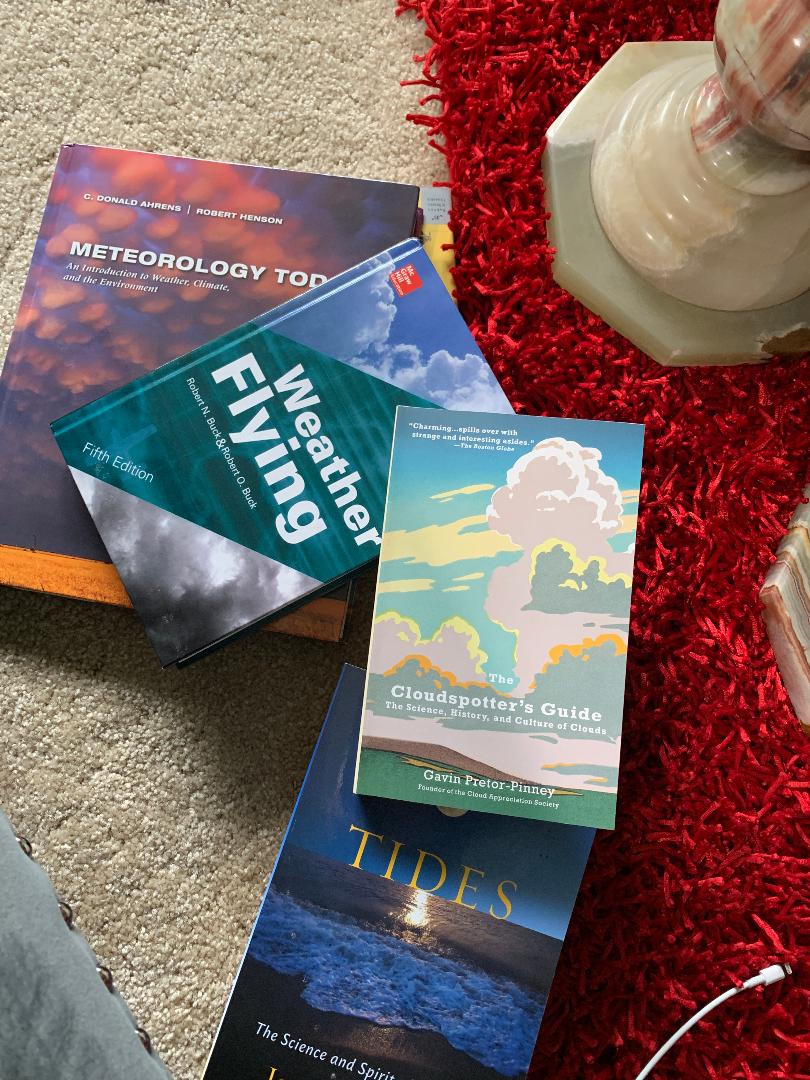
Convention has it that we call clouds by their Latin names. But, I wondered, why did the Latin-speakers use the words they used? What do these Latin names mean?
It turns out that they mean what we mean if we were to just describe the cloud. Without any meteorological training we might see a big puffy cloud and say, “There’s a big puffy cloud.” Well, that’s just what our many cloud-spotting ancestors did in their language. If that big puffy cloud is making rain, then a prefix or suffix meaning “rain” is appended. In other words, “cumulo-nimbus” are just big puffy clouds which are producing rain, whereas “cumulus” are merely big puffy clouds.
Put another way: there is no magic.
Trackin’? First question for you: What is the difference between showers and thundershowers? Ding, ding, ding! You got it! The sound of “thunder” which accompanies the shower.
Next question, new angle: What is the difference between snow-showers and rain-showers? Ding, ding, ding! That’s two in a row! Nice work. The difference is in the type of “precipitation” falling. (BTW, quick note, “meteorology” is so-named because Aristotle and friends called anything falling from the sky “meteors”. Rain. Snow. Rocks from space. You know, all things similar.)
One more softball: What is the difference between an isolated thunderstorm and a super-cell of thunderstorms? Good job. The size and probably the longevity of the storm.
Harder question: What is the difference between the high winds of a thunderstorm, the high winds of a tornado, and the high winds of a hurricane? It’s no trick question. I’m looking for “scale”. These three types of high winds are different in scale. The wind is strong in all three, but the amount of wind and the duration of the wind are the distinguishing characteristics–no different than the falling rain being both the actual and linguistic factor which distinguishes cumulus clouds from cumulonimbus clouds. But this time, it’s a total name change, not just a prefix or suffix.
Current Event question: How long were the Bahamas hit by Hurricane Dorian? Couple of days, right? How long was Hurricane Dorian called Hurricane Dorian? Maybe a couple of weeks?
What’s bigger than a hurricane? That’s a tough question, no? I’m thinking “droughts.” In the past there were “famines” that lasted years. Surely we all know and hear–a totally disproportionate amount of talk–about past “ice ages.” Is that it? Is there anything else that’s bigger than a hurricane in size and duration? Well, there is now. There is something of which I’m aware. It’s called Climate Change.
And I say we call this first one, “Climate Change Greta”, in honor of–well, you know. Climate Change Greta will be a larger scale than Hurricane Dorian, than hurricanes as a category of weather, in fact. (This, just as hurricanes are a larger scale than tornados and tornados are a larger scale than summer breezes).
While Climate Change Greta will affect the same area as an ice age (everywhere), Climate Change Greta’s duration and intensity won’t be scaled quite as grandly as the last ice age, the late Paleozoic.
Climate Change Greta will affect the planet as a whole. But it won’t end life, anymore than the late Paleozoic stopped me from typing this.
Here’s the thing: Anyone who’s stood under a tree, anyone who’s been in a cave, anyone who’s worn a hat, anyone who’s stood in a man-made shelter has had the experience of discovering that rain was falling all around them, after rain had started falling all around them. Every single one of us has said, “Huh. I didn’t know it was raining.”
Not everyone has worked outside, though. But some of us have worked outside. That is, some of us have labored under the sky, in the sky, on the earth, in the earth, on the seas, or in the seas. Often, that work doesn’t stop for rain. I once climbed to the top of our oil rig while it was raining and with lightning nearby–merely to get that stuff that makes your indoor job possible out of the ground. I once raced a thunderstorm–and won–to help just one of you get to a hospital. I once landed in a field which kicked up so much fine dust that after we landed it took minutes for the ground team to be able to see where their ride was so they could get on and we could go home.
And I’m arguing to you that my more adrenaline fueled experiences are no different than how you don’t stop your car and wait for the rain to end before you proceed on your merry way, no different than how you wear a raincoat, no different than how you don’t let your dog have free reign in the house after he’s been doing his business in the rain-soaked backyard until after you dry him off.
In short, then, for the same reason I didn’t care that it was raining, I don’t care about Climate Change Greta. And you shouldn’t either.
 Captain’s Log