Reading Log 6.9.2025



Heart of Darkness was a spur of the moment addition to what I had lined up. I stepped out of my car in my sister’s neighborhood and the neighbor whose yard I was parking in front of, and of whom I inquired if the parking spot was okay, became chatty and mentioned he’d read the book 10 times. He mentioned many other things about it too. I hadn’t read it in years (there’s a review on here from a decade or so ago). So I figured I’d give it a re-read. It is scary. Definitely not for kids. And yet it is a must read. Also, the film adaptation Apocalypse Now is probably the best adaptation of any book/story ever.
****
Freud is someone I kinda disdain with all my heart. What a waste.
So everyone is living on the planet, all hunky-dory, and then one man says, “You know that feeling in your belly, the one you get when you haven’t filled your belly in a while? Well, we get hungry and have needs in our minds too, don’t ya know? Oh, and this means we invented religion.”
I enjoy reading people who I disagree with—I like trying to imagine arguing with them. So there’s that. But Freud is someone whose influence I could live without. I will say this, though. Rather, I’ll let him say it.
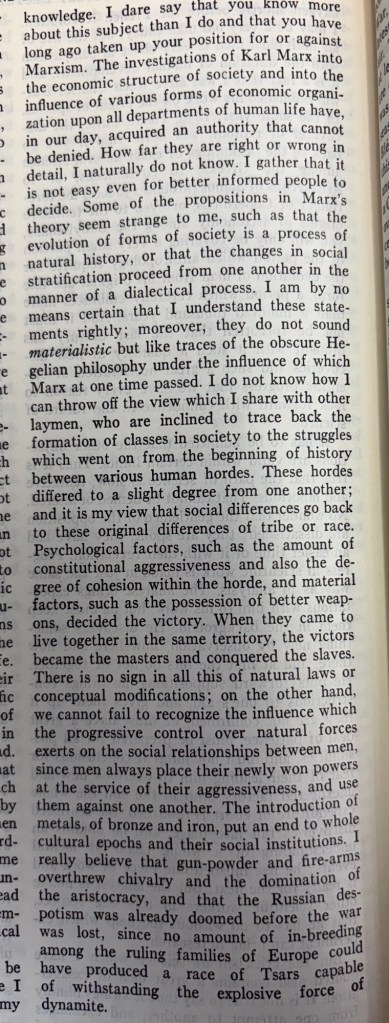
Freud went on to declare that Marxism and its “suffer now, be rewarded later” propaganda was, to him, no different than religion—and needs to go, too. So with that I say, Freud, ol’ buddy ol’ pal, pull up a chair. Let’s get you another round.
****
I had been reading that Eddington for far too long. I am happy to be finished with it. He is exactly my style and we see the same world. The main takeaway that an honest man like Sir Eddington gives is the truth about the speed of light. He very clearly explains that the speed of light is, in fact, not unsurpassable. Instead, what the physicists mean is the speed of light is universal. His analogy is that it is the “wood grain” of the (wood)universe. Even while he was alive they had experimentally collided electrons or whatever together and gone “faster” than the speed of light. But that doesn’t affect the fact that nothing is faster than the speed of light. This is because the speed of light is the separation of time from space. So if you were to go “faster”, you’d be combining time and space, which is clearly unimaginable.
****
I picked up this book on AI for obvious reasons. And guess what? My instincts were right again. There is nothing to fear. AI does not learn. It does not read. It does not understand.
In short, the computer nerds learned from the brain nerds that between 1. a conscious decision to move the body, and 3. the brain-activity that moves the body are 2. many other brain-activities whose purpose is unknown. So the computer nerds built (2.-like) delays between “do this” commands and “do this NOW” action. And then, the computer nerds programmed the “do this NOW” action to respond to “you failed” responses with (actual jargon alert) back-propagation. It is this back-propagation that is “mysterious” and where the nerds say the AI is “learning”. But again, the AI is not learning, it is following commands and making exceedingly subtle adjustments. The trouble for the nerds is the time it would take to map out all the exceedingly subtle adjustments of back propagation is considerable—and even if they took the time, they’d simply have a ton of data points and not really any necessary reason to draw one conclusion from another as to why the program executed either 1. that many actions or 2. those actions in particular in order to not “fail” again.
Talk about navel-gazing.
Regarding handling and “seeing” images, the computer nerds, this time, learned from the eyeball-nerds. In short, the eyeball nerds have learned that there is a distinct method to how we see, which essentially goes from big to small. Like, outside, blue sky, green earth, forest, tree, tree branch, tree leaf, leaf veins etc.
So on an image, the computer nerds tell a program to find edges first, and then go from there. Again, AI does not see anything. It just is really good at the game of “memory” (unless humans screw with images in certain, invisible to naked eye, ways.)
One final comment of recommendation for this book. (You really should admit ignorance and read it.) The author describes the phrases “AI Spring” and “AI Winter”. And she proceeds to use them throughout her description of AI’s history. In short, AI “astounds” someone (Computer beats Chess Champion), and money shows up in large amounts. The computer nerds take the money and promise everlasting life. This is AI Spring. Then the computer nerds fail to deliver. The money dries up. This is AI Winter. The cycle repeats. ICYMI, we are currently in AI Spring, more like AI Monsoon. But winter is coming. It always does and always will. Withstand the hype! You can do it!
 Captain’s Log