Tagged: photography
Museum Quality TDS, South Park Quality Indoctrination, and Food—My Trip to Rushmore and Crazy Horse
Anyone who has ever visited a custom framing store knows that the easiest upsell in the universe is museum quality glass. For the uninitiated, the glass companies, or whoever, provide this shadow box which holds an item—usually a yellow tassel—behind what appears to be one half of a pane of glass. That’s the gimmick. It appears like there is no glass on one half. But there is. And now you’re hooked. How could you ever cover any framed object with a dirty window?
Naturally, this museum quality glass gets its name from its use in museums—these carefully curated places of unfiltered history. Or at least that’s how I think of museums. Sure, there are going to be words of explanation besides the clear-glass-encased pieces and sure these words will naturally be written with an agenda of some sort. But the objects behind the unseen glass are the real communicators.
Luckily for us, this is still the case with Mt Rushmore. You see, I just took the kids to visit it—A- had learned about it in kindergarten. And all I can say is I am happy to report the museum piece was worth it. Because the description was sorely lacking.
The video presentation, which spent a lot of time on the importance of the right type of rock for such a project, had a line, “Years later, the artist (I can’t recall his name) was asked if there was enough room for another face and he said, ‘No’.”
TDS has infected a national memorial. Firstly, if Trump wants his face on it, he will get it done—and in gold. Secondly, the Left is somehow afraid of this man. What has he done to them besides disagree and name call? It’s incredible to witness their fear.
Oh, and did you know women and minorities helped create Mt Rushmore?
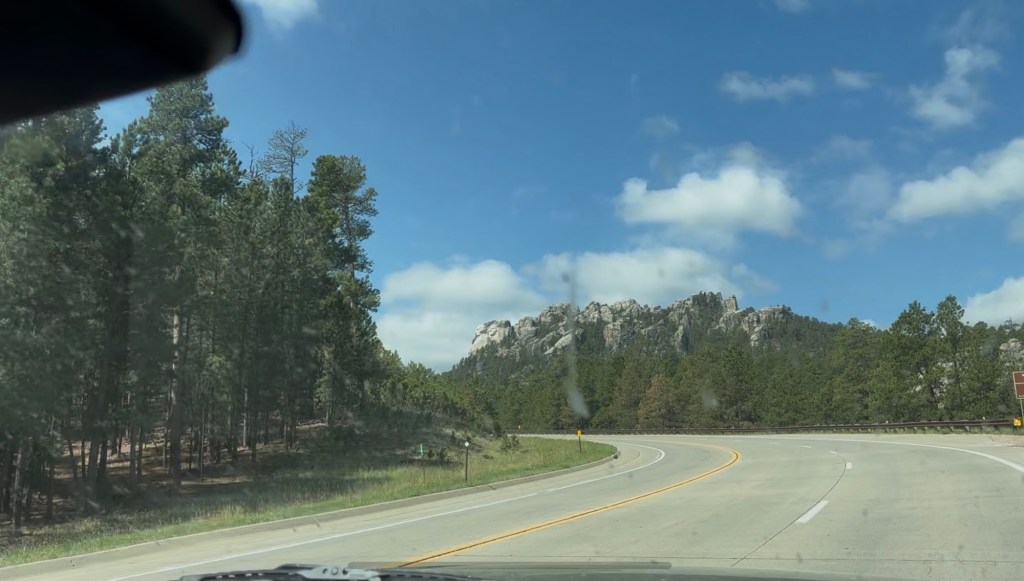
It is impossible—literally you can see both from the road—to not want to go to check out the Johnny-come-lately Indians’ effort while in the Rushmore area. Of course, I mean Crazy Horse.
Unfortunately, for anyone who has ever seen South Park, the experience is uneasy. Rushmore charges $10 to park. And the entire site is built to last—lots of stone and whatever that fake but permanent wood is called that decks can be built out of. Bathrooms are great. Viewing area is great. The whole experience is great.
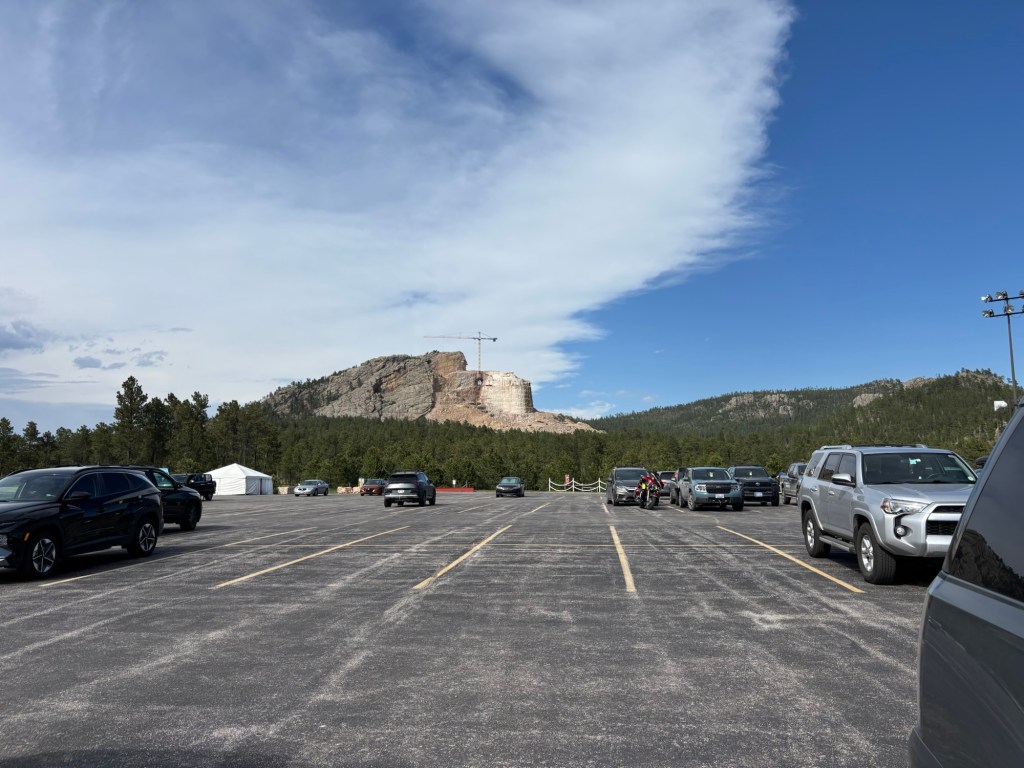
But the Crazy Horse experience is embarrassing. They have a fee schedule—to include $10(!) to walk up. And a car load is $35. The entire monument (which will be epic at a LOTR level if they ever get smart and finish it) is very far away. Everything about the place is VHS in a world of 4K streaming—and I mean the kind of chasm involved in visiting your distant relatives whose TV/VCR combo unit isn’t flat, let alone do they have two bathrooms.
We watched a video (as recommended) to continue the post-parking lot experience which began with actually handing a just-received physical ticket to a gatekeeper. The movie was informative, and it contained the key flaw to the concept: the belief in adherence to unduly stubborn principles.
Again, back at Rushmore we were informed us that the artist and his son barely touched the mountain—instead they directed the many workers.
Crazy Horse’s artist was the sole worker, at least to start. And from Rushmore’s crew.
Rushmore took 14 years.
Crazy horse is 78 and no horse in sight.
I understand TTP (Trust the Process) and am living proof that it is true. Also, I cannot stress enough how cool the final monument will be. I am also totally fine with the tragic concept behind the project, that of an Indian pointing to where his home was—even though it necessarily carries the false idea that losers were participants in an unfair fight.
Back to the visit, we next perused what there was to peruse and noticed that in only 8 minutes there would be a proper drum and dance performance.
We took our seats and proceeded to listen to a real (looking) lady Indian dressed in real (looking) Indian gear lecture us for 50 minutes of an hour, on how the 600 tribes of Indians were living in perfect harmony, how they forecast Einstein’s E=mc2, and how the word “Sioux” means “snake”.
It was a family affair, we learned. So her 10 year old daughter came out and sang a short Indian song. And then her 19 year old daughter came out and danced two dances, accompanied by iPhone drums (probably not AI song) over loudspeakers, in a dress strung with hundreds of bell-looking things that sounded like kazoos jingling.
I need to emphasize here: I understand totally the concept of “talk before eat”. It is impossible to serve free food and then ask people to stay for a free lecture. Main attractions have to come last, I get it. But the lecture was 5/6ths of the allocated time and rife with inaccuracies—she even pointed out the brains of buffaloes were used to oil the hides.
(See Wilder’s settler’s written description of “butchering day” for context.)
Anyhow, after driving away, and while tearing down our campsite the next morning (have I mentioned I am an Eagle Scout and quite literally one of the Last Boy Scouts?), it hit me. These people need to, firstly, tell the truth about how tragic and brutal life was before civilization approached and conquered. Secondly, after starting with the depressing, they need to regain some face and their only way to do that is to highlight proudly (and most welcomed-ly) all the ways the Indian ways influenced and sustains the dominant civilization—like, say, Indian Guides, Boy Scouts, chief, army helicopter titles (blackhawk, kiowa etc).
Lastly, the food at Rushmore is exactly what I imagined food in communist countries is like—terrible. But guess what?! The entire restaurant facility is award winning in its “green”-ness. I mean, consider this. The restaurant which serves terrible food (except the ice cream of course) is award winning: “Feel good about how the preparation and housing of the terrible, and overpriced, food adheres to irrelevant, purpose-less government guidelines.”
This brings me to my concluding advice: the food at Crazy Horse smelled really good—even to a full stomach. So don’t let any of my criticism deter you from seeing both monuments. But skip Rushmore’s restaurant and donate your money to the Crazy Horse food crowd instead of the commies.
Finally, two illustrative pics.
The Easiest Call To Answer
Breakfast at 7:00 am with his woman, a quick shower at 7:45, and they’d be out the door by 8:30 on their way to the home store. After picking up a few essentials it would be time to head to the hardware store. He desperately needed a new tool for weeding, and also a bit of potting soil. Oh, and winter fertilizer. If things went perfect, they’d be driving away from the hardware store at 11:00 on their way to meet friends for lunch at 11:30.
It wasn’t quite a sit-down restaurant, but the couples hadn’t seen each other in what seemed like forever, so he budgeted an hour and a half for the lunch. Farewell handshakes and hugs would conclude at 1:00 pm, so he figured they could be pulling out of the parking lot at 1:05, which would leave plenty of time to drive to the ‘burbs for their nephews game. The kid was only 6, so it wasn’t exactly organized. From his perspective it was more like a bunch of adults forming a fleshy boundary which attempted to keep sacred childhood. Either way, he was excited to see his sister and brother-in-law.
From there, the plan was to split-up for an hour or so to clean up. Then everyone would meet back up at 6:00 for some Colorado-style pizza. He figured they’d be out of the restaurant by 8:00–8:30 at the latest. Afterwards everyone would return to their respective homes, and have a nice quiet night on couches.
Yep, he was pretty proud of himself for having such a thought out plan, but now it was time for bed.
Pulling the covers up–awkwardly as usual–to warm the back of his neck, he shut his eyes, smiling.
He awoke. Widening his eyes as if that helped him regain consciousness faster, he reached for his phone. Seeing the time before noting who was calling, he read “5:30” with some confusion. “Who would be calling so early on a Saturday?” he wondered to himself. The screen informed him who it was, and he couldn’t help but smile.
“Honey,” he said. “Honey, wake up, wake up,” he said shaking her.
“What time is it?” she mumbled.
“Huh? Why? That doesn’t matter. We’ve got to cancel our plans for the day. The mountains called. They’re open!”
Origins of the Unfamiliar Camera Shudder
The truth? Well, no one ever seemed to want to know the truth. Just the same, the truth was his great-great grandpa was the culprit. Having never met him, of course, he only had heard stories. The man’s name was Pete. In fact, he was named after his great-great grandpa. Apparently this Pete was quite the guy. Loved by everyone; despised by no one.
Herein begins the tale.
Thinning, fine white hair revealed Pete’s old age. A welcoming smile betrayed his young heart. And a never satisfied quest for practical jokes kept him busy even after he was too brittle to work on the family farm.
They say great-great grandpa Pete really was a jokester. He was always catching everyone off-guard, and even though his victims always eventually got over it, his pranks were usually very inappropriate. The legends account for this by telling of his ridiculously strong character. While inappropriate, his making-fun was meticulously timed and delivered. One could only imagine, then, how well-planned Pete’s crowning gag must have been.
It was a large family reunion. Not just cousins, but second cousins, third cousins, and fourth cousins thrice removed were invited and made their appearance. With a guest list that large, quite a few dignitaries and very wealthy people were in attendance. Great-great grandpa Pete would have been banking on this.
On the guest list, a fairly distant relation was former president Rutherford B. Hayes and his wife “lemonade” Lucy, known (without justification) for her role in the temperance movement. To Pete, they were Uncle Rutherford and Aunt Lucy.
It was a warm sunny day in June. June 25, 1889, to be exact. Pete had known the president and his wife for some time. Rutherford and Lucy were just a bit too–let’s say proper–for practical jokes. Just the same, Pete had seen in Rutherford’s eyes something of a sparkle each time he witnessed one of Pete’s masterpieces.
Now, as everyone knows, former Presidents are not to be trifled with. Despite not occupying the position anymore, they are still well-connected to all the right people. Pete would have known this too. Apparently he didn’t care. He had chosen his course, and on that fateful day nothing was going to stop him.
As the first of Pete’s family trickled in, he encouraged the required small talk by talking about his new camera. This camera, he said, was not unlike other cameras of the day, except in one feature. His camera had a timed shutter. He really wanted this affair to be a family only event, and so he didn’t want to hire a professional photographer. He also began spreading that he wanted the first picture taken that day to be a photograph of everyone there.
As the trickle of guests became a raging rapid, so did the story of Pete’s camera. Soon everyone was anxiously awaiting picture time. All in attendance naturally assumed Pete would be the one to press the button then run to his spot in the 4.75 seconds before the shutter opened.
One can only imagine the surprise, then, when ol’ Pete announced to a gathering of 250 of his family members that he was going to give the honor to his “favorite Aunt-who-was-also-a-first-lady” Lucy Hayes. Not being one to regularly indulge in the frivolities and vices of life, the story has it that Lucy succumbed just this once and accepted. They say Pete had a curious twinkle in his eye as he was explaining the task to her.
Straightening up as he finished, he calmly took his place among those about to be photographed.
Trembling with nervous excitement Lucy began to sense the crowd’s growing impatience. She knew she must get it right the first time. She knew that if Pete had to come back and help her one more time, the most distant relatives–already drunk she noticed–would just leave the formation.
The pressure became unbearable and as she pressed the button and began to walk briskly back to her spot, a loud report was heard and as she shuddered in fright, she looked to Pete for reassurance that she didn’t make a mistake. In an instant, Pete tossed her a bottle of whiskey which she caught out of instinct. Turning, she realized she was front and center, looking guilty and holding the substance that she had fought her entire adult life to ban as the shutter opened. A moment later, we’re told that everyone else fell over laughing as they realized Pete had struck again. Everyone but Uncle Rutherford. He was holding his dear beloved who appeared to have fainted. Within the hour she was pronounced dead.
Pete had finally done it. He had finally picked on the wrong person, at the wrong time. By the end of the day, despite former-President Hayes’ insistence that the incident be kept a family matter, word had spread. Naturally, like all stories, the listener heard what they wanted to hear. Couple this with Rutherford demanding Pete hand over the single piece of evidence that proved it was all about Lucy’s obnoxious stance on liquor, and the story really scrambled to build a foundation. In the end, the story that spread throughout the country was that Lucy died because she used an unfamiliar camera to take the picture at the family reunion.
While you may never have heard of great-great grandpa Pete, or Lucy Hayes, you surely have experienced the result of this rumor. Even to this day, when relatives handle camera’s unfamiliar to them, they do so with great trepidation. They cannot shake the fear that something terrible may happen as they take the picture. Little do they know that it wasn’t the use of an unfamiliar camera that killed Lucy, but irrational shame.
At least that’s what I tell myself to explain why we’re so afraid of other people’s cameras at family functions. Can you explain it?
 Captain’s Log